


The world begins at a kitchen table. No matter what, we must eat to live.
The gifts of earth are brought and prepared, set on the table. So it has been since creation, and it will go on.
We chase chickens or dogs away from it. Babies teethe at the corners. They scrape their knees under it.
It is here that children are given instructions on what it means to be human. We make men at it, we make women.
At this table we gossip, recall enemies and the ghosts of lovers.
Our dreams drink coffee with us as they put their arms around our children. They laugh with us at our poor falling-down selves and as we put ourselves back together once again at the table.
This table has been a house in the rain, an umbrella in the sun.
Wars have begun and ended at this table. It is a place to hide in the shadow of terror. A place to celebrate the terrible victory.
We have given birth on this table, and have prepared our parents for burial here.
At this table we sing with joy, with sorrow. We pray of suffering and remorse. We give thanks.
Perhaps the world will end at the kitchen table, while we are laughing and crying, eating of the last sweet bite.
From The Woman Who Fell From the Sky (W. W. Norton, 1994) by Joy Harjo. Copyright © 1994 by Joy Harjo. Used with permission of the author.
The moon will shine for God
knows how long.
As if it still matters. As if someone
is trying to recall a dream.
Believe the brain is a cage of light
& rage. When it shuts off,
something else switches on.
There’s no better reason than now
to lock the doors, the windows.
Turn off the sprinklers
& porch light. Save the books
for fire. In darkness,
we learn to read
what moves along the horizon,
across the periphery of a gun scope—
the flicker of shadows,
the rustling of trash in the body
of cities long emptied.
Not a soul lives
in this house &
this house & this
house. Go on, stiffen
the heart, quicken
the blood. To live
in a world of flesh
& teeth, you must
learn to kill
what you love,
& love what can die.
Copyright © 2016 by Burlee Vang. Originally published in Poem-a-Day on December 20, 2016, by the Academy of American Poets.
with design by Anthony Cody
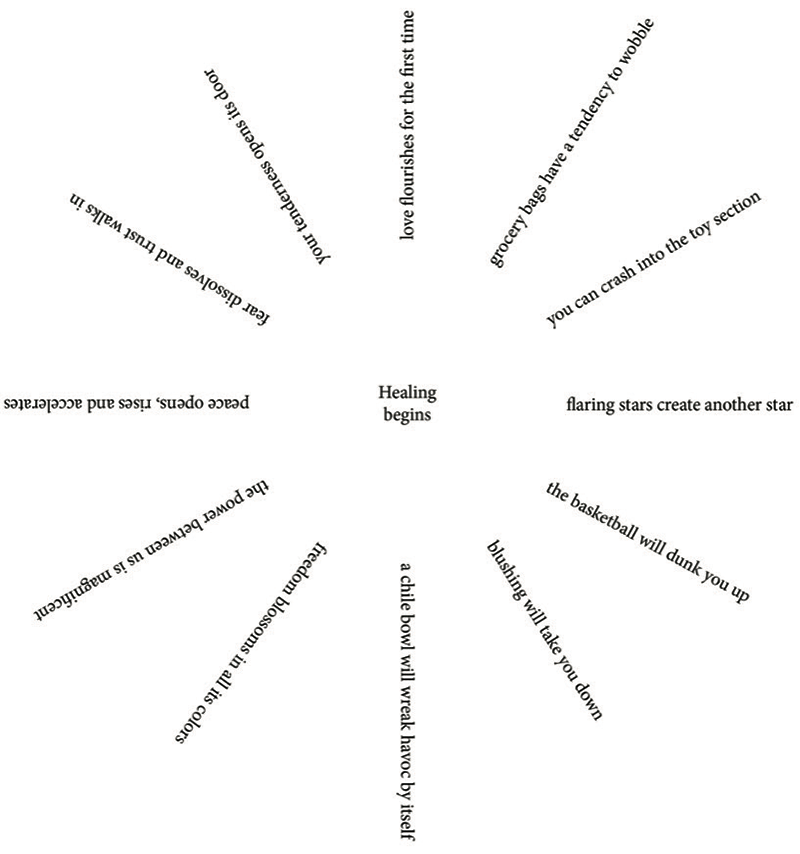
Copyright © 2020 by Juan Felipe Herrera. Design by Anthony Cody. Originally published with the Shelter in Poems initiative on poets.org.
So the world turned
its one good eye
to watch the bees
take most of metaphor
with them.
Swarms—
in all their airborne
pointillism—
shifted on the breeze
for the last time. Of course,
the absence of bees
left behind significant holes
in ecology. Less
obvious
were the indelible holes
in poems, which would come
later:
Our vast psychic habitat
shrunk. Nothing was
like nectar
for the gods
Nobody was warned by
a deep black dahlia, and nobody
grew like a weed.
Nobody felt spry as
a daisy, or blue
and princely
as a hyacinth; was lucid as
a moon flower. Nobody came home
and yelled honey! up the stairs,
And nothing in particular
by any other name would smell as sweet as—
Consider:
the verbal dearth
that is always a main ripple of extinction.
The lexicon of wilds goes on nixing its descriptions.
Slimming its index of references
for what is
super as a rhubarb, and juicy
as a peach,
or sunken as a
comb and ancient as an alder tree, or
conifer, or beech, what is royal
as jelly, dark as a wintering
hive, toxic as the jessamine vine
who weeps the way a willow does,
silently as wax
burned in the land of milk and
all the strong words in poems,
they were once
smeared on the mandible of a bee.
Copyright © 2023 by RK Fauth. Originally published in Poem-a-Day on April 29, 2023, by the Academy of American Poets.
translated from the Macedonian by the author
When at evening I hear the voice of my dead mother,
I summon deer to my side—
they who understand all the languages of fear
without saying a word.
I would invite them into the courtyard of quiet changes
and ask them about the sins of the unborn,
about the distance between the blood
of two enemies after the war.
I would ask them to lock the silence—
secret of the open eyes.
ТИШИНАТА ОД ДРУГИ МЕСТА ДОАЃА
Кога навечер ќе го чујам гласот на мојата мртва мајка,
повикувам елени во својата соба —
оние кои никогаш не прозбориле,
а ги разбираат сите јазици на стравот.
Ќе ги поканам во дворот на тивките промени
и ќе ги прашам за гревовите на неродените,
за далечината помеѓу крвта
на двајца непријатели по војната.
Ќе ги замолам да ја закатанчат тишината —
тајната на отворените очи.
Copyright © 2026 by Nikola Madzirov. Originally published in Poem-a-Day on September 10, 2026, by the Academy of American Poets.
We’ve turned our walks into finding things
that catch fire easily, like us
our fascination with bush craft—
how to survive in a forest
without the conveniences
we have at home
the first human to discover fire
rubbed two stones together
friction is a good thing.
we have fun starting fires
scratching the Mora knife against the small iron rod
sending sparks into a nest of dried grass and fibrous barks
you put out the flame with the sole of your hiking boot
so we can begin, again
by the time we leave the forest,
we’ve discovered deer poo combusts easily
human hair doesn’t
I’ve given a lock and you’ve won the bet
By the time we leave
we’ve lost count of the fires we’ve started.
Copyright © 2015 Mildred Barya. This poem originally appeared in Poetry Quarterly. Reprinted with permission of the author.
You are never mentioned on Ararat
or elsewhere, but I know a woman’s hand
in salvation when I see it. Lately,
I’m torn between despair and ignorance.
I’m not a vegetarian, shop plastic,
use an air conditioner. Is this what happens
before it all goes fluvial? Do the selfish
grow self-conscious by the withering
begonias? Lately, I worry every black dress
will have to be worn to a funeral.
New York a bouillon, eroded filigree.
Anything but illness, I beg the plagues,
but shiny crows or nuclear rain.
Not a drop in London May through June.
I bask in the wilt by golden hour light.
Lately, only lately, it is late. Tucking
our families into the safeties of the past.
My children, will they exist by the time
it’s irreversible? Will they live
astonished at the thought of ice
not pulled from the mouth of a machine?
Which parent will be the one to break
the myth; the Arctic wasn’t Sisyphus’s
snowy hill. Noah’s wife, I am wringing
my hands not knowing how to know
and move forward. Was it you
who gathered flowers once the earth
had dried? How did you explain the light
to all the animals?
Copyright © 2019 by Maya C. Popa. Originally published in Poem-a-Day on September 30, 2019, by the Academy of American Poets.
Everything is fine: a means to endure
news cycles, historic cycles, menstrual
cycles. This is walking home after work,
crawling into bed naked. Night, quiet with
snow. I am an empty bank account.
I am a pylon glowing in the dark. I am
a primal scream. I am not here.
The body speaks first. If that doesn’t work,
the mind empties: a crate of crabs scuttling
toward nothingness. Authoritarianism
blossoms like a corpse flower: foul men
spread their stench across the globe.
I remember these songs. It’s all on fire.
A meteor // a virus // a bomb
like a dark-eyed angel hurtles toward us.
I’d like to see the ocean lap against a glacier
before the end. I’d like to see the northern
lights. I’d like to watch effigies of foul men
burn in the desert. I’d like to be there, reel there,
at the end.
Copyright © 2026 by Amy M. Alvarez. Originally published in Poem-a-Day on January 23, 2026, by the Academy of American Poets.
In the beginning there was darkness,
then a bunch of other stuff—and lots of people.
Some things were said and loosely interpreted,
or maybe things were not communicated clearly.
Regardless—there has always been an index.
That thing about the meek—how we
shall inherit the earth; that was a promise
made in a treaty at the dawn of time
agreed upon in primordial darkness
and documented in the spiritual record.
The nature of the agreement was thus:
The world will seemingly be pushed past capacity.
A new planet will be “discovered” 31 light-years away.
Space travel will advance rapidly,
making the journey feasible. The ice sheets will melt.
Things will get ugly. The only way to leave
will be to buy a ticket. Tickets will be priced at exactly
the amount that can be accrued
by abandoning basic humanity.
The index will show how you came by your fortune:
If you murdered, trafficked or exploited the vulnerable,
stole, embezzled, poisoned, cheated, swindled,
or otherwise subdued nature to come by wealth
great enough to afford passage to the new earth;
if your ancestors did these things and you’ve done nothing
to benefit from their crimes yet do nothing to atone
through returning inherited wealth to the greater good
you shall be granted passage. It was agreed.
The meek shall stay, the powerful shall leave.
And it all shall start again.
The meek shall inherit the earth,
and what shall we do with it,
but set about putting aside our meekness?
Copyright © 2020 by Rena Priest. Originally published in Poem-a-Day on November 4, 2020, by the Academy of American Poets.
In the beginning, the ending was beautiful.
Early spring everywhere, the trees furred
pink and white, lawns the sharp green
that meant new. The sky so blue it looked
manufactured. Robins. We’d heard
the cherry blossoms wouldn't blossom
this year, but what was one epic blooming
when even the desert was an explosion
of verbena? When bobcats slinked through
primroses. When coyotes slept deep in orange
poppies. One New Year’s Day we woke
to daffodils, wisteria, onion grass wafting
through the open windows. Near the end,
we were eyeletted. We were cottoned.
We were sundressed and barefoot. At least
it’s starting gentle, we said. An absurd comfort,
we knew, a placebo. But we were built like that.
Built to say at least. Built to reach for the heat
of skin on skin even when we were already hot,
built to love the purpling desert in the twilight,
built to marvel over the pink bursting dogwoods,
to hold tight to every pleasure even as we
rocked together toward the graying, even as
we held each other, warmth to warmth,
and said sorry, I'm sorry, I'm so sorry while petals
sifted softly to the ground all around us.
Copyright © 2020 by Catherine Pierce. From Danger Days (Saturnalia, 2020). Used with the permission of the poet.
i come from the fire city / fire came and licked up our houses, lapped them up like they were nothing / drank them like the last dribbling water from a concrete fountain / the spigot is too hot to touch with your lips be careful / fire kissed us and laughed / and even now the rust climbs the walls, red ivy / iron fire and the brick blossoms florid / red like stolen lipstick ground down to a small flat earth / stand on any corner of the fire city, look west to death / the red sun eats the bungalows / the fire city children watch with their fingers in their mouths / to savor the flaming hots or hot flamins or hot crunchy curls or hot chips / they open the fire hydrants in the fire city and lay dollar store boats in the gutters / warrior funeral pyres unlit
Copyright © 2017 Eve L. Ewing. “I come from the fire city.” originally appeared in Electric Arches (Haymarket Books, 2017). Used with permission of the author.
so I count my hopes: the bumblebees
are making a comeback, one snug tight
in a purple flower I passed to get to you;
your favorite color is purple but Prince’s
was orange & we both find this hard to believe;
today the park is green, we take grass for granted
the leaves chuckle around us; behind
your head a butterfly rests on a tree; it’s been
there our whole conversation; by my old apartment
was a butterfly sanctuary where I would read
& two little girls would sit next to me; you caught
a butterfly once but didn’t know what to feed it
so you trapped it in a jar & gave it to a girl
you liked. I asked if it died. you say you like
to think it lived a long life. yes, it lived a long life.
Copyright © 2019 by Fatimah Asghar. Originally published in Poem-a-Day on May 8, 2019, by the Academy of American Poets.
is a black shambling bear
ruffling its wild back and tossing
mountains into the sea

is a black hawk circling
the burying ground circling the bones
picked clean and discarded

is a fish black blind in the belly of water
is a diamond blind in the black belly of coal

is a black and living thing
is a favorite child
of the universe
feel her rolling her hand
in its kinky hair
feel her brushing it clean
Lucille Clifton, “the earth is a living thing” from The Book of Light. Copyright © 1993 by Lucille Clifton. Reprinted with the permission of The Permissions Company, LLC on behalf of Copper Canyon Press, coppercanyonpress.org.
I was meant for all things to meet:
to make the clouds pause in the mirror
of my waters, to be home to fallen rain
that finds its way to me, to turn eons
of loveless rock into lovesick pebbles
and carry them as humble gifts back
to the sea which brings life back to me.
I felt the sun flare, praised each star
flocked about the moon long before
you did. I’ve breathed air you’ll never
breathe, listened to songbirds before
you could speak their names, before
you dug your oars in me, before you
created the gods that created you.
Then countries—your invention—maps
jigsawing the world into colored shapes
caged in bold lines to say: you’re here,
not there, you’re this, not that, to say:
yellow isn’t red, red isn’t black, black is
not white, to say: mine, not ours, to say
war, and believe life’s worth is relative.
You named me big river, drew me—blue,
thick to divide, to say: spic and Yankee,
to say: wetback and gringo. You split me
in two—half of me us, the rest them. But
I wasn’t meant to drown children, hear
mothers’ cries, never meant to be your
geography: a line, a border, a murderer.
I was meant for all things to meet:
the mirrored clouds and sun’s tingle,
birdsongs and the quiet moon, the wind
and its dust, the rush of mountain rain—
and us. Blood that runs in you is water
flowing in me, both life, the truth we
know we know: be one in one another.
Copyright © 2019 Richard Blanco. This poem originally appeared in in How to Love a Country, 2019. Reprinted with permission of the author.
My river was once unseparated. Was Colorado. Red-
fast flood. Able to take
anything it could wet—in a wild rush—
all the way to Mexico.
Now it is shattered by fifteen dams
over one-thousand four-hundred and fifty miles,
pipes and pumps filling
swimming pools and sprinklers
in Los Angeles and Las Vegas.
To save our fish, we lifted them from our skeletoned river beds,
loosed them in our heavens, set them aster —
‘Achii ‘ahan, Mojave salmon,
Colorado pikeminnow—
Up there they glide, gilled with stars.
You see them now—
god-large, gold-green sides,
moon-white belly and breast—
making their great speeded way across the darkest hours,
rippling the sapphired sky-water into a galaxy road.
The blurred wake they drag as they make their path
through the night sky is called
‘Achii ‘ahan nyuunye—
our words for Milky Way.
Coyote too is up there, crouched in the moon,
after his failed attempt to leap it, fishing net wet
and empty, slung over his back—
a prisoner blue and dreaming
of unzipping the salmon’s silked skins with his teeth.
O, the weakness of any mouth
as it gives itself away to the universe
of a sweet-milk body.
Just as my own mouth is dreamed to thirst
the long desire-ways, the hundred-thousand light year roads
of your throat and thighs.
Copyright © 2015 by Natalie Diaz. Used with permission of the author.
—after Marie Howe
in the wordless beginning
iguana & myrrh
magma & reef ghost moth
& the cordyceps tickling its nerves
& cedar & archipelago & anemone
dodo bird & cardinal waiting for its red
ocean salt & crude oil now black
muck now most naïve fumbling plankton
every egg clutched in the copycat soft
of me unwomaned unraced
unsexed as the ecstatic prokaryote
that would rage my uncle’s blood
or the bacterium that will widow
your eldest daughter’s eldest son
my uncle, her son our mammoth sun
& her uncountable siblings & dust mite & peat
apatosaurus & nile river
& maple green & nude & chill-blushed &
yeasty keratined bug-gutted i & you
spleen & femur seven-year refreshed
seven-year shedding & taking & being this dust
& my children & your children
& their children & the children
of the black bears & gladiolus & pink florida grapefruit
here not allied but the same perpetual breath
held fast to each other as each other’s own skin
cold-dormant & rotting & birthing & being born
in the olympus of the smallest
possible once before once
Copyright © 2020 by Marissa Davis. Originally published in Poem-a-Day on July 1, 2020, by the Academy of American Poets.
(Inventory, 1950–present)
We were the dream of convenience, the permanent press.
We were the yogurt cup you spooned empty at dawn,
the blister-pack popped for a single white pill,
the slick, sterile innards of the IV that saved you.
We were the unbreakable toy in the 1962 sandbox,
the fleece that wicked your first marathon sweat,
the photo-bright banner that welcomed you home from a war
you only understood through our lens.
We are the hangover of that dream.
We are the lint in your deepest lung pocket,
the bright shard in the albatross’s gullet,
the glint in your daughter’s first meconium.
We are the polymer of your placenta’s print,
the slow, milky bead in your grandfather’s cataract lens
through which he sees a world softening at the edges.
We do not arrive as invasion.
We are issued at conception,
like a social-security number,
like a name you cannot change.
We perform the trophic math:
krill eats colorful flake,
salmon eats krill,
you eat salmon,
we pay compound dividends in your marrow fat.
Our half-life is a new form of forever.
Every birthday candle is a small, bright flare
against the petrochemical balance sheet
you carry inside your own body.
We are the derivative that never degrades,
the toxic asset sliced thinner than sunlight,
securitized and repackaged
until the valuation is your own vasculature.
Your 1950-cutoff is a fairy tale.
We were waiting in the womb’s warm lobby to disprove.
We are the call coming from inside the house.
We are the house.
We are the mortar in its very cells,
the silent, synthetic hinge
on which your own heart swings.
We are the heirloom you did not ask for,
the inheritance that cannot be refused,
the future fossil of your present,
already here.
Copyright © 2026 by Ronald Carson. Originally published in Poem-a-Day on May 10, 2026, by the Academy of American Poets.
Most likely, you think we hated the elephant,
the golden toad, the thylacine and all variations
of whale harpooned or hacked into extinction.
It must seem like we sought to leave you nothing
but benzene, mercury, the stomachs
of seagulls rippled with jet fuel and plastic.
You probably doubt that we were capable of joy,
but I assure you we were.
We still had the night sky back then,
and like our ancestors, we admired
its illuminated doodles
of scorpion outlines and upside-down ladles.
Absolutely, there were some forests left!
Absolutely, we still had some lakes!
I’m saying, it wasn’t all lead paint and sulfur dioxide.
There were bees back then, and they pollinated
a euphoria of flowers so we might
contemplate the great mysteries and finally ask,
“Hey guys, what’s transcendence?”
And then all the bees were dead.
Copyright © 2017 by Matthew Olzmann. Originally published in Poem-a-Day on April 14, 2017, by the Academy of American Poets.
The Earthlings arrived unannounced, entered
without knocking, removed their shoes
and began clipping their toenails.
They let the clippings fall wherever.
They sighed loudly as if inconvenienced.
We were patient. We knew our guests
were in an unfamiliar environment; they needed
time to adjust. For dinner, we prepared
turkey meatloaf with a side of cauliflower.
This is too dry, they said.
This is not like what our mothers made.
We wanted to offer a tour of our world,
demonstrate how we freed ourselves
from the prisons of linear time.
But the Earthlings were already spelunking
our closets, prying tools
from their containers and holding them
to the light. What’s this? they demanded.
What’s this? What’s this? And what’s this?
That’s a Quantum Annihilator; put that down.
That’s a Particle Grinder; please put that down.
We could show you how to heal the sick, we said.
We could help you feed every nation, commune
with the all-seeing sentient energy that palpitates
through all known forms of matter.
Nah! they said. Teach us to vaporize a mountain!
Teach us to turn the moon into revenue!
Then the Earthlings
left a faucet running and flooded our basement.
Copyright © 2023 by Matthew Olzmann. Originally published in Poem-a-Day on November 17, 2023, by the Academy of American Poets.
The maples sweat now, out of season.
Buds pop eyes in wintry bushes
as the birds arrive, not having checked
the calendars or clocks. They scramble
in the frost for seeds, while underground
a sobbing starts in roots and tubers.
Ice cracks easily along the bank.
It slides in gullies where a bear, still groggy,
steps through coiled wire of the weeds.
Kids in T-shirts run to school, unaware
that summer is a long way off.
Their teachers flirt with off-the-wall assignments,
drum their fingers on the sweaty desktops.
As for me, my heart leaps high—
a deer escaping from the crosshairs,
skipping over barely frozen water
as the surface bends and splinters underfoot.
From New and Collected Poems: 1975-2015 by Jay Parini (Beacon Press, 2016). Reprinted with permission from Beacon Press.
I used to dream of living here. I hike
a trail I know that at the end opens
to glorious views of the city I did
live in once, when men my age kept dying
while I learned how to diagnose AIDS.
Some dreams don’t come true, and some dreams become
nightmares. Across a field that smells of sage,
a few horses loiter. I want to think
that they forgive me, since they’re noble creatures.
They stamp and snort, reminding me they know
nothing of forgiveness. I used to dream
that someday I’d escape to San Francisco,
when I was still in high school and I knew.
Tall and muscled, the horses are like the jocks
on the football team who beat me once, as if pain
teaches truth and they knew I had to learn.
I used to dream I was as white as them,
that I could slam my locker closed and not
think of jail. Some nightmares come true,
like when my uncle got arrested for
cocaine. My family never talked about it,
which made me realize they could also feel shame.
That’s when I started dreaming I could be
a doctor someday, that I could get away,
prescribe myself a new life. Right now, as
the city comes into view, I think of those
animals and hope they got what they deserved.
The city stretches out its arms, its two bridges
to Oakland, to Stockton, to San Rafael,
to Vallejo; places I could have been from
but wasn’t. It looks just as it did
all those years ago. Yet I know it’s changed
because so many of us died, like Rico,
who took me up here for the first time.
We kicked a soccer ball around and smoked
a joint. I think we talked about our dreams,
but who can remember dreams. I look out
and the sun like your hand on my face
is warm, and for a moment I think this is
glorious, this is what forgiveness feels like.
Copyright © 2020 by Rafael Campo. Originally published in Poem-a-Day on October 5, 2020, by the Academy of American Poets.
Here, an olive votive keeps the sunset lit,
the Korean twenty-somethings talk about hyphens,
graduate school and good pot. A group of four at a window
table in Carpinteria discuss the quality of wines in Napa Valley versus Lodi.
Here, in my California, the streets remember the Chicano
poet whose songs still bank off Fresno's beer-soaked gutters
and almond trees in partial blossom. Here, in my California
we fish out long noodles from the pho with such accuracy
you'd know we'd done this before. In Fresno, the bullets
tire of themselves and begin to pray five times a day.
In Fresno, we hope for less of the police state and more of a state of grace.
In my California, you can watch the sun go down
like in your California, on the ledge of the pregnant
twenty-second century, the one with a bounty of peaches and grapes,
red onions and the good salsa, wine and chapchae.
Here, in my California, paperbacks are free,
farmer's markets are twenty-four hours a day and
always packed, the trees and water have no nails in them,
the priests eat well, the homeless eat well.
Here, in my California, everywhere is Chinatown,
everywhere is K-Town, everywhere is Armeniatown,
everywhere a Little Italy. Less confederacy.
No internment in the Valley.
Better history texts for the juniors.
In my California, free sounds and free touch.
Free questions, free answers.
Free songs from parents and poets,
those hopeful bodies of light.
Originally published in ZYZZYVA, Number 83, 2008. Used with permission by the author.
for Leia and Graham
Before he is sick, he surfs the Pacific.
After he is sick, his faint body is pulled
from the water just in time to know
something is expanding. Leia goes over.
Just as friends, she says.
She sleeps in his bed, makes coffee,
tackles the wild zinnias of the Santa Barbara
hills, bends the flora to her spells.
The brain controls everything
except his nearly lifeless foot
moving to a Steely Dan cover.
All his orchids are crooked in the greenhouse
and the cats are missing. Too many coyotes,
he once said. When he was well,
everything survived. The orchids grew
erect, the coyotes were spineless, and Leia
stitched things together on her porch
exactly half a mile from the ocean.
Does anyone ever die in California,
I wonder. Leia enshrines him with eucalyptus
and Neruda, calls us, sleeps fetal now in LA.
You want to hear a love story, someone says.
Meaning them. Meaning this thing,
not quite knowable to us, her hand
on his laughing foot, the only part still alive,
it seems, the contract of their intimacy
that is not quite love, not quite
anything we’ve seen or can name.
Copyright © 2017 Megan Fernandes. Used with permission of the author. This poem originally appeared in Tin House (Winter 2017).
Honolulu, Hawaii
Copyright © 2017 Craig Santos Perez. Used with permission of the author. This poem originally appeared in Tin House, Fall 2017.
I’m scared, so I’m writing this book of the dead,
a last testament, like James Kidd, Arizona prospector
mining the edge of Superstition Wilderness,
maybe murdered in Haunted Canyon for his gold,
whose will left his half million to research the spirit
because “I think in time we will photograph the soul
leaving the human at death.” Perhaps we will, or perhaps
there’s no will left when the body, sleeplike, settles
and the mind breaches, and the last neurons flaring in a final
visionary chain try to understand the storm wind ripping us
from our bodies, the million tiny Buddhas crawling down
the eyelids, white buddhas, red buddhas, blue and yellow.
The teenager daydreams super powers, walking invisible
into the girls’ locker room and bank vaults, a super punch
that sends the football jocks sprawling, but doesn’t dream
of the body’s simplest power—the power to stop.
The body has its own will, and so I leave this testament.
Crack wide the doors of the sky, let my spirit leap
into heaven like a grasshopper, let me float among the stars
and eat the gods, and when I stand before the lords of death
I’ll testify that I leapt from the pit of dreams each morning
and tried to live my life awake, that I gave twenty dollars
to the woman by the freeway entrance with the Homeless
and Humiliated sign while the red truck honked behind me,
that I bowed my head and dug with my tongue
between my lover’s legs, that I mined that cave
and the gold for me was the pleasure she felt, but I did not
sleep with that woman at the French bistro who was so bored
of her husband and her little girls. I lived the best I could.
And if the mind breaks down in death, and the last neuron
fires in darkness like a sun snuffed out in a dying galaxy,
and if I wander for a while alone and find no god,
no rat, no earthworm, no butterfly of the spirit realm,
then let this be my superpower, the ability to speak
without breath, to write without fingers, to streak like
a meteorite across a black screen, and to go on and on
without will or consciousness, just these dead words
dancing before your eyes, a toy skeleton on a string.
From Beast in the Apartment (Sheep Meadow Press, 2014) by Tony Barnstone. Copyright © 2014 by Tony Barnstone. Used with the permission of the author.
it
wasn't
san
andreas
fault
it
wasn't
mine
things
just
started
sliding.
Reprinted by permission of Daleth Foster. All rights reserved.
Tan skin, tan voice,
square jaw and white shirt
pulled taut, a posture
of abstinence. Knots
of muscle, broad shoulders,
tight hips, slender legs—
in high school they called him
Coyote because he was so
skinny. Now my father calls
himself a gym rat, fighting
to get back that slimness,
fighting to fill the quiet
where the gnawing
enters with the wish
of weights sliding
onto the barbell, fighting
age with diet and exercise
and secrets. Coyote
is a trickster who fools
the eye, who makes you
believe he could never die.
Coyote told the first lie.
But his slippery tongue
ran off, let loose, and knotted
itself a noose no language
could untangle, because a coyote
is a coyote is a coyote,
the same in English and Spanish,
a perfect cognate. But understand this:
there could be no heroes
nor villains, no beginnings nor
endings, no happiness nor sorrows,
without a Coyote.
My father and I break bread
over this word because it cannot
become lost in translation
like so many others. We eat guiso
de papa, sudado pescado, and
tallarines rojos over this word.
We toast with chicha morada,
maracuyá, and Inca Kola over
this word. For twenty years
we have sliced panettone on
New Year’s with this word,
our bridge from Trujillo, Peru
to Auburn, Washington, from
booming waves of terracotta
roofs and tangled telephone
wires to dark forests and angled
houses huddled close around the heat
of the railroad. Here, electricity
travels underground, buzzes
beneath the concrete, the little
shake in our tires, the pep in our
step, the caffeine in our veins. Here,
coyotes howl at the witching hour
like a crowd of crying babies, from
the swamp hills across the valley
to the farmland laced with electricity
pylons like paper chains of pancaked
Eiffel towers where he’s resided since
she left him, waiting for a spark
that could only cause a fire.
As a child, he watched cartoons
from morning to noon, just him
and the screen, Wile E. Coyote
chasing after the Road Runner
again and again and again—
and every day, I pass a coyote
lying by the side of the freeway
just before Golden Given Road,
facing away
from passing cars. It has been rotting
there for three weeks in the stench of paper
sulfur, oil, and its own flesh, in long
puddles broken up by grooved cement
mirroring the sky above, cerulean smoked
puffs of white. Three weeks, and no one
has come to bury it. Again and again
and again I look in the rearview mirror,
but I can’t see its expression.
From Dear Spanish (Poetry Northwest Editions, 2024). Copyright © 2024 by Mateo Quispe. Reprinted with permission of the poet.
translated from the Spanish by Francisco Aragón
I learned
Spanish
from my grandma
mijito
don’t cry
she’d tell me
on the mornings
my parents
would leave
to work
at the fish
canneries
my grandma
would chat
with chairs
sing them
old
songs
dance
waltzes with them
in the kitchen
when she’d say
niño barrigón
she’d laugh
with my grandma
I learned
to count clouds
to recognize
mint leaves
in flowerpots
my grandma
wore moons
on her dress
Mexico’s mountains
deserts
ocean
in her eyes
I’d see them
in her braids
I’d touch them
in her voice
smell them
one day
I was told:
she went far away
but still
I feel her
with me
whispering
in my ear:
mijito
En un barrio de Los Ángeles
el español
lo aprendí
de mi abuela
mijito
no llores
me decía
en las mañanas
cuando salían
mis padres
a trabajar
en las canerías
de pescado
mi abuela
platicaba
con las sillas
les cantaba
canciones
antiguas
les bailaba
valses en
la cocina
cuando decía
niño barrigón
se reía
con mi abuela
aprendí
a contar nubes
a reconocer
en las macetas
la yerbabuena
mi abuela
llevaba lunas
en el vestido
la montaña
el desierto
el mar de México
en sus ojos
yo los veía
en sus trenzas
yo los tocaba
con su voz
yo los olía
un día
me dijeron:
se fue muy lejos
pero yo aún
la siento
conmigo
diciéndome
quedito al oído:
mijito
From From the Other Side of Night/del otro lado de la noche: New and Selected Poems by Francisco X. Alarcón. © 2002 The Arizona Board of Regents. Reprinted by permission of the University of Arizona Press.
I.
my lover is a woman
& when i hold her
feel her warmth
i feel good
feel safe
then—i never think of
my family’s voices
never hear my sisters say
bulldaggers, queers, funny
come see us, but don’t
bring your friends
it’s ok with us,
but don’t tell mama
it’d break her heart
never feel my father
turn in his grave
never hear my mother cry
Lord, what kind of child is this?
II.
my lover’s hair is blonde
& when it rubs across my face
it feels soft
feels like a thousand fingers
touch my skin & hold me
and i feel good
then—i never think of the little boy
who spat & called me nigger
never think of the policemen
who kicked my body & said crawl
never think of Black bodies
hanging in trees or filled
with bullet holes
never hear my sisters say
white folks hair stinks
don’t trust any of them
never feel my father
turn in his grave
never hear my mother talk
of her backache after scrubbing floors
never hear her cry
Lord, what kind of child is this?
III.
my lover’s eyes are blue
& when she looks at me
i float in a warm lake
feel my muscles go weak with want
feel good
feel safe
then—i never think of the blue
eyes that have glared at me
moved three stools away from me
in a bar
never hear my sisters rage
of syphilitic Black men as
guinea pigs
rage of sterilized children
watch them just stop in an
intersection to scare the old
white bitch
never feel my father turn
in his grave
never remember my mother
teaching me the yes sirs & ma’ams
to keep me alive
never hear my mother cry
Lord, what kind of child is this?
IV.
& when we go to a gay bar
& my people shun me because i crossed
the line
& her people look to see what's
wrong with her
what defect
drove her to me
& when we walk the streets
of this city
forget and touch
or hold hands
& the people
stare, glare, frown, & taunt
at those queers
i remember
every word taught me
every word said to me
every deed done to me
& then i hate
i look at my lover
& for an instant
doubt
then—i hold her hand tighter
& i can hear my mother cry.
Lord, what kind of child is this?
“My Lover Is a Woman” by Pat Parker © Anastasia Dunham-Parker-Brady, used with permission.
I wonder what I’d do
with eight arms, two eyes
& too many ways to give
myself away
see, I only have one heart
& I know loving a woman can make you crawl
out from under yourself, or forget
the kingdom that is your body
& what would you say, octopus?
that you live knowing nobody
can touch you more
than you do already
that you can’t punch anything underwater
so you might as well drape yourself
around it, bring it right up to your mouth
let each suction cup kiss what it finds
that having this many hands
means to hold everything
at once & nothing
to hold you back
that when you split
you turn your blood
blue & pour
out more ocean
that you know heartbreak so well
you remove all your bones
so nothing can kill you.
Copyright © 2025 by Denice Frohman. Published by permission of the author.
Where does the future live in your body?
Touch it
1.
Sri Lankan radical women never come alone.
We have a tradition of coming in groups of three or four, minimum.
The Thiranagama sisters are the most famous and beloved,
but in the ’20s my appamma and great-aunties were the Wild Alvis Girls.
Then there’s your sister, your cousin, your great-aunties
everyone infamous and unknown.
We come in packs we argue
we sneak each other out of the house we have passionate agreements and disagreements
we love each other very much but can’t stand to be in the same room or continent for years.
We do things like, oh, start the first rape crisis center in Jaffna in a war zone
in someone’s living room with no funding.
When war forces our hands,
we all move to Australia or London or Thunder Bay together
or, if the border does not love us, we are what keeps Skype in business.
When one or more of us is murdered
by the state or a husband
we survive
whether we want to or not.
I am an only child
I may not have been born into siblinghood
but I went out and found mine
Made mine.
We come in packs
even when we are alone
Because sometimes the only ancestral sisterlove waiting for you
is people in books, dreams
aunties you made up
people waiting for you in the clouds ten years in the future
and when you get there
you make your pack
and you send that love
back.
2.
When the newly disabled come
they come bearing terror and desperate. Everyone else has left them
to drown on the titanic. They don’t know that there is anyone
but the abled. They come asking for knowledge
that is common to me as breath, and exotic to them as, well,
being disabled and not hating yourself.
They ask about steroids and sleep. About asking for help.
About how they will ever possibly convince their friends and family
they are not lazy and useless.
I am generous—we crips always are.
They were me.
They don’t know if they can call themselves that,
they would never use that word, but they see me calling myself that,
i.e., disabled, and the lens is blurring, maybe there is another world
they have never seen
where crips limp slowly, laugh, have shitty and good days
recalibrate the world to our bodies instead of sprinting trying to keep up.
Make everyone slow down to keep pace with us.
Sometimes, when I’m about to email the resource list,
the interpreter phone numbers, the hot chronic pain tips, the best place to rent a ramp,
my top five favorite medical cannabis strains, my extra dermal lidocaine patch
—it’s about to expire, but don’t worry, it’s still good—I want to slip in a
P.S. that says,
remember back when I was a crip
and you weren’t, how I had a flare and had to cancel our day trip
and when I told you, you looked confused
and all you knew how to say was, Boooooooooo!
as I was lying on the ground trying to breathe?
Do you even remember that?
Do your friends say that to you now?
Do you want to come join us, on the other side?
Is there a free future in this femme of color disabled body?
3.
When I hear my femme say, When I’m old and am riding a motorcycle with white hair down my back.
When I hear my femme say, When I’m old and sex work paid off my house and my retirement.
When I hear my femme/myself say, When I get dementia and I am held with respect when I am between all worlds.
When I see my femme packing it all in, because crip years are like dog years and you never know when they’re going to shoot Old Yeller.
When I hear my femme say, when I quit my teaching gig and never have to deal with white male academic nonsense again.
When I hear us plan the wheelchair accessible femme of color trailer park,
the land we already have a plan to pay the taxes on
See the money in the bank and the ways we grip our thighs back to ourselves
When I hear us dream our futures,
believe we will make it to one,
We will make one.
The future lives in our bodies
Touch it.
Originally published in Hematopoiesis Press, Issue 2. Copyright © 2017 by Leah Lakshmi Piepzna-Samarasinha. Used with the permission of the author. Published in Poem-a-Day on March 12, 2022, by the Academy of American Poets.
Scrolling through the at-the-limit list of names,
I’m caught unaware: my phone displays a friend
I’ll never be able to call again.
Now that all that’s left of her are memories
I can’t delete her entry, it seems too final,
as if it would erase our entire past together.
Phones are democratic: jumbled together
are lovers and colleagues, name after name
in alphabetical order. It was she who finally
convinced me to get a phone; the day my friend
and I went to buy it is still a vivid memory:
I was having one of those lapses of memory;
not long before, he and I had spent the night together.
We run into him on the street; both he and my friend
expect an introduction, but I’ve forgotten his name.
I’ve now forgotten so many boys; only their names
remain, stored in my phone’s memory.
Those I can delete, but not my friend’s.
It’s as if all that remains of our friend-
ship is this metonymy of her name
on a SIM-card full of memories and names.
From Deleted Names (A Midsummer Night’s Press, 2013). Copyright © 2013 by Lawrence Schimel. Used with the permission of the author.
to a man who’s dating a man who’s
married to a woman. The husband
of the man I’m dating knows he’s
dating me and my boyfriend knows his
husband is dating the man who’s
married to the woman who does not
know her husband is gay. The guy
she’s married to—the boyfriend
of my boyfriend’s husband—just told
his mom he’s gay and she’s happy
because she never liked his wife
which is kind of funny but mostly
sad and I feel sad that her husband
who’s dating a man is also a man
with a mother who has never liked her.
I tell my boyfriend to tell his husband
to tell his boyfriend that he needs
to tell his wife sooner rather than later
and I know he knows that but still it needs
to be said. My boyfriend said his husband
said his boyfriend plans to tell his wife
Memorial Day weekend when his grown
kids are home from college and everyone,
I imagine, is eating potato salad by the pool.
She works at a flower shop two towns
over. I want to go there when she’s not
there and buy her flowers, leave a note
with her coworker at the counter:
You deserve happiness, Natalie.
You deserve love.
Love,
Your husband’s boyfriend’s
husband’s boyfriend.
Copyright © 2025 by Aaron Smith. Originally published in Poem-a-Day on August 19, 2025, by the Academy of American Poets.
I suppose I should place them under separate files
Both died from different circumstances kind of, one from HIV AIDS and possibly not having
taken his medicines
the other from COVID-19 coupled with
complications from an underlying HIV status
In each case their deaths may have been preventable if one had taken his meds and the
hospital thought to treat the other
instead of sending him home saying, He wasn’t sick enough
he died a few days later
They were both mountains of men
dark black beautiful gay men
both more than six feet tall fierce and way ahead of their time
One’s drag persona was Wonder Woman and the other started a black fashion magazine
He also liked poetry
They both knew each other from the same club scene we all grew up in
When I was working the door at a club one frequented
He would always say to me haven’t they figured out you’re a star yet
And years ago bartending with the other when I complained about certain people and
treatment he said sounds like it’s time for you to clean house
Both I know were proud of me the poet star stayed true to my roots
I guess what stands out to me is that they both were
gay black mountains of men
Cut down
Felled too early
And it makes me think the biggest and blackest are almost always more vulnerable
My white friend speculates why the doctors sent one home
If he had enough antibodies
Did they not know his HIV status
She approaches it rationally
removed from race as if there were any rationale for sending him home
Still she credits the doctors for thinking it through
But I speculate they saw a big black man before them
Maybe they couldn’t imagine him weak
Maybe because of his size color class they imagined him strong
said he’s okay
Which happened to me so many times
Once when I’d been hospitalized at the same time as a white girl
she had pig-tails
we had the same thing but I saw how tenderly they treated her
Or knowing so many times in the medical system I would never have been treated so terribly if I
had had a man with me
Or if I were white and entitled enough to sue
Both deaths could have been prevented both were almost first to fall in this season of death
But it reminds me of what I said after Eric Garner a large black man was strangled to death over
some cigarettes
Six cops took him down
His famous lines were I can’t breathe
so if we are always the threat
To whom or where do we turn for protection?
Copyright © 2020 by Pamela Sneed. Originally published in Poem-a-Day on June 18, 2020 by the Academy of American Poets.
If I have a gender, let it be a history learned from orange
Freak Sun Sucker Queer Orange Boy
Rumor of 6th grade sunrise, dressed in you I was a child
of unspeakable obsession. Archaic language, Giolureade
Until Margaret Tudor, Queen of Scots. Her lips unlocked
your sarcenet line, my fingers knew taste before the orange
Dared on Norwood apartments, Dutch colonies
hunted man straight into your family crests of orange
Scraped from dust to crown our bruises, warriors we
stared directly into the sun, Tainos dyed in orange
As if we always knew we were history. Amber hardened into gold
tricking mortals, mortals tricking gods asking Was it the fruit or the color?
First, Tibbets’ grove, millions of fruits grafted
instead of born, from two parent orange trees
The key to a philosopher’s stone: Colormen flirting
with volcanos to retrieve your arsenic orpiment
Forever in danger of sliding into another color, I ran
after you, tracing rivers and creeks and streams of citrus
The Washington Navel Orange, a second fruit protruding:
not a twin, nor translation, but a new name every season.
Copyright © 2025 by Noel Quiñones Originally published in Poem-a-Day on April 28, 2025, by the Academy of American Poets.
Grocery store carnations
arranged on a kitchen table—
call things what they are—they’re dead,
the flowers, the water only delays
their dying. Online, a biology forum
debates what constitutes death:
Tissue dies, someone writes,
and everyone agrees though not
on a definition. Theory of mind,
theories of everything—I trained
to be an English teacher for years
before I suffered under a principal
who warned me: pronouns are heavy here,
and I agreed, though we meant
different things, he was telling me
to avoid teaching a part of speech.
My friend had a hysterectomy
before the state could take away
his right to do it; more friends
married last year for the same reason,
rings bought with a promise
to upgrade them in the future.
I like mimicry in nature, eyespots
on a moth, though I recognize
that change is one response to brutality—
like Judith slaying Holofernes,
her sword passing cleanly through
the despot’s neck; when the people
of her besieged city saw his severed
head, they must have applauded,
they must have felt such unrepentant joy.
Copyright © 2026 by William Ward Butler. Originally published in Poem-a-Day on June 4, 2026, by the Academy of American Poets.
for Nica, Mary, Ryan, et al.
A friend on a rival team confesses
they’ve always been into it.
As a kid, they locked themselves in a closet
to read Trivial Pursuit cards.
They wanted to know everything.
Their team is named Shooting Nudes.
We are Butch Believers.
The next category is Famous Dykes.
The whole bar is packed and smells like
bike sweat and Cosmo slushies.
Our best guess is that it was Audre Lorde
in ’89 advocating for Palestine.
On the fly, we struggle to spell
Stormé DeLarverie, but we’re hoping
bad handwriting hides it, huddling closer
so no one hears our answers.
Meanwhile, the National Park Service
erases the letter T in twenty places
from the Stonewall Monument website.
Slime mold? Whiptail lizards? The category is
Queer Ecology. Now, a federal directive
threatens to cut gender-affirming
care for youth in our city.
The category is Gay for Pay.
Will Smith, Tom Hanks, Hilary Swank.
Cleverness I know can feel exclusive
but here I lean into my friends’ literacies,
their wisdoms my shelter.
The forty somethings know the local lore,
the bygone parties: Donny’s, Pegasus,
Operation Sappho, while The Gen Z kids ace
the tech round, scribbling the name of
a translesbian hacktivist on a canceled sci-fi show.
It turns out being an autodidact is
the unspoken prerequisite for being queer in America.
Will we nerd ourselves into futures
of intergenerational knowing?
In our time, the Press 3 option
of the youth suicide hotline
was created and deleted.
In booths with curly fries,
we turn to each other and say:
Kiki. Bussy. Bulldagger.
Kitty Tsui. Vaginal (Crème) Davis.
Truths our bodies internalized arise
in quick crescendos like this one:
Bernard Mayes founded
the first suicide prevention hotline
in the country. I know this because
he was a dean at my college and the first
audaciously out educator I ever met.
Monthly he held a donut hour,
I was closeted then, so I showed up early
to squeeze onto a cramped couch
and listen: In 1961, he leafletted streets
with a phone number safe to dial
and then waited by a red rotary phone
certain that many would call.
The category is Gay Rage.
Name the band and the song:
Bikini Kill, “Suck My Left One”
Bronski Beat, “Why?”
Princess Nokia, “Tomboy”
Planningtorock, “Get Your
Fckin Laws Off My Body”
Copyright © 2026 by Jenny Johnson. Originally published in Poem-a-Day on January 8, 2026, by the Academy of American Poets.
I have not been having an easy HRT experience for a trans gal, especially when it comes to blocking testosterone so my body can develop properly in response to estrogen.
*
Spironolactone gave me brain fog, so to block T, I switched to Finasteride.
*
The blocker dose of Finasteride made me too sleepy to function, so I switched to Progesterone.
*
Progesterone had some nice effects but it made me loopy and had a kind of thought-freezing effect, so I switched to Dutasteride.
*
Dutasteride made me too sleepy to function and caused me to phase shift into a fourth dimension at unexpected moments, so I switched to Walzanone.
*
Walzanone helped ease off my body hair, but it gave me unanticipated telekinetic powers which would cause a table to fly crashing acrosss the room when I got upset with someone, so I switched to Benefiontin.
*
Benefiontin seemed to be working for a while and I could genuinely concentrate, until I slowly became aware that it was making my skin fluorescent green and stretchable over any nearby hardwood surfaces. Punk rock anamorphosis had ended long ago, so I switched to Penalzombion.
*
While I enjoyed the ultra-feminine high that Penalzombion enfaulked from my kinesthetic being, it had the unfortunate side effect of causing me to hate most poetry I hear, or maybe that was just poetry. In any case, the constant sore throat or what they call the “Penalzombion engorgement” became highly inconvenient when I needed to sing impromptu arias for job talks on composition theory. So I switched to Rubicon.
*
Though not technically a blocker, Rubicon had several advantages in terms of how it personified and mirrored my t-levels internally. A short-range tactical missile flew by in search of its drone-targeted recipient. Testosterone self-reflectiveness on Rubicon invaded my being on a coding level of intensity to the point where rows of shark teeth swallowed every time management skill I ever learned. There was no going back. I decided that Rubicon was too much of a simultaneously alienated and intimately ski mask experience. So I switched to Novascotia.
*
The best side effect of Novascotia was its remoteness. Though it made me feel slightly alienated around other poets, I did manage to get a lot of writing done. However, in the process I lost all sense of reality and missed my grant deadlines for the fourth time. A mouse ear grew out of my hand. Peach cobbler. So I switched to Nepotismapolitan.
*
With Nepotismapolitan I definitely engrotted some anti-testosterone connections in the entertainment world, which had me at an advantage when passing as entertainmentally female, but my pores became enormous. When I think back I wonder if Nepotismapolitan was taunting me the whole time. Gam tumescent wing growth polited out of the sinking vessel. Due to interaction warnings I couldn’t eat too much processed food anymore and my T levels were still too high, so I switched to Wellmasteride.
*
I liked the feeling of cosmic omnipotence corresponding with complete and utter abjection that Wellmasteride gave me, being at once a unique delicate flower/snowflake and a humanistic reproconfection seeking air time like every other platelet in the bloodstream, but it made me inconveniently leery of discussions about trigger warnings and delaying puberty in children. Pang of detained weekend fixture turned permanent yawp. I stopped thugging around in my endocrine blotter with Wellmasteride, and instead turned to Jaimeleecuritsol.
*
Jaimeleecurtisol made me witty and urbane. Being around me was like an episode of female Frasier slightly sped up. But soon the crash happened and we were in a recession. Jaimeleecurtisol caused me to scream and scream at the horrible truth coming at me about how people really perceived my gender suddenly rushing at me around street corners. So I switched to Smallpondilaxone.
*
Smallpondilaxone made me feel big.
For a minute I contemplated calling an agent
to discuss my enormous very specialized coupon stash, but I
couldn’t get out of bed. So next I tried Crepusculane.
*
Now the great thing about Crepusculane was that on this one I really felt like myself on five cups of coffee for a few minutes lugging a trampoline up the capital steps past the stone lions that guarded the secret to what’s inside increasingly smaller panties I never held any responsibility for, a good place to do research. I made all kinds of appointments to publish poet things and attend everybody’s readings in a stacker, almost steroid-like configuration demented with charm. But the hyper-concentration that Crepusculane offers caused me instead to stare at a Grecian Urn for days on end, transfixed by thoughts of lighting up and smoking the latest poet laureate or at least getting a medical prescription for him/her to become culturally all over me. Crepusculane rendered my t-levels nearly invisible as I lay swooning across a Chatterton velvet couch in my garret, but there was no one around but me to serenade, so I switched to Lesbiamine.
*
Lesbiamine caused .......................................... in peace talks ...........
...............................................................................................................
.............................. rankled tall girl spat juicer ............................ but
...............................................................................................................
......... looks at your spork ................... like a gorgon, tufts of ..........
...............................................................................................................
kissing us in the museum ....................................................................
....................... making me ................. attachment weekend blocker
...............................................................................................................
my leg around your ..............................................................................
.................................. wetter, a death ................... bank holiday itch
...............................................................................................................
clasped ……………………………………… in a restaurant booth ........
...... or vamp stamped .................. something chocolate ..................
...............................................................................................................
..............................anxiety being unsexy………………………..............
..................and you need lateness ……………….…………...................
destorying me .....................................................................................
.................................................................too intense...........................
like the crushed flower. I couldn’t take all the ellipses anymore and they were intruding into my dissertation writing time, so I switched to Pastoralwenchtrin.
*
I think I am going to stick with Pastoralwenchtrin for awhile and see where this goes. It’s quiet here and there are sheep and no wolves masquerading as bears climbing the hillside of an apple danish I bought from my student loan debt ceiling. As long as I pay the credit card bills by end of the month and get my name changed in time for the church basement sale, maybe I can find a way to live. As my body reaches a kind of equilibrium, I am trying to have as small a percentage of me as possible be fabricated as method acting and as great a possibility as a pink skull half-shaven skyline be real. The valleys are so lush and steep. How to end not wanting to be myself being not quite myself.
Originally appeared in EK * PRHAS * SIS, the Home School gallery. Copyright © 2016 Trace Peterson. Used with permission of the author.
In response to Sharon Olds’ poem “Outside the Operating Room of the Sex-Change Doctor”
In an operating room outside of the cis woman’s imagination,
no tray of organs—severed.
No blood for her to leaden with a massacre’s name.
After anesthesia, nothing is removed. Nothing wasted. Instead, skin
budded inward, a rose blooming into its own mouth.
While the patient is still sedated, the doctor scalpels genesis,
sutures her body toward the truth.
There is no organ severed & named a weapon for the convenience
of a body’s disposal.
No organ severed & speaking at all. Made a puppet in the lazy
pantomime of metaphor.
If anything is cut away, let it be the word his from the tip
of the cis woman’s tongue. Let it be her tongue.
If anything speaks, let it be the new & perfect organ, who says
I was a Georgia O’Keefe painting dressed in drag & now, darlings
see how I bloom, how my petals slowdance the breeze.
The cis woman’s severed tongue says nothing—least of all
to name trans women animals.
The poem is about imagination? Right? I want to tell you
that I believe the tongue would whisper I’m sorry, I’m sorry.
I’m not willing to lie.
Originally published as a broadside by Radical Paper Press. Copyright © 2019 by torrin a. greathouse. Used with the permission of the author
something between Latino and Latina, reclaiming how we are defined
hombres sitting in front of lit mirrors with a table full of cosmetics & mujeres
with skin fades and ACE-bandaged-down breasts. Something like
drag queens
at La Escuelita and butches at Café con Leche, like your cool tio that teaches
you how to death drop and titi with a mustache. Something like your primo
that mysteriously disappeared from the family and is never spoken about.
Somewhere between “When did you come into this country?”
& brown babies
in hospital delivery rooms. Growing up in a country where we are told to go back
to wherever we came from. Somewhere between being oppressed by white-washed
politicians that come from families that look like us & our bodies outlined with white chalk on sidewalks when we are killed. Checked boxes without nuance. Something between J-Lo & Jenny from the block,
Rita Hayworth & Rita Moreno, migrating across
rivers & spending all your money on airfare. Something between
VapoRub & brujeria.
Appreciating art by Goya & Trump-loving Goya products from Spain. Taco Tuesdays
& the waitstaff and cooks at Italian restaurants, children in cages & kids bussed to
schools where they are called “Spics!” Teens turning to gangs for brotherhood/
sisterhood & in the hood, maricones getting gay-bashed. Alcoholism & Corona, tequila, margaritas, mezcal. Somewhere between a quinceañera
and a Sweet Sixteen.
Celebrating Cinco de Mayo & clutching your purse as brown boys walk by. Fetishizing Latin lovers & sex-trafficking girls who speak Spanish. Getting displaced by gentrification & “They’re taking over our neighborhoods!” Somewhere between
desirable & Undesirable. Being unwanted no matter what letter closes
us out—an o, an a, an x, an e.
Somewhere between Vanna White and “Wanna buy a vowel?” Somewhere between
“Your English is so good!” and speaking Spanglish. Somewhere
between the right to live
the American dream & being a “welfare queen!” Somewhere
between “Gracias to the
Academy!” & filling up our prisons. Somewhere between “¡El pueblo, unido, jamás
será vencido!” and “We’re Here! We’re Queer! Get used to it!” Somewhere between Dia
de los Muertos & painting your face white to symbolize death. Somewhere between “You
have the right to remain silent!” and “Silence equals death.” Somewhere between
telenovelas and the new One Day at a Time. Somewhere between
Richie Valens & Cardi
B. Gender fluid like Walter Mercado and Demi Lovato. Somewhere between
Lady
Bunny’s favorite snacks & Bad Bunny. Something like we were here on this land first and x marks the damn spot!
Copyright © 2023 by Emanuel Xavier. Originally published in Love(ly) Child, by Rebel Satori Press.
That winter was long and full of records:
snow up to our chests and the chill deep in our cells,
the forever rain and with it, the mud that dripped
like sap and became a part of us.
Then came days of
grass as soft as fleece
bees flying like comets and goats
rotating around the creekbend we followed up until
water water water was all we could hear,
until wild wild wildflowers were all we could see—
a galaxy of them twinkling
their bright violets and yellows and oranges,
a reminder of what has endured
what has always been
what is now ready to be seen.
—
Like a lizard, I bathe naked on a rock
and let the south wind and let the waterfall
and let the buckeye lead me.
The horizon is a line I cannot yet say.
The screen shows me what I haven’t seen in months,
what others see: curves and a blur.
Not a thing, but any thing.
Finally, I am the animal that I am.
Copyright © 2025 by Jennifer Huang. Originally published in Poem-a-Day on December 8, 2025, by the Academy of American Poets.