


Imported, my given name barely sounds
like the Arabic. I barter two selves
on my passport. Border control doesn’t
look up. I, civil, lift my arms, balance.
I correct my presence, my moniker:
pronounced as Zeina, which means adornment,
not Zenia, which stands for adulteress,
though I never said I’d be loyal. It’s
terrible, I know, this reading error.
That a hummingbird flies to a lightbulb
in search of nectar. Isn’t it reckless,
my immigration to the wrong language
now that the banks collapsed? It’s magical
how my daughters’ accent is gone. Haha.
How my daughters’ accent is gone, haha,
now that the banks collapsed. It’s magical,
my immigration to the wrong language
in search of nectar. Isn’t it reckless,
that a hummingbird flies to a lightbulb?
Terrible, I know, this reading error.
Though I never said I’d be loyal, it’s
not Zenia, which stands for adulteress.
Pronounced as Zeina, which means adornment,
I correct my presence, my moniker.
Look up: I, civil, lift my arms, balance
on my passport. Border control doesn’t like
the Arabic I barter. Two selves,
imported. My given name barely sounds.
Copyright © 2025 by Zeina Hashem Beck. Originally published in Poem-a-Day on October 6, 2025, by the Academy of American Poets.
Today my mum said she doesn’t remember
arriving at my house with a dishcloth,
doesn’t remember me telling her
my kitten stayed overnight at the vet,
that I’d be coming over to help with bills.
What she remembers is now.
She knows her memory is a ship
leaving port without permission,
her memory is a cloud she can’t hold.
When she asks, Why is everything so hard?
I say, I don’t think you’re the only one
asking that. When I say, I have trouble
with loss, she says, We are all leaving.
She adds: I know I won’t be around
much longer. So I ask her
what she’ll come back as? A pig, she says,
then laughs. I tell her I can’t imagine
seeing a pig and having to say,
Oh, there’s my mom! She smiles
and says, Then maybe I’ll return
as a hummingbird. Another conversation
in the present. Another conversation
I will remember alone.
Copyright © 2025 by Kelli Russell Agodon. Originally published in Poem-a-Day on October 7, 2025, by the Academy of American Poets.
Wearied of its own turning,
Distressed with its own busy restlessness,
Yearning to draw the circumferent pain—
The rim that is dizzy with speed—
To the motionless centre, there to rest,
The wheel must strain through agony
On agony contracting, returning
Into the core of steel.
And at last the wheel has rest, is still,
Shrunk to an adamant core,
Fulfilling its will in fixity.
But the yearning atoms, as they grind
Closer and closer, more and more
Fiercely together, beget
A flaming fire upward leaping,
Billowing out in a burning,
Passionate, fierce desire to find
The infinite calm of the mother’s breast.
And there the flame is a Christ-child sleeping,
Bright, tenderly radiant;
All bitterness lost in the infinite
Peace of the mother’s bosom.
But death comes creeping in a tide
Of slow oblivion, till the flame in fear
Wakes from the sleep of its quiet brightness
And burns with a darkening passion and pain,
Lest, all forgetting in quiet, it perish.
And as it burns and anguishes it quickens,
Begetting once again the wheel that yearns—
Sick with its speed—for the terrible stillness
Of the adamant core and the steel-hard chain.
And so once more
Shall the wheel revolve, till its anguish cease
In the iron anguish of fixity;
Till once again
Flame billows out to infinity,
Sinking to a sleep of brightness
In that vast oblivious peace.
This poem is in the public domain. Published in Poem-a-Day on October 5, 2025, by the Academy of American Poets.
Fully occupied with growing—that’s
the amaryllis. Growing especially
at night: it would take
only a bit more patience than I’ve got
to sit keeping watch with it till daylight;
the naked eye could register every hour’s
increase in height. Like a child against a barn door,
proudly topping each year’s achievement,
steadily up
goes each green stem, smooth, matte,
traces of reddish purple at the base, and almost
imperceptible vertical ridges
running the length of them:
Two robust stems from each bulb,
sometimes with sturdy leaves for company,
elegant sweeps of blade with rounded points.
Aloft, the gravid buds, shiny with fullness.
One morning—and so soon!—the first flower
has opened when you wake. Or you catch it poised
in a single, brief
moment of hesitation.
Next day, another,
shy at first like a foal,
even a third, a fourth,
carried triumphantly at the summit
of those strong columns, and each
a Juno, calm in brilliance,
a maiden giantess in modest splendor.
If humans could be
that intensely whole, undistracted, unhurried,
swift from sheer
unswerving impetus! If we could blossom
out of ourselves, giving
nothing imperfect, withholding nothing!
By Denise Levertov, from This Great Unknowing: Last Poems. Copyright © 1998 by The Denise Levertov Literary Trust, Paul A. Lacey and Valerie Trueblood Rapport, Co-Trustees. Reprinted by permission of New Directions Publishing Corp. All rights reserved. Used with permission.
and God said Let there be light
and we stood before the sun
shed the daylight from our selves
and donned dusk
God said Let there be light
and a moth emerged
from my molasses-black chrysalis
God said Let there be light
and we became
our blackest selves
God said Let there be light
and we became our own gods
God said Let there be light
and from the shade we watched
the sky shine her brightest
Let there be light
and day became
seemingly so
Let there be light
and night was never so black
Let there be light
and flesh became skin
and skin became colored
and the light was let in the house
and the cotton rose in the fields
and the master’s tools took shape
and an ocean kept us apart
and the indigo washed the coastline
and blue-black hands worked their fingers to the bone
and the rivers teemed with teeth
and barks ran through the woods
and the days grew darker
and the heavens rose beyond our reach
and God’s absence became apparent
and smoke poured over the mountain’s edge
and the fields filled with fire
and there was light
Copyright © 2025 by Dāshaun Washington. Originally published in Poem-a-Day on October 8, 2025, by the Academy of American Poets.
The autumn leaves
Are too heavy with color.
The slender trees
On the Vulcan Road
Are dressed in scarlet and gold
Like young courtesans
Waiting for their lovers.
But soon
The winter winds
Will strip their bodies bare
And then
The sharp, sleet-stung
Caresses of cold
Will be their only
Love.
From The Weary Blues (Alfred A. Knopf, 1926) by Langston Hughes. This poem is in the public domain.
Mother gave birth to me in the fall
in the midst of grieving trees and withering leaves.
Winter came home right after
accompanied by winds of solitude.
My earliest memories revolved around cold weather
yet I remember meeting with summer
before ever blowing my first candle.
I saw these same trees shimmer in full bloom.
I saw their branches clothed in vivid green.
Early on,
I learned not to shed a tear when autumn leaves
for I know that summer comes home through the shiver.
Reprinted from A Pathway Through Survival (2021). Copyright © 2021 by Margaret O. Daramola. Used with permission of the author. All rights reserved.
Pillowed and hushed on the silent plain,
Wrapped in her mantle of golden grain,
Wearied of pleasuring weeks away,
Summer is lying asleep to-day,—
Where winds come sweet from the wild-rose briers
And the smoke of the far-off prairies fires;
Yellow her hair as the golden rod,
And brown her cheeks as the prairie sod;
Purple her eyes as the mists that dram
At the edge of some laggard sun-drowned stream;
But over their depths the lashes sweep,
For Summer is lying to-day asleep.
The north wind kisses her rosy mouth,
His rival frowns in the far-off south,
And comes caressing her sunburnt cheek,
And Summer awakes for one short week,—
Awakes and gathers her wealth of grain,
Then sleeps and dreams for a year again.
From Flint and Feather: The Complete Poems of E. Pauline Johnson (Tekahionwake) (The Musson Book Co., Limited, 1917) by Emily Pauline Johnson. This poem is in the public domain.
I walk the world with a locked box
Lodged in my chest. Doctor, it hurts
But not as much as it should. In Bucha,
On the roadway of the Street of Apples
A woman lay four weeks straight
Unburied even by snow. They saw her red
Coat and rolled right over, Russians,
Tanked and vigilant in their to and fro.
Doctor, there’s nothing wrong with me
That isn’t also true of many others.
At night I sleep under a vast epiphany
That hasn’t descended upon me,
Pinpricks that shine a white writing
I can’t read. I don’t want to know
Yet. Instead I ask to stay here, greedy
For the smell of autumn. Before
Leaving, I’ve made a miniature of me
To witness the raising of the sea,
To watch over the unimaginable,
To greet this revelation of a future
With those new names it will need.
Copyright © 2025 by Monica Ferrell. Originally published in Poem-a-Day on October 15, 2025, by the Academy of American Poets.
Unhappy shepherdess,
Numbed feet and hands and the face
Turbid with fever
You love, and that is no unhappy fate
Not one person but all, does it warm your winter?
Walking with numbed and cut feet
Along the last ridge of migration
On the last coast above the not-to-be-colonized
Ocean, across the streams of the people
Drawing a faint pilgrimage
As if you were drawing a line at the end of the world
Under the columns of ancestral figures:
So many generations in Asia
So many in Europe, so many in America:
To sum the whole. Poor Clare Walker, she already
Imagines what sum she will cast in April.
This poem is in the public domain. Published in Poem-a-Day on October 18, 2025, by the Academy of American Poets.
Hold on, they said, but she was tiny and let
the kite go flying above tears and treetops.
The kite had a will of its own, and its will
was wind which carried it the way love carries
surrender and forgiveness. I was right behind
and watched until hope was a speck and gone.
I’d have let it swoop me up the way a bird
of prey lifts a rabbit or a mouse, not afraid
to rub my nose in sky and roll about in deep
fields of snow far above cirrostratus.
Not afraid to let bliss devour me whole.
Or grief, if I must live my forever in orbit
with the Wolf Moon as it prowls night
after night howling for the wilderness we lost.
Copyright © 2025 by Susan Mitchell. Originally published in Poem-a-Day on October 21, 2025, by the Academy of American Poets.
translated from the Spanish by William George Williams
Lord, I ask a garden in a quiet spot
where there may be a brook with a good flow,
an humble little house covered with bell-flowers,
and a wife and a son who shall resemble Thee.
I should wish to live many years, free from hates,
and make my verses, as the rivers
that moisten the earth, fresh and pure.
Lord, give me a path with trees and birds.
I wish that you would never take my mother,
for I should wish to tend to her as a child
and put her to sleep with kisses, when somewhat old
she may need the sun.
I wish to sleep well, to have a few books,
an affectionate dog that will spring upon my knees,
a flock of goats, all things rustic,
and to live off the soil tilled by my own hand.
To go into the field and flourish with it;
to seat myself at evening under the rustic eaves,
to drink in the fresh mountain perfumed air
and speak to my little one of humble things.
At night to relate him some simple tale,
teach him to laugh with the laughter of water
and put him to sleep thinking that he may later on
keep that freshness of the moist grass.
And afterward, the next day, rise with dawn
admiring life, bathe in the brook,
milk my goats in the happiness of the garden
and add a strophe to the poem of the world.
Señor, yo pido un huerto
Señor, yo pido un huerto en un rincón tranquilo
donde haya una quebrada con aguas abundantes
una casita humilde cubierta de campánulas,
y una mujer y un hijo que sean como Vos.
Yo quisiera vivir muchos años, sin odios,
y hacer como los ríos que humedecen la tierra
mis versos y mis actos frescos y de puros.
Señor, dadme un sendero con árboles y pájaros.
Yo deseo que nunca os llevéis a mi madre,
porque a mi me gustara cuidarla cual a un niño
y dormirla con besos, cuando ya viejecita
necesite del sol.
Quiero tener buen sueño, algunos pocos libros
un perro cariñoso que me salte a las piernas,
un rebaño de cabras, toda cosa silvestre,
y vivir de la tierra labrada por mis manos.
Salir a la campiña, y florecer en ella;
sentarme por la tarde, bajo el rústico alero,
a beber aire fresco y olorosa a montaña,
y hablarle a mi pequeño de las cosas humildes
Por la noche contarle algún cuento sencillo,
enseñarle a reír con la risa del agua
y dormirle pensando en que pueda, a la tarde,
guardar esa frescura de la hierba embebida;
y luego, al otro día, levantarme a la aurora
admirando la vida, bañarme en la quebrada,
ordeñar a mis cabras en la dicha del huerto,
y agregar una estrofa al poema del mundo.
From Hispanic Anthology: Poems Translated From the Spanish by English and North American Poets (G. P. Putnam’s Sons, 1920), edited by Thomas Walsh. Translated from the Spanish by William G. Williams. This poem is in the public domain. Published in Poem-a-Day on October 8, 2022, by the Academy of American Poets.
translated from the German by Pierre Joris
Aspen tree, your leaves gaze white into the dark.
My mother’s hair ne’er turned white.
Dandelion, so green is the Ukraine.
My fair-haired mother did not come home.
Rain cloud, do you dally by the well?
My quiet mother weeps for all.
Round star, you coil the golden loop.
My mother’s heart was seared by lead.
Oaken door, who ripped you off your hinges?
My gentle mother cannot return.
Espenbaum
Espenbaum, dein Laub blickt weiß ins Dunkel.
Meiner Mutter Haar ward nimmer weiß.
Löwenzahn, so grün ist die Ukraine.
Meine blonde Mutter kam nicht heim.
Regenwolke, säumst du an den Brunnen?
Meine leise Mutter weint für alle.
Runder Stern, du schlingst die goldne Schleife.
Meiner Mutter Herz ward wund von Blei.
Eichne Tür, wer hob dich aus den Angeln?
Meine sanfte Mutter kann nicht kommen.
Copyright © 2020 by Pierre Joris. From Memory Rose into Threshold Speech: The Collected Earlier Poetry (Farrar, Straus & Giroux, 2020) by Paul Celan, translated by Pierre Joris. Used with the permission of the translator.
Out here, there’s a bowing even the trees are doing.
Winter’s icy hand at the back of all of us.
Black bark, slick yellow leaves, a kind of stillness that feels
so mute it’s almost in another year.
I am a hearth of spiders these days: a nest of trying.
We point out the stars that make Orion as we take out
the trash, the rolling containers a song of suburban thunder.
It’s almost romantic as we adjust the waxy blue
recycling bin until you say, Man, we should really learn
some new constellations.
And it’s true. We keep forgetting about Antlia, Centaurus,
Draco, Lacerta, Hydra, Lyra, Lynx.
But mostly we’re forgetting we’re dead stars too, my mouth is full
of dust and I wish to reclaim the rising—
to lean in the spotlight of streetlight with you, toward
what’s larger within us, toward how we were born.
Look, we are not unspectacular things.
We’ve come this far, survived this much. What
would happen if we decided to survive more? To love harder?
What if we stood up with our synapses and flesh and said, No.
No, to the rising tides.
Stood for the many mute mouths of the sea, of the land?
What would happen if we used our bodies to bargain
for the safety of others, for earth,
if we declared a clean night, if we stopped being terrified,
if we launched our demands into the sky, made ourselves so big
people could point to us with the arrows they make in their minds,
rolling their trash bins out, after all of this is over?
From The Carrying (Milkweed Editions, 2018) by Ada Limón. Copyright © 2018 by Ada Limón. Used with the permission of Milkweed Editions. milkweed.org.
translated from the Vietnamese by Phương Anh
Bundoora, February 05, 2016, one afternoon full of birds’ sound
the afternoon has seeped in well under the roof
you hear
bitterly inundates the sunset’s shatter
the wing-clouds.lost in thoughts
the rocky banks.ease at heart
the roaring waves bathe the sunset melancholia
let’s go home, dear
the evening breaks the shadow under the rain
trees & leaves
whistle green
mountains & forests
so magnificent.tomorrow
the closing afternoon closes my eyes
drops of birds’ coo.amber pearls overflow
lonesome soul.pensive wind as still as still-life.
let’s
go home.dear
the yin-yang song has mossed the roof!
Chiều tĩnh vật,
Bundoora 05 tháng hai 2016, một chiều rộn tiếng chim …
chiều đã ngấm sâu dưới mái
cm nghe không
ngập đắng tiếng hoàng hôn giập vỡ
những cánh mây.lơ lãng
những kè đá.cam lòng
những sóng gào tầm tã nỗi tà dương …
về thôi.em
đêm gẫy bóng dưới mưa
cây & lá
hồi còi lam lục diệp
núi & rừng
đẹp tha thiết quá.ngày mai
chiều đã khép nâu trong mắt
giọt chim gù. Hổ phách ngước tràn ly
hồn mông quạnh.gió trầm tư tĩnh vật …
về
thôi.em
khúc âm dương đã rêu mờ mái ngói!
Used with the permission of the poet and translator.
I do not know the ocean’s song,
Or what the brooklets say;
At eve I sit and listen long,
I cannot learn their lay.
But as I linger by the sea,
And that sweet song comes unto me,
It seems, my love, it sings of thee.
I do not know why poppies grow,
Amid the wheat and rye,
The lilies bloom as white as snow,
I cannot tell you why.
But all the flowers of the spring,
The bees that hum, the birds that sing,
A thought of you they seem to bring.
I cannot tell why silvery Mars,
Moves through the heav’ns at night;
I cannot tell you why the stars,
Adorn the vault with light.
But what sublimity I see,
Upon the mount, the hill, the lea,
It brings, my love, a thought of thee.
I do not know what in your eyes,
That caused my heart to glow,
And why my spirit longs and cries,
I vow, I do not know.
But when you first came in my sight,
My slumbering soul awoke in light,
And since the day I’ve known no night.
This poem is in the public domain. Published in Poem-a-Day on October 26, 2025, by the Academy of American Poets.
I’d never seen them up this close before
or ever known the awkward reckoning
of our collapsing distance. Their hatred
of what I am blooms wreckage on their skin,
their arms and faces blare in crimson while
they wave their placards with my breath
misspelled. I never thought that I would find
myself the object of foreboding thick
enough to make a white man bare his teeth,
all Lucky Struck and rotting, just to hiss
a tightening noose in my direction, or spot
a mother in a boxy robe of dimming flowers,
hair all done up high and gelled, wrapped
’round Velcro rollers. She sidearms rocks
at the window by my head—I refuse to flinch.
She calls me monkey. I smile at her beyond
and through the spidered cracking of the glass.
It really drives them crazy when you smile
my father said this morning, while I scrubbed
my pimpled cheeks and picked my badass ’fro
to sky. Don’t let on that you’re mad or scared.
I can’t say that I really understood the strategy
of being less of myself—pretending deafness,
unremembering my fists. I know he was thinking
of those long ago students in Greensboro, stiff
in their counter seats at Woolworth’s while
keening white boys leered and drenched their
heads with flour, ketchup, sugar, mustard,
spit. Perhaps there was a lesson to be learned.
But this is Boston, ten whole years from then,
and maybe I don’t want to be a martyr because
to me it looks like nothing much has changed.
I’m stiff in my seat on this bus while seething
white folks scan the ground for stones, for shards
of glass, for ways to break the skin that vexes
them. I know that this is not the South, and yet
it is. I know God said they know not what
they do—but yeah, they do. I know that I am
not a fool, and yet I feel like one. Like the coon
they expect to see—smiling and swallowing.
And everyone still sitting on the bus is silent—
fascinated by the spew of phlegm and venom
smearing the windows, the way no matter how
they sing our names it sounds like nigger—
nigger screeched so wide, so thousand times
and so on-key. When they let me go I just might
wear that new name home to show my father.
Copyright © 2021 by Patricia Smith. Used with the permission of the author.
translated from the Ukrainian by Olena Jennings
in the thick halo of insects, the lamp resembles
a mature dandelion
the girl as pale as bandages incessantly conjures spells
I can’t make out the words
I am still there where there is roaring and how......
ling
unbridled nature has undone me thoroughly
I lay like a stunned fish in the lord’s hand
and a thought about water fills a warm sea
bordering the land’s illuminated wounds
that the worms, animals and feathered messengers
visited while searching for sustenance
and instead of my arm a bamboo shoot hangs out
gathering strength
and in my hand someone has placed
the globe of this complicated world
exhaling: live
I don’t have enough strength to close my eyes in shame
or scream get away from me, I’m alone
alone I’m alone, give me back my hand
how now to overcome the grand piano’s mouth of silence
and toss a baby up to the sun
the bamboo will only be good for a flute
but I lack enough breath even for that
a tall girl with a gaze like the Mother of God
murmurs seeds of words upon the tiles
the mocking moon peeks through a hole burnt
in the tulle: time to go
and now in the cottony silence, a yellow
melody of resurrection pushes its way through
like a ylang-ylang flower
and a damaged airplane like a lost petal
returns to the sky
and the little boy with my hands embroiders the collected sounds
I exhale so loudly that the dandelion’s
circle of insects dissipates
dawn ...
Copyright © 2025 Olena Jennings. Originally published in The Common, Issue 30. Used with the permission of the translator.
A secret came a week ago though I already
knew it just beyond the bruised lips of consciousness.
The very alive souls of thirty-five hundred dead birds
are harbored in my body. It’s not uncomfortable.
I’m only temporary habitat for these not-quite-
weightless creatures. I offered a wordless invitation
and now they’re roosting within me, recalling
how I had watched them at night
in fall and spring passing across earth moons,
little clouds of black confetti, chattering and singing
on their way north or south. Now in my dreams
I see from the air the rumpled green and beige,
the watery face of earth as if they’re carrying
me rather than me carrying them. Next winter
I’ll release them near the estuary west of Alvarado
and south of Veracruz. I can see them perching
on undiscovered Olmec heads. We’ll say goodbye
and I’ll return my dreams to earth.
Used with permission by Copper Canyon Press, www.coppercanyonpress.org
New Year on my mountain
mama says: long noodles, long life,
so I slurp them loud, drink gingery
broth—polka-dot beads of sweat
forming as my nose hovers over
the soup’s steam. circles for luck.
circles on my dress. papa says:
make a lot of noise! so the children
bang on pots & pans to hush
yesterday’s demons. later, in the cold,
the family plods up the hill to wonder
at the fireworks, sky like a warzone lit
with spraying flames from Roman Candles—
fire on the ground from Watusi whips snaking
& coiling, sizzling our feet.
I feel it all in my chest—
a drumming,
a warning, a spell.
back in the yard, granny doles out rice
& meat, pineapple liquor, glass bottles
of Sprite. but I am snoring by midnight,
my sisters & I still swathed in red chiffon.
by morning, I cry because I missed it.
I cry because they say I’m not alone.
I cry because home is a warning,
its pulse a whiff of flint in the dark.
Copyright © 2023 by Ina Cariño. Originally published in Poem-a-Day on January 17, 2023, by the Academy of American Poets.
Put down that bag of potato chips, that white bread, that bottle of pop.
Turn off that cellphone, computer, and remote control.
Open the door, then close it behind you.
Take a breath offered by friendly winds. They travel the earth gathering essences of plants to clean.
Give it back with gratitude.
If you sing it will give your spirit lift to fly to the stars’ ears and back.
Acknowledge this earth who has cared for you since you were a dream planting itself precisely within your parents’ desire.
Let your moccasin feet take you to the encampment of the guardians who have known you before time, who will be there after time. They sit before the fire that has been there without time.
Let the earth stabilize your postcolonial insecure jitters.
Be respectful of the small insects, birds and animal people who accompany you.
Ask their forgiveness for the harm we humans have brought down upon them.
Don’t worry.
The heart knows the way though there may be high-rises, interstates, checkpoints, armed soldiers, massacres, wars, and those who will despise you because they despise themselves.
The journey might take you a few hours, a day, a year, a few years, a hundred, a thousand or even more.
Watch your mind. Without training it might run away and leave your heart for the immense human feast set by the thieves of time.
Do not hold regrets.
When you find your way to the circle, to the fire kept burning by the keepers of your soul, you will be welcomed.
You must clean yourself with cedar, sage, or other healing plant.
Cut the ties you have to failure and shame.
Let go the pain you are holding in your mind, your shoulders, your heart, all the way to your feet. Let go the pain of your ancestors to make way for those who are heading in our direction.
Ask for forgiveness.
Call upon the help of those who love you. These helpers take many forms: animal, element, bird, angel, saint, stone, or ancestor.
Call your spirit back. It may be caught in corners and creases of shame, judgment, and human abuse.
You must call in a way that your spirit will want to return.
Speak to it as you would to a beloved child.
Welcome your spirit back from its wandering. It may return in pieces, in tatters. Gather them together. They will be happy to be found after being lost for so long.
Your spirit will need to sleep awhile after it is bathed and given clean clothes.
Now you can have a party. Invite everyone you know who loves and supports you. Keep room for those who have no place else to go.
Make a giveaway, and remember, keep the speeches short.
Then, you must do this: help the next person find their way through the dark.
Reprinted from Conflict Resolution for Holy Beings by Joy Harjo. Copyright © 2015 by Joy Harjo. Used with permission of the publisher, W. W. Norton & Company, Inc. All rights reserved.
The world asks, as it asks daily:
And what can you make, can you do, to change my deep-broken, fractured?
I count, this first day of another year, what remains.
I have a mountain, a kitchen, two hands.
Can admire with two eyes the mountain,
actual, recalcitrant, shuffling its pebbles, sheltering foxes and beetles.
Can make black-eyed peas and collards.
Can make, from last year’s late-ripening persimmons, a pudding.
Can climb a stepladder, change the bulb in a track light.
For four years, I woke each day first to the mountain,
then to the question.
The feet of the new sufferings followed the feet of the old,
and still they surprised.
I brought salt, brought oil, to the question. Brought sweet tea,
brought postcards and stamps. For four years, each day, something.
Stone did not become apple. War did not become peace.
Yet joy still stays joy. Sequins stay sequins. Words still bespangle, bewilder.
Today, I woke without answer.
The day answers, unpockets a thought from a friend
don’t despair of this falling world, not yet
didn’t it give you the asking
Copyright © Jane Hirshfield. Used with permission of the author.
That August, he worried if one lamb
Could carry the family well past the last few snows.
Who, though, speaks crow at that age.
A year later, and he would’ve known to sleep
In the barn the night before leading her to slaughter.
He would’ve fed her dried apricot slices,
Her favorite, by hand. He would’ve read
To her from the book on clouds he had found,
The wind picking up, dawn coming fast.
The thaw, closer than those with no time for art.
Copyright © 2024 by Tommy Archuleta. Published in Invisible Strings: 113 Poets Respond to the Songs of Taylor Swift (Random House, 2024), edited by Kristie F. Dougherty. Used with permission of the poet.
As winter enters this land of rivers and lakes,
the snow is more than a foot in depth.
Even though my hat is made of bamboo
and my coat is woven from straw,
This body’s warmth is also a debt
we owe to our great king.
This poem is in the public domain. The Ever White Mountain; Korean Lyrics in the Classical Sijo Form (Rutland, Vt., Tuttle, 1965).
(Lenox)
There was a bush with scarlet berries,
And there were hemlocks heaped with snow,
With a sound like surf on long sea-beaches
They took the wind and let it go.
The hills were shining in their samite,
Fold after fold they flowed away;
“Let come what may,” your eyes were saying,
“At least we two have had to-day.”
This poem is in the public domain.
The point of a pen opens a hole
into a soul’s dereliction. This search
for the right word bores through stone.
Sunlight takes no measure of what is clung to.
A man can place the half-dome
of a tomato, slice into flesh,
and cut an island of loss. Migrant,
punished by spice and the scent of cooking,
you wake up on a cold day in another country
and put your faith in hot rice and braised goat,
and the persistent aftertaste of a lost home.
Gospels are made of less than this.
But outside it is morning. A summer breeze
burns down to the water and the ocean begins.
From Smoking the Bible (Copper Canyon Press, 2022) by Chris Abani. Copyright © 2022 Chris Abani. Used with the permission of The Permissions Company, LLC on behalf of Copper Canyon Press.
The only citizenship I have was given to me
by the Brooklyn trees. The trees of heaven, now ghost trees;
the trees of Canarsie: little-leaf lindens, silver maples, Norway
maples, and their little ship of seeds like ships on the Atlantic.
Or their paired tinted samaras which have wings and
thus love to spiral and flutter down to the soil in the autumn
gardens where I sometimes sit and try to listen
to the labor of aquifers underground, the groan of seeds.
My sister who died and is now underground must be one of
those seeds. The white seeds, milky and deciduous, grow up to
feed Carolina wrens, Buteo hawks and laughing gulls, these
birds of Brooklyn are my companions when I sleep and dream
that I’m singing in my sister’s voice, or that I’m a bird of
paradise, high and mauve above a mountain,
gliding over a blue marina, and in that dream I have on my
head a crown of fuchsia, and on my feet the bronze
hooves of white horses, the animals of grief.
Once, in the slice of the dark, returning
from the day’s labor, with rose apples in my knapsack, and
suddenly remembering something funny my sister had once
said, I laughed in the dark and blessed myself. Then flush with
images of how we used to climb trees together as children, and
knowing that I’m invisible in this city of gilded harbors
anyway, I thought, though I did not do it, I thought I might
climb the bark and silk of this maple tree
I saw and jostle with black ants and vine dust, and go higher
and higher, as in my childhood until I reached the dome of the
tree. And from that high up, look toward the ports and islands
and tidal estuaries of the city and see them as silver
constellations held together by a finger of darkness;
Or toward the leafy cloud of the Botanical Garden
where goldenrods, asters and canna lilies sleep in midnight sap
and await resurrection by light. Perhaps, my sister is only
asleep. Or toward the bay of the Hudson, near the Little Red
Lighthouse, where the Atlantic meets the shore, and see my
ancestors rise as mist from the ocean.
I thought I might look from my tree and see the mossy acres of
Hart Island, that burial ground of strangers and citizens,
where all those we’ve lost are under the white dwarf stars of
headstones. The spectral multitude. As if while we slept, the
graves, on their own, began to spread
from plot to plot, multiplying all over the face of the earth.
It is not true that I praise the dead. I merely ask them to teach
me their song.
Poems excerpted from Death Does Not End at the Sea by Gbenga Adesina by permission of the University of Nebraska Press. Copyright © 2025 by the Board of Regents of the University of Nebraska.
I followed here the heart
I built for you. Here it is, blue
as the preening peacock’s crest, bruise
renewed again and again. Blue as
children made vapor, families ground
to grist raining on the accordion
chest of the sea. I followed here my own
forgetting of the fireflies that blink
like prayers in belligerent grasses; my
dreams of mattering, as in, appearing—
a noun in your syntax. That stone
you strike for water. Is this not
the Dream? To take more than
bodies have to give, then eat without
discord? I want you to know I have
always understood my place. That
the only feeling more beautiful than
your fear is your want. Look,
how your flowers light the world.
Copyright © 2025 by Cynthia Dewi Oka. Originally published in Poem-a-Day on April 15, 2025, by the Academy of American Poets.
Dear President,
I’m a Hispanic immigrant
You know me
You’ve heard me.
But you don’t
You know my story
You know where I’m from
You know what I look for
You know what I want.
But you don’t
Like thousands of people
Like thousands of stories
I’m a Hispanic immigrant
But you don’t know me.
I left pinolillo y cacao helado
Fritangas los viernes en la noche
Nacatamal los fines de semana
A mi abuela en la casa
Al perrito que quedó solo y llorando
A mi Nicaragua
Mi Nicaragua y su rica cultura
Sus hermosas playas y volcanes ardientes
Su gente amorosa y hermosa
I left my Nicaragua hoping
That my future would look brighter here
I left hoping
Y todo por el
“American Dream”
El American Dream que se va desvaneciendo
The longer I stay
Because the longer I stay
I realize
I am not heard
I am not seen
And I am not wanted here
“Permanent residency or citizenship”
Is the first requisite for any scholarship
Because I have to be one of them
I have to be an American
I have to speak English
In order to have real opportunities
Because while I’m still Hispanic
While I’m still an immigrant
There’s no American Dream
¿Y el sueño americano?
With no scholarships
How do I pay ten thousand dollars per year?
How can my immigrant parents with immigrants’ jobs pay ten thousand dollars per year for each of their children? Or even one?
Where’s the American Dream for them?
There isn’t one
Cause they can’t speak English
And they have to be American
The American Dream
That promised we could study, work, live
Fades away
And if there are so many stories like mine?
If there are so many people like me
If they decide to take away my identity and label me as just another immigrant
If presidents, Americans, put all of us into one group
If they assume that they know each one of our stories and each one of our needs
If they think their system is fair
If they think that they’re helping us
If they think they know what’s best for us
If they know immigrants so well
Then how are we still not seen?
How are we still so overlooked?
How are we still so overworked?
Working for a government that does not want us in their country
That is the American Dream.
From Let This Be Our Anthem: Call to Action from Young Writers to the Next President (826 National, 2024). Copyright © 2024 826 National. Used with the permission of the author. Published in Poem-a-Day on November 2, 2024, by the Academy of American Poets.
and the boy
played
with
the mother’s
fluvial hair
black
her
mosaic-frame
burnt umber
the daughter just
out of
arms reach
gone already
they found the boy in time to save him. many years
from now someone will tell him the awful truth of
all that was lost. the bruises on their backs.
shoulders. waists. how two women. mother. sister.
carried him. gave him their water. on that day he
will learn all there is to know of brown and gold
of
flesh
and
sand
Copyright © 2022 by Joaquín Zihuatanejo. Originally published in Poem-a-Day on November 1, 2022, by the Academy of American Poets.
The briar patch where I was born is flowering.
A stone path leads to the brook.
Hummingbirds find the greensward’s stargazer lilies,
their sepals open like the intimate eye of belief.
Yes. I would.
I would repeat this life.
Excerpted from The Near and Distant World by Bianca Stone. Copyright © 2026 Bianca Stone. Published with permission from Tin House, an imprint of Zando, LLC.
1.
She was no taller than the children,
who would eventually be able to look down
upon the oiled braids tied with black cloth,
and greased strings threading her earlobes.
If she’d worn jewelry, it would have been to a church.
Still, we couldn’t imagine her in those churches, except
to see her brother off, laid in land the Methodists owned.
Or for her wedding—but that had been a small gathering
at the wooden shack whose dark rooms promised adventure.
In one corner, the iron bed surfaced in daylight, pulling
all the worn contents of the room toward it, then sank again
in evening, like our astral bodies dragged by an undertow.
Grandmama, little pirate, burying the children
under quilts and old coats, weighting our slumber with
leftover clothes of the stubborn dead, seeding our dreams with
haints hiding under the house, pacing the yard, perching in trees.
2.
The green truck poised over roiling traffic
beneath the bridge’s guardrail,
father dead drunk, wedged behind the wheel.
Whispers as we feigned sleep—hurt deciphered from garbled cries.
Grandmama and mama’s prayers that brought him back
despite ours.
Copyright © 2026 by Sharan Strange. Originally published in Poem-a-Day on February 16, 2026, by the Academy of American Poets.
From above, stolen
land here is brown, green, mauve:
as if a child’s hand drew a frog’s palm,
colored it so. Slender fingers, meaty
ends—
here again buildings bend but do not fall, bear
shadows almost black, interrupted by a splinter
of silver country road here or there.
When my elders passed I lost
more than their poise or laughter or mischief
or their small cruelties or care—long muscle
of history, sliver of my very first breath.
To leave, to arrive—
to catch a self at home.
Copyright © 2026 by Siwar Masannat. Originally published in Poem-a-Day on February 20, 2026, by the Academy of American Poets.
i.m. Paula Merwin
All this time, I felt like I had to describe
the things I did, and what was done to me,
how I had to wander a strange world for years,
needing to be busy, sleeping in strange beds,
searching through cities for chapels to weep in,
learning the stitches that keep a ripped heart
together for a while, when what I really need
to say is that it rained all night and morning,
and the drops were a percussion on the trees,
and after the sun rose, I saw an insect land on the railing
and take shelter, and a bird drank from a leaf.
Wild pigs exploded from the bushes where they’d hid,
and the sage in the bowl smelt of memory and musk.
A toad sat—still as any god—on the wet stone.
Copyright © 2026 by Pádraig Ó Tuama. Originally published in Poem-a-Day on March 9, 2026, by the Academy of American Poets.
for Can
I love the slow, tender
hooved gallop behind my left
nipple & how it turns me
into less a prisoner; prisoner
once, now a man less burdened
by time. I love the rust & callous, the half
of it that makes me weep.
I love my lashes like scimitars,
the scar above my left eye
shaped by a fallen tree branch
& staring too long at the sun. I love
how g-d outlasts belief. I love
the tooth chipped sliding along
the stone of a mango;
the brokenness my body coupling
with hers won’t fashion. I love
the ridge that parts my bald head.
The days of whisky pickling
my liver. I love eleven rings
on my fingers. The two moons
on each fingernail. I love
all my eclipses. How my history
begs for song from crackheads
& soothsayers. I love this prayer,
this sin-eater or ghost or madman
humming to my soul. I love discursive
& juxtaposition & the alchemy turning
words into the only parachutes
I long for. This body long been
a troubled river. I love the storm.
The weary. The thousand wild
cicadas. I love every invention,
every windmill turned monster.
I love how I know the deluge;
how most likely I shall see it coming;
or if, the empty of its absence. I love
these two livers. This sac of humor,
this broken vinyl scratched
& spinning, & that one paladin
who refuses to let me be lonely.
Copyright © 2026 by Reginald Dwayne Betts. Originally published in Poem-a-Day on March 10, 2026, by the Academy of American Poets.
for P.C.
My friend grieves while we search
for an authentic experience, like tacos
in hand-made corn tortillas. On Zarzamora,
Letitia’s is busy, so it must be good and real.
Early April—Lent specials in cursive
on posters outside. We park near
an unexpected cluster of purple flowers,
short and wild like a sudden storm.
We kneel. I think of Anthony of Padua,
the patron saint of lost things. Both of us
draw closer. The flowers speak to us. They say—
existence and persistence are the same thing.
A brisk spring wind brings sweet
peppers and onions, oil and fish.
Copyright © 2026 by Michael Kleber-Diggs. Originally published in Poem-a-Day on March 12, 2026, by the Academy of American Poets.
What are these strangers
sitting on the table in their ruffled
collars. They open, close, open,
emit the scent of cracked pepper
and honey. Magenta punctuation marks
at which to pause. Pink commas
against the green scrub.
I would trade ten goats for one whiff
of peonies opening in a vase.
An ancient proverb says
you should not let a woodpecker
see you plucking a peony
lest it peck out your eyes.
We are afraid of happiness.
Peonies are to loneliness
what wind is to the trees.
Are they animal? Mineral?
Vegetable? They move
as the sun moves. When I
brought them home
they were dark. Now,
a whisper, balletic tulle.
They are not diminished
even as they turn to smoke.
Copyright © 2026 by Danusha Laméris. Originally published in Poem-a-Day on April 1, 2026, by the Academy of American Poets.
Born at midnight, fish were spotted on the ceiling, and language,
all song and curlicues.
Mother was a pretty ribbon, father, a painted merry-go-round horse.
I hunted arrowheads,
watched water-skeeters on the surface of a pond.
I had a pet chameleon with half a tail that lived on my windowsill.
Somewhat abstract, I loved swimming pools, the deep end,
kissing boys on the high school hill,
listening to the sound of distant trains in the middle of the night—
I walked in hot mud
ate pie cherries from a tree above a creek,
was baptized for the dead, read Edgar Allan Poe,
could crack codes, enter caves and sestinas.
When asked, what do you want to be when you grow up?
I always answered, “the weather girl.”
Copyright © 2026 by Kathy Evans. Originally published in Poem-a-Day on April 6, 2026, by the Academy of American Poets.
translated from the German by Babette Deutsch and Avrahm Yarmolinsky
My springtime, a sobbing hunger,
my summer, a hot struggle—
what
will my autumn be?
A tardy golden sheaf?
a lake of mist?
This poem is in the public domain. Published in Poem-a-Day on April 25, 2025, by the Academy of American Poets.
We were living in a blue room, somewhere near
the coast. The trees were tall and green as sleeping men,
bent against the wind. There were blackberries,
apple farms, roaring waves of storms. Long December
foghorn nights, the distant tinny ringing of a bell.
We watched the ships go by, the seagulls flock
and spread. We stayed up late and read Neruda
in the dark, returning every nerve. So close it seemed
the other person’s body was our own. Eyes for eyes,
hands for hands, waiting for the other one to come.
It wasn’t beauty but a lack of time. We saw the stars
dissolve, the shifting range of blues against the peaks.
Mountains in the distance. Black hills. Moon. There was
a time, a period of days and nights before the end.
We were living in a blue room, and we were happy.
Copyright © 2026 by Kai Carlson-Wee. Originally published in Poem-a-Day on April 28, 2026, by the Academy of American Poets.
These are the days of jasmine in Rome
when headlong, emboldened April has dissolved,
and the joyous braiding of sun and rain
brings this sweet, steady broadcast;
when I step from the suppertime train,
that’s what greets me:
Roman hedges and walkways,
graffiti-laden precincts graced
with pallid fireworks, so even
the most tumbledown niches seem
breeze-swept,
festive now with fragrance
Jasmine the elating moment’s shibboleth,
the cool, enrapturing night’s cavalry
Even crone-glorious Daria,
my terrace-loving neighbor, confides:
When Galliano came back from the front,
his right hand was bandaged,
but in his injured one,
ah, poet, he held
a fistful of jasmine he’d picked
along the path to my door.
How could I not become his wife?
From The Gospel according to Wild Indigo (Southern Illinois University Press, 2018) by Cyrus Cassells. Copyright © 2018 by Cyrus Cassells. Used with the permission of the author.
The moon tonight is closer to us
than it will be
for the rest of the year,
grace willing, the year
we will remember as the Great Pandemic.
Pulling us closer into its orbit,
shining the light of its fullness into the room,
we turn to hold in our hands
each other’s face as if
for the first time,
and the last—
Pink Moon, Egg Moon, Moon of New Grass.
Copyright © 2022 by Cathy Song. Originally published in Poem-a-Day on January 3, 2022, by the Academy of American Poets.
April now walks the fields again,
Trailing her leaves
And holding all her buds against her heart:
Wrapt in her clouds and mists
She walks,
Groping her way among the graves of men.
The green of earth is differently green,
A dreadful knowledge trembles in the grass
And little wide-eyed flowers die too soon:
There is a stillness here—
After a terror of all raving sound—
And birds sit close for comfort
On broken boughs.
April, thou grief!
What of thy sun and glad, high wind,
Thy lifting hills and woods and eager brooks,
Thy thousand-petaled hopes?
The sky forbids thee sorrow, April!
And yet,
I see thee walking listlessly,
Across those scars that once were pregnant sod,
Those graves,
Those stepping-stones from life to life.
Death is an interruption between two heart-beats,
That I know—
Yet know not how I know—
But April mourns,
Trailing her leaves.
The passion of her leaves,
Across the passion of those fearful fields.
Yes, all the fields!
No barrier here,
No challenge in the night,
No stranger-land,
No foe!
She passes with her perfect countersign,
Her green,
She wanders in her garden,
Dropping her buds like tears,
Spreading her lovely grief upon the graves of men.
From A Canopic Jar (E. P. Dutton & Company, 1921) by Leonora Speyer. Copyright © 1921 by E. P. Dutton & Company. This poem is in the public domain.
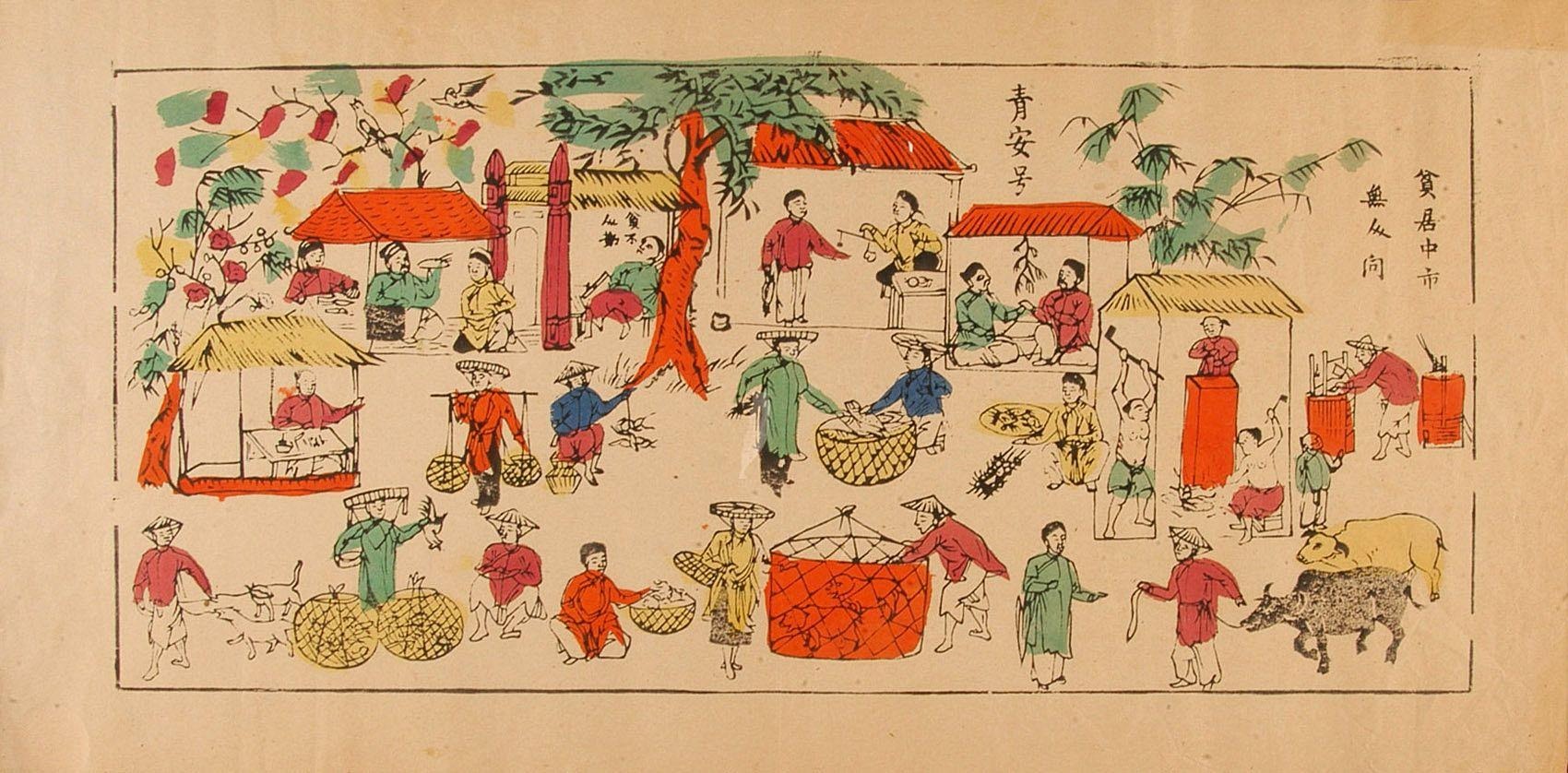
Market scene in the Đông Hồ folk tradition, twentieth century (from Saigoneer) [Possible deviations from the traditional Đông Hồ style due to the more detailed composition with finer lines and less intense colors]
*Sài Sơn Mountain (also known as Thầy Mountain) is located in Sài Sơn Commune, Quốc Oai District, Hà nội. This picturesque area is also renowned for the Thầy Pagoda and Cắc Cớ Cavern.
translated from the Vietnamese by Thúy Ðinh
Look, The Maker has built for the ages
An open market on Sài Sơn Mountain
On windswept mornings and sun-soaked afternoons
Cloud-veiled evenings and moonlit nights
Nature’s lush bounties are displayed year round
Eager players stake their bets on mountains, rivers
Peddlers of fame and fortune lurk in every corner
Stay true! Don’t try to bluff your wager.
Chợ Giời Núi Sài Sơn
Hoá công xây đắp bấy bao đời
Nọ cảnh Sài Sơn có chợ giời
Buổi sáng gió tuôn trưa nắng dãi
Ban chiều mây họp tối trăng soi
Bầy hàng hoa quả quanh năm đủ
Rải thẻ giang sơn bốn mặt ngồi
Bán lợi mua danh nào những kẻ
Chả nên mặc cả một hai nhời
Copyright © 2026 Thúy Đinh. Used with the permission of the translator.
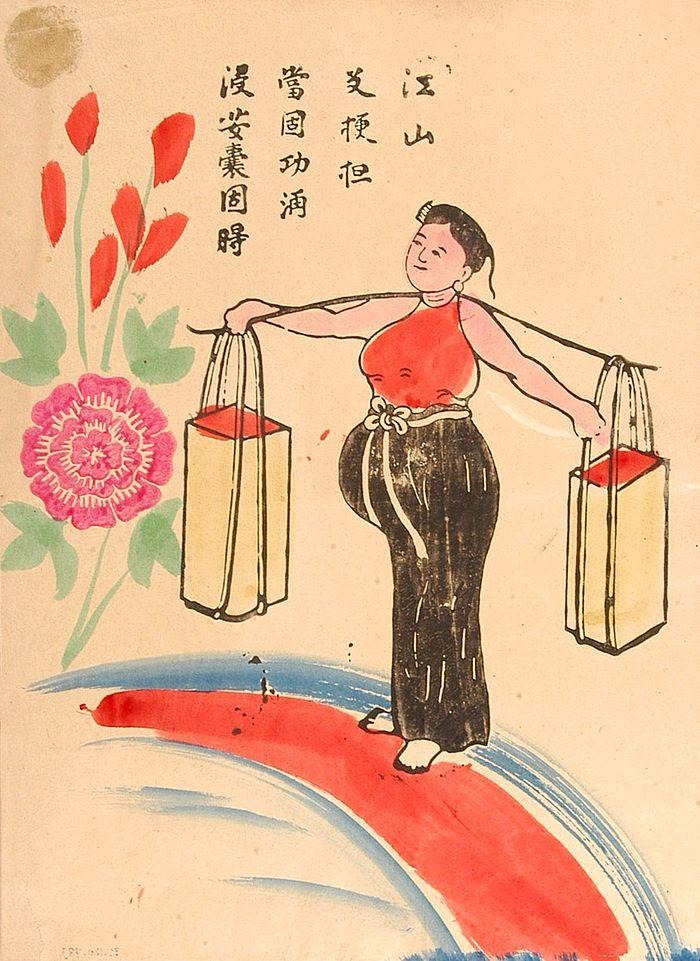
Young woman carrying water with “drum-shaped belly,” Đông Hồ tradition, twentieth century (from Saigoneer)
*Drum Gorge, also known by the name Kiềm Cổ, is located in Nam Kênh commune, Thanh Liêm district, bordering Kim Bảng district in Hà Nam province, northern Vietnam. Situated along the banks of the Đáy River, it is a spot where the river is squeezed between two rock faces, narrowing it significantly like an alleyway.
translated from the Vietnamese by Thúy Ðinh
Mountain walls flanking a narrow stream
Is this what they call The Drum Gorge?
Wind-lashed rocks crackle, cower, creak
Waves-borne river rum-tumbles its belly song
Inside the cave one’s path winds tight and steep,
Out on the bluff, the sky a gaping maw.
Crossing the gorge, a woman looks back
No man can grasp her drum-shaped pain.
Kẽm Trống*
Hai bên thì núi, giữa thì sông
Có phải đây là Kẽm Trống không?
Gió giật sườn non khua lắc cắc,
Sóng dồn mặt nước vỗ long bong
Ở trong hang núi còn hơi hẹp,
Ra khỏi đầu non đã rộng thùng.
Qua cửa, mình ơi, nên ngắm lại,
Nào ai có biết nỗi bưng bồng.
Copyright © 2026 Thúy Đinh. Used with the permission of the translator.
*Quán Sứ Temple was built in the fifteenth century during the reign of Emperor Lê Thế Tông, and located in An Tâp Village, Thọ Xương District, Thăng Long (modern day Hà nội). At that time, according to Hoàng Lê Nhất Thống Chí (Records of the Unification of the Imperial Lê), a guesthouse had been erected in this area to receive ambassadors from countries such as Laos, the Khmer Empire, and Champa. Since these nations practiced Buddhism, Lê Thế Tông subsequently ordered the construction of a temple adjacent to the guesthouse to accommodate the ambassadors in their observance of religious rites; thus, the temple was named Quán Sứ (Ambassador) Temple. Today only the temple remains, and since 1934 has become the headquarters of the Buddhist Sangha of Vietnam.
translated from the Vietnamese by Thúy Ðinh
Quán Sứ Temple looks so empty, so sad
Some say its head monk has turned into a cat
In broad daylight, no clackings of its whale-shaped drum
By late afternoon, no sight of moss-sweeping devotees
Once, the clack-clacks would roar, rest, then resume
Susurrations of prayers with counting beads could be heard
The head monk had set his sail toward the Western Paradise
But the monsoon wind upturned his good ship.
Quán Sứ Tự*
Quán Sứ chùa xưa cảnh vắng teo,
Thương ôi sư đã hoá ra mèo
Sáng banh vắng kẻ khua dùi mõ,
Trưa trật không người quét kẽ rêu.
Chí chát chày kình im lại đấm,
Lầm rầm tràng hạt đếm cùng đeo.
Buồm từ cũng rắp sang Tây Trúc,
Gió vật cho nên phải lộn lèo.
Copyright © 2026 Thúy Đinh. Used with the permission of the translator.
translated from the Spanish by Carina del Valle Schorske
Between August and surf season
is dead time in Rincón. Most shops shut down.
There’s a ban on catching grouper, crab, and conch.
The fishermen spend Sundays singing
karaoke salsa classics on the public beach,
their voices trained by salt and resignation.
The reef rests, regenerates. The seafloor is a neon feast.
Elkhorn corals celebrate, turtles come close to shore.
But the people suffer scarcity.
Luckily, the fruit trees flourish.
Locals trade bananas, breadfruit, green plantains.
This year the avocado harvest was abundant.
At any moment a hurricane might strike.
Septihambre
Después de agosto
y antes de la temporada de surfing,
en Rincón es tiempo muerto.
Muchos negocios cierran durante esta época.
Hay veda de juey, de mero y de carrucho.
Los pescadores se reúnen los domingos en el balneario
a cantar clásicos de salsa en el karaoke,
sus voces entrenadas a fuerza de resignación y sal.
El arrecife descansa, se regenera.
El fondo del mar es un festín neón.
Celebran las palmatas
y las tortugas se acercan a la orilla.
Pero la gente padece la escasez.
Por suerte abundan los árboles frutales.
Se hace trueque de guineos, panas, plátanos.
Este año la cosecha de aguacates fue abundante.
En cualquier momento puede azotar un huracán.
Copyright © 2026 by Nicole Cecilia Delgado. Originally published in Poem-a-Day on July 14, 2026, by the Academy of American Poets.
Life is short, though I keep this from my children.
Life is short, and I’ve shortened mine
in a thousand delicious, ill-advised ways,
a thousand deliciously ill-advised ways
I’ll keep from my children. The world is at least
fifty percent terrible, and that’s a conservative
estimate, though I keep this from my children.
For every bird there is a stone thrown at a bird.
For every loved child, a child broken, bagged,
sunk in a lake. Life is short and the world
is at least half terrible, and for every kind
stranger, there is one who would break you,
though I keep this from my children. I am trying
to sell them the world. Any decent realtor,
walking you through a real shithole, chirps on
about good bones: This place could be beautiful,
right? You could make this place beautiful.
This poem originally appeared in Waxwing, Issue 10 (June 2016). Used with the permission of the author.
The title is xīn chuántǒng, which means “new tradition” in Mandarin.
Let it be known. We circled—
barefoot—the parking lot, searching
for our car, last seen by villagers to be ferrying
torsos across a river. No matter, the living do
what they know best. From this foreign shore
I now call street, I hand body parts to you
for wear: a father’s shoulder, a mother’s
back—the things we do for survival.
At home, everyone is missing a chest,
taken by a bullet tracing itself through
a new frontier, and I name it immigrant.
There, you wear your country’s skin well.
When the sun gives, you could hang it
alongside my wedding dress, but I am
a boy, and you looked into my face, bruised
with makeup, to remind me, so you don’t.
Though I am your son, it’s too easy to forget
how I ran from love, how the Chinese night
eats its simple men; how these streets
swallow cars whole. One thing is easy
to keep, your old language I use for poems
and pillow talk. Here’s one: the jade talismans
you brought over from the village have made
like a wishbone, and split itself home. Follow it,
but you can’t—your tires are slashed. You run,
but everywhere is made of streets, and everything
is slashed. Come back, we are in the parking lot
again, holding your son—stroking his cheek—
finding in his mouth the second half
of everything you’ve ever wanted.
Originally published in Pigeon Pages, 2024. Used with the permission of the author.
I ask you this:
Which way to go?
I ask you this:
Which sin to bear?
Which crown to put
Upon my hair?
I do not know,
Lord God,
I do not know.
From Caroling Dusk (Harper & Brothers, 1927), edited by Countee Cullen. This poem is in the public domain.