


In South Philadelphia the b-ball hoops
in the playgrounds and parks mostly had no nets,
no nets on the rims—they’d been stolen
or ripped down after being torn by leaping teenagers.
When my son was a boy the difference mattered
because he loved basketball, he loved the Sixers,
he loved shooting baskets and there is beautiful satisfaction
when a good shot falls through the net—
“Swish” we said—“Nothin’ but net”—
and so as I moved around town I always noticed
where the hoops had nets
so Nick and I could shoot there.
The difference mattered. Life should be a certain way
but often the right way becomes unavailable—
the nets disappear—you have to be alert
to find the courts where a perfect shot really does go
swish. Life has disappointments
but you don’t want your boy to feel that life is
mainly or mostly disappointing
or that the Sixers on TV are absurdly far from his real life—
because he needs to believe
that life allows moments of sublimity—swish—
so even now when Nick is almost forty
wherever I see good intact nets on the rims
I make a mental note for half a second:
Nick and I could play here.
The difference matters.
Copyright © 2025 by Mark Halliday. Originally published in Poem-a-Day on January 24, 2025, by the Academy of American Poets.
—after Beenie Man and Derek Walcott
who am i?
either i’m nobody or
i’m the cramped quarters
of any vessel voyaging the sea
with contraband and trafficked cargo
who am i?
either i’m nobody or
i’m the rum barrel hollowed out
and beaten into percussion
who am i?
either i’m nobody or
i’m a pidgin picking its way
into a creole—any savage tongue
consumed again and again
until it can be repeated
who am i?
either i’m nobody or
i’m the plátano deep frying sweet
in oil or i’m the plátano fry-smash-
fried into tostones
who am i?
either i’m nobody or
i’m the hibiscus steamed
with ginger and sugar
and allspice and clove
who am i?
either i’m nobody or
i’m a field song morphing
out each new generation’s lips
who am i?
either i’m nobody or
i’m the pilón smashing
plátano and garlic and chicarrón
into mofongo or i’m the pilón
grinding allspice and clove
and fennel and cinnamon into a jerk
who am i?
either i’m nobody or
i’m this tripped-up tongue
tryna wind its way through
english, spanish, and patois
smashed and ground-up together
who am i?
either i’m nobody or
i’m sugarcane fields burnt or i’m
the the scotch bonnet burn
in the curry chicken or
i’m the ron añejo burning
its way down the throat
who am i?
either i’m nobody or
i’m a poco man jam
morphing into a dembow
who am i?
either i’m nobody or
i’m the poems chanted
over and over on the slave ship
until they all mishmash smashed
into a whole new song
who am i? who am i? who am i?
either i’m nobody or
i’m all of the nations
or i am no nation or i’m a
singular, ephemeral nation—
the one i sing into being with this
savage tongue, the one that disappears
as soon as the sound stops shaking
in the ocean salt air
Copyright © 2025 by Malcolm Friend. Originally published in Poem-a-Day on April 18, 2025, by the Academy of American Poets.
Yesterday it was still January and I drove home
and the roads were wet and the fields were wet
and a palette knife
had spread a slab of dark blue forestry across the hill.
A splashed white van appeared from a side road
then turned off and I drove on into the drab morning
which was mudded and plain and there was a kind of weary happiness
that nothing was trying to be anything much and nothing
was being suggested. I don’t know how else to explain
the calm of this grey wetness with hardly a glimmer of light or life,
only my car tyres swishing the lying water,
and the crows balanced and rocking on the windy lines.
Copyright © 2025 by Kerry Hardie. Originally published in Poem-a-Day on January 16, 2025, by the Academy of American Poets.
After Amiri Baraka and Stefania Gomez
Poems are bullshit unless they are broken
like a horse, like a dog kicked in the ribs,
Like your favorite toy that’s missing an arm.
Love can make you feel used.
I want the poem that limps back to me.
Poems should hurt like love,
like ice water on your teeth
like a massage to smooth out a cramped muscle.
Give me the poem that’s like leather.
Give me the poem that smells like gasoline.
I want a poem that is a warning,
a poem that makes me check to see
if I left the shotgun by the door,
a poem that’s a runny nose, a sneeze, a poem
that’s the moment the sky turns green.
Copyright © 2024 by Kenyatta Rogers. Originally published in Poem-a-Day on November 20, 2024, by the Academy of American Poets.
will poetry change the world? no one asks
this about football, the thrill of watching or
playing. we get that nurses & doctors are
healers. no question that rabbis, priests, &
imams guide individuals & groups through
spiritual thickets. we don’t tell cooks to put
down their wooden spoons & go make a real
difference instead of a real soufflé. teachers
are honored for the learning they impart. so
let poets keep on exciting passion in them-
selves & others. don’t discourage us from our
efforts to diagnose the human heart or create
trail markers for those coming behind us on
this journey. trust me when i say that poetry
heals, guides, feeds, & enlivens. poetry may
not change the world, but might change you.
Copyright © 2024 by Evie Shockley. Originally published in Poem-a-Day on October 17, 2024, by the Academy of American Poets.
(Mather AFB, California, 1956)

When we play horses at recess, my name
is Moonlily and I’m a yearling mare.
We gallop circles around the playground,
whinnying, neighing, and shaking our manes.
We scrape the ground with scuffed saddle oxfords,
thunder around the little kids on swings
and seesaws, and around the boys’ ball games.
We’re sorrel, chestnut, buckskin, pinto, gray,
a herd in pastel dresses and white socks.
We’re self-named, untamed, untouched, unridden.
Our plains know no fences. We can smell spring.
The bell produces metamorphosis.
Still hot and flushed, we file back to our desks,
one bay in a room of palominos.
From How I Discovered Poetry (Dial Books, 2014). Copyright © 2014 by Marilyn Nelson. Used with permission of the author and Penguin Books.
to Mary Rose
Here is our little yard
too small for a pool
or chickens let alone
a game of tag or touch
football Then
again this stub-
born patch
of crabgrass is just
big enough to get down
flat on our backs
with eyes wide open and face
the whole gray sky just
as a good drizzle
begins I know
we’ve had a monsoon
of grieving to do
which is why
I promise to lie
beside you
for as long as you like
or need
We’ll let our elbows
kiss under the downpour
until we’re soaked
like two huge nets
left
beside the sea
whose heavy old
ropes strain
stout with fish
If we had to we could
feed a multitude
with our sorrows
If we had to
we could name a loss
for every other
drop of rain All these
foreign flowers
you plant from pot
to plot
with muddy fingers
—passion, jasmine, tuberose—
we’ll sip
the dew from them
My darling here
is the door I promised
Here
is our broken bowl Here
my hands
In the home of our dreams
the windows open
in every
weather—doused
or dry—May we never
be so parched
Copyright © 2024 by Patrick Rosal. Originally published in Poem-a-Day on March 13, 2024, by the Academy of American Poets.
To be a good
ex/current friend for R. To be one last
inspired way to get back at R. To be relationship
advice for L. To be advice
for my mother. To be a more comfortable
hospital bed for my mother. To be
no more hospital beds. To be, in my spare time,
America for my uncle, who wants to be China
for me. To be a country of trafficless roads
& a sports car for my aunt, who likes to go
fast. To be a cyclone
of laughter when my parents say
their new coworker is like that, they can tell
because he wears pink socks, see, you don’t, so you can’t,
can’t be one of them. To be the one
my parents raised me to be—
a season from the planet
of planet-sized storms.
To be a backpack of PB&J & every
thing I know, for my brothers, who are becoming
their own storms. To be, for me, nobody,
homebody, body in bed watching TV. To go 2D
& be a painting, an amateur’s hilltop & stars,
simple decoration for the new apartment
with you. To be close, J.,
to everything that is close to you—
blue blanket, red cup, green shoes
with pink laces.
To be the blue & the red.
The green, the hot pink.
From When I Grow Up I Want to Be a List of Further Possibilities. Copyright © 2016 by Chen Chen. Used by permission of The Permissions Company, Inc., on behalf of BOA Editions, Ltd., www.boaeditions.org.
If every bomb
Appeared in the sky a dove
Shrapnel into rain
If vengeance vanquished
From the cursed lips of weak men
An idea never taking root
If every tank vanished
If by chance a miracle
Peace reclaims the land
If laughter broke out
Like wars fought with satire’s
Pugilist punning
What room would there be
For anger what bitter root
Not allowed to stretch
Its tentacles
Through the hearts of men hardened
By indifference
What will we bequeath
Our children if not a world
Evermore human
Copyright © 2024 by Tony Medina. Originally published in Poem-a-Day on February 19, 2024, by the Academy of American Poets.
Easy as an exquisite corpse paraphrased
as dictionaried as a pontificator
raised by the thump of the 146 bus—
these 16 are for you. Shout out
to the city warblers yelling in slanted
syllables on avenues porous
with ill-built adornments & horse-riding
monuments. These 16 are for you:
linebreakers & trash talkers, polysyllabic
halfsteppers ready to mom’s spaghetti
their one opportunity. Meanwhile,
the rooftop across from us undercuts
the sunsetted skyline & is topped with
two metric heretics dressed
like crows. Another bullheaded poet
ina Bulls hat rests his elbows
on the bench back & wonders if
it is his hoarse verse or the verbed
streetlights making ellipsis from
the veritable trees & inevitable breezes.
Copyright © 2025 by Adrian Matejka. Originally published in Poem-a-Day on July 24, 2025, by the Academy of American Poets.
My daughter says six is her favorite year ever
though she suspects that seven will be better.
Her dress spins down the corridor.
It’s made of butterflies and billowing
like the memory of a chocolate souffle.
Was I ever more like her than like me,
shoulders not flagging, breath hot
with awe as I sidestepped each stone,
the promise of age like a helium balloon
dragging me behind it on a flouncy string?
My daughter tries to show me everything
she’s left a mark on: painted clay,
a smiley-faced cotton ball perched on a stick.
her name in all-caps on an envelope.
Does she already somewhere in her spleen
or pancreas, in the soft tissues and marrow, sense
that the impossible goal is, for all of us,
just to keep going? No, she is not grieving
over Goldengrove whatever. Six is her favorite
year ever, I feel not so much nostalgia
as Sehnsucht, the desire for something
missing, vertigo under the infinite sky.
We crane our twin heads as a falcon or drone
pierces the cloud cover into the future.
How to get closer to the mystery.
Older, she will do whatever: name a new nation,
isolate a microbe, hear the whales mutter
the muscadine water. Every time the regimes change
she will dance Swan Lake, bending her knees
at the requisite intervals. Attagirl, daughter!
The economy continues to show resilience
in the face of despair and mass depredation.
My daughter is swan. Is crab grass run riot.
Meanwhile, I am becoming unrecognizable
to everyone except myself, and it does not matter:
before it is time to resemble no one
I have had the mixed fortune to resemble most things.
My shadow lingers in the corner of the photo of the painting.
I may not know more than a bedraggled llama
craning its neck past the impregnable fence. Still,
I participated in the world. I wore the ceremonial
knee breeches required by protocol.
Led her through ferry boats and Ferris wheels,
this ardent daughter clinging to my hand
as though it was God’s hand on a church ceiling.
We took turns licking the strawberry ice cream.
In this knowledge, I feel content.
Copyright © 2025 by Michael Dumanis. Originally published in Poem-a-Day on August 11, 2025, by the Academy of American Poets.
Worried my love’s not worth much, but I always
come when called. Ain’t my name your favorite
command? No need to raise your hand. How
long you plan on marauding me with meak
mercies: I’m still bandaged from your last love:
dogged years I’ve knelt at your lap: tongue out,
eyes wet and for what: when it’s not your hands
on me, it’s your dead come ready to wind up
and wound.
Copyright © 2025 by Saeed Jones. Originally published in Poem-a-Day on August 5, 2025, by the Academy of American Poets.
As a child I made things
out of clay—a pig who
could not be eaten, a mule
who refused to carry
anything other than a pig
who could not be eaten.
They were companion
pieces. They kept each
other company, and me.
We kept each other’s
secrets: what flesh can
do with clay, what clay
can do that flesh can’t.
I was a small child who made
small decisions. I made big
people angry. I made them
confused. I
refuse, I refuse.
Copyright © 2025 by Andrea Cohen. Originally published in Poem-a-Day on August 4, 2025, by the Academy of American Poets.
We met ourselves as we came back
As we hiked the trail from the north.
Our foot-prints mixed in the rainy path
Coming back and going forth.
The prints of my comrade’s hob-nailed shoes
And my tramp shoes mixed in the rain.
We had climbed for days and days to the North
And this was the sum of our gain:
We met ourselves as we came back,
And were happy in mist and rain.
Our old souls and our new souls
Met to salute and explain—
That a day shall be as a thousand years,
And a thousand years as a day.
The powers of a thousand dreaming skies
As we shouted along the trail of surprise
Were gathered in our play:
The purple skies of the South and the North,
The crimson skies of the South and the North,
Of tomorrow and yesterday.
This poem is in the public domain. Published in Poem-a-Day on August 2, 2025, by the Academy of American Poets.
—after Freda Epum
the day could do without
me. The ice outside glitters around
my car’s tires like a pageant
dress. Only digital utterances between
myself and the world for at least
a week. The last time he visited, my friend
noted the lack of natural light
in my downstairs apartment,
the posthumous-grey bleeding into
the mood. Aught of light
in the bedroom due to the blackout
curtains. But sometimes,
the day heckles, with its high-
bitch sun and melting snow. Some
days, I lay in the morgue
of darkness, hyper-alone,
and the sunlight, so audacious, paints
the color back onto my cheeks.
Copyright © 2025 by Taylor Byas. Originally published in Poem-a-Day on August 1, 2025, by the Academy of American Poets.
translated from the Navajo by Washington Matthews
Where my kindred dwell, there I wander.
Child of the White Corn am I, there I wander.
At the Red Rock House, there I wander.
Where the dark kethawns are at the doorway, there I wander.
With the pollen of dawn upon my trail, there I wander.
At the yuni the striped cotton hangs with pollen. There I wander.
Going around with it, there I wander.
Taking another, I depart with it. With it I wander.
In the house of long life, there I wander.
In the house of happiness, there I wander.
Beauty before me, with it I wander.
Beauty behind me, with it I wander.
Beauty below me, with it I wander.
Beauty above me, with it I wander.
Beauty all around me, with it I wander.
In old age traveling, with it I wander.
On the beautiful trail I am, with it I wander.
This poem is in the public domain. Published in Poem-a-Day on November 16, 2025, by the Academy of American Poets.
A white curtain turning in an open window.
A swan, dipping a white neck in the trees’ shadow,
Hardly beating the water with golden feet.
Sorrow before her
Was gone like noise from a street,
Snow falling.
This poem is in the public domain. Published in Poem-a-Day on December 14, 2025, by the Academy of American Poets.
sees my mother seated up in bed, unable to move
of her own accord, lips parched from medication,
she begins to sing, a chant, an Arab song,
from her childhood, eyes almost transparent.
My two aunts, or they would have been my aunts,
who died in infancy . . . from pneumonia? . . .
scarlet fever? . . . no one alive now knows.
What was, when my mother was a child, in the air
of the world’s most industrialized city? Blessings
and horrors, raw orange sunsets, that blue flame
burning is industry, the smell of incense rising
in the fabulous churches, Latin, Greek, Arabic, Aramaic
liturgies, descendants of inventors of alphabets.
After midnight humid and hot. The dead are wherever
we are. They’re not just details, these tears of bliss.
Survival’s what’s involved. Furious, the fate
that keeps watch. Everything’s something else and yet itself
at the same time. Home, you know? Everyone
and everything is related. Wet steel-blue morning, thin,
purple salvias near the backyard fence. Your Grandpa’s
dead, I, the baby, must have heard it said.
Copyright © 2025 by Lawrence Joseph. Originally published in Poem-a-Day on December 11, 2025, by the Academy of American Poets.
The family I’m staying with,
because my father is working,
have called their dog Darkness,
and it is a beautiful name.
I’ve decided to camp.
And out here in an old tent
on the edges of their property,
Darkness encircles me.
I burrow my back into the field,
strangely soft with a grass I don’t
know the name of. I should know
the names of grasses, and of trees,
and of so many things.
Soon, the thick
wind loosens into coolness and the light
begins to dim. As I look up into Darkness,
the underside of her tongue is spotty
with inky-on-pink constellations.
Her body makes me think of my own body,
my fingertips dry as match heads
that will light this nameless grass if I’m
not careful.
Darkness is a good teacher,
and she guides me to be gentle with myself.
With a nuzzle of her head into my hand,
she says, in her way, that I am ok.
I stroke her so long that the heavy night
settles, and all that is left is the white blaze
on her chest.
Soon, my eyes, and I, will adjust.
But for now, I’m suspended,
in this moment that is the sum
of all moments.
The grass, it occurs to me,
is bluestem. The air is amniotic.
And I cry a good cry as the great dog
keeps on guarding me.
Copyright © 2026 by Jacob Shores-Argüello. Originally published in Poem-a-Day on January 7, 2026, by the Academy of American Poets.
Alliterate often equals anyone can stutter.
—Louis Zukofsky
CLASSROOM
Backpack. Back to school. A bookworm. Late nights book-warmed. Tall tales. Tell-Tale Heart. Stone soup. Mike Fink. A pink eraser. Ser & estar. A star atop the page. A typed page. Cut & paste. Sometimes I’m slow paced. Trace a wave. Cursive. Cursor. Sine curve. Frogger goes kerplunk. We speak & spell. Read & write. I do a rewrite. Rhyme by rote. Hey Diddle Diddle. Digits double. In my textbook I doodle. Sketch pad. Scotch tape. Scratch & sniff. Pear-fect. Berry good. Grape going. Study group. I glue some goop. A great big gooey glob. We spin the globe. Hong Kong. Fiji. Cancún. New York, New York. Blue ink. Half inch. Fluid ounce. I ace the exam for once. Pop quiz. Pop fizz. Scissors. Seat sore. Stegosaurus. From my seat paper planes soared. Chalkboard. I’m stark bored. The chalk broke. Pop Rocks. Pop cans. I can’t. You can. Pop-top. Twist the tab & crush. Orange Crush. Secret crush. Love letter. Origami amore. Already going steady. Valentine-vexed. Doodle-doted. Dimple-dappled. You’re dumped. Humpty Dumpty. We play pin the tail on the donkey. Mountain Dew. Scooby Doo. Dewey Decimals. Dutifully I return The Snowy Day by the due date. Dried dates. Damp day. Windowsill. Pencil. Pen swell. Pen pals. Pentagons. Going, gone. The bus is gone. Let go. Lego. Logo turtle. Or. Are. Oreo. Oregon Trail. Homework. Homeward. Sidewalk. The sign says walk. All week.
Copyright © 2026 by Adam Giannelli. Originally published in Poem-a-Day on January 9, 2026, by the Academy of American Poets.
Remember the sky that you were born under,
know each of the star’s stories.
Remember the moon, know who she is.
Remember the sun’s birth at dawn, that is the
strongest point of time. Remember sundown
and the giving away to night.
Remember your birth, how your mother struggled
to give you form and breath. You are evidence of
her life, and her mother’s, and hers.
Remember your father. He is your life, also.
Remember the earth whose skin you are:
red earth, black earth, yellow earth, white earth
brown earth, we are earth.
Remember the plants, trees, animal life who all have their
tribes, their families, their histories, too. Talk to them,
listen to them. They are alive poems.
Remember the wind. Remember her voice. She knows the
origin of this universe.
Remember you are all people and all people
are you.
Remember you are this universe and this
universe is you.
Remember all is in motion, is growing, is you.
Remember language comes from this.
Remember the dance language is, that life is.
Remember.
“Remember.” Copyright © 1983 by Joy Harjo from She Had Some Horses by Joy Harjo. Used by permission of W. W. Norton & Company, Inc.
Trippers and askers surround me,
People I meet, the effect upon me of my early life or the ward and city I live in, or the nation,
The latest dates, discoveries, inventions, societies, authors old and new,
My dinner, dress, associates, looks, compliments, dues,
The real or fancied indifference of some man or woman I love,
The sickness of one of my folks or of myself or ill-doing or loss or lack of money, or depressions or exaltations,
Battles, the horrors of fratricidal war, the fever of doubtful news, the fitful events;
These come to me days and nights and go from me again,
But they are not the Me myself.
Apart from the pulling and hauling stands what I am,
Stands amused, complacent, compassionating, idle, unitary,
Looks down, is erect, or bends an arm on an impalpable certain rest,
Looking with side-curved head curious what will come next,
Both in and out of the game and watching and wondering at it.
Backward I see in my own days where I sweated through fog with linguists and contenders,
I have no mockings or arguments, I witness and wait.
This poem is in the public domain. From Leaves of Grass (1855) in Whitman: Complete Poetry and Collected Prose (Library of America, 1982).
I read on my iPhone, stopped at a red light, & next to my car
a child is playing a street piano fast, counting THREE, TWO, ONE,
yelling over traffic, I’m PLAYING, sun on the child’s face
& fingers skittering on keys—
neurons direct these fingers, a consciousness no one shares
that says, high notes now, then low, & laughter,
& an adult urges the child to come-on-let’s-go,
but the child plays a crescendo & says
I AM FINISHING MY SONG—
& artificial intelligence can use recurrent neural networks to create
piano music & AI can drive cars, but my eyes tire,
my eyes are animal eyes with animal need to gaze out
at red lights & be given the useless-lovely data of a sparrow skimming
to a telephone wire, a child at a rainbow-painted stringed instrument,
the sparrow hopping on a wire, the child pressing keys like a question:
low, high? Low, high? Perception a note not played again,
& when the light turns green my car drives,
I am finishing my song. The light is yellow now.
Copyright © 2026 by K. A. Hays. Originally published in Poem-a-Day on January 29, 2026, by the Academy of American Poets.
I am a child
of wonder again and
rain tells me to watch
for snails and slugs.
I gather dirt, sand, and sticks
for the terrarium
where I make a safe home
away from footsteps, fast cars, and ditch water.
I don’t want them to die
so I make them
a space for living.
I ask my ma to buy lettuce
because in the book I got from the library
I learned they will eat lettuce.
I am
greedy to learn
what keeps everything alive.
Their spiral shapes leave shiny trails behind.
I imagine I am a snail leaving
magic everywhere I go.
Copyright © 2026 by Marlanda Dekine. Originally published in Poem-a-Day on January 30, 2026, by the Academy of American Poets.
As if weightlessness were aspirational―
what nonsense―
your death,
a stone
I can only hope to shoulder forever. Imagine
it gets better―
what nothing
am I left with
then? Even despair carries a particular
charge: that fantastic
last whiff of lavender
detergent
imprinted on the collar of a holiday sweater―
mama,
the mourners are assembling. March me
up that hill …
Copyright © 2026 by Shara Lessley. Originally published in Poem-a-Day on January 28, 2026, by the Academy of American Poets.
and i return to the field
that i never leave other boys
are here too stamping the bruise-dark grass
one of us stands alone between posts
and waits for the rest to rifle
a ball through the dark and toward the net
he defends security lights
from the school on the embankment
above us cast angles and shadows that cut
through our bodies
and abstract them all i have learned
up till now is fear
of opaque windows
in houses outside the fence of headlights
to lone cars that pass leaving a wake
of deeper dark of the neighbor nightwalking
his brindled, snarl-jawed dog of other boys
laughing and taunting before their volleys
bullet toward and beyond the boy guarding the net
of myself how i understand no choice
but to join them
then i am called
to stand between the posts
and what else can I do
when i am there
other boys strike the one ball
shared between us and it sidewinds
out of the dark hurtling above or around or
sometimes straight at me
and what else
can i do crouched in my place
and ready to throw my body
after the ball as it rips out of the night
but raise my own laughter against them
the boys arrayed 20 yards away and aiming
for my failure but ring out with a taunting
glee of my own
until i call another boy
to his turn and walk back to the edge
of the group and wait to stand over the ball
and hope to make the new boy
lay down his body for our game as i
have laid down mine
and at the end of it
what else can i do but return the shoves
of other boys as we send each other
away in a gesture we refuse to name as love
and slip through the fence gap
where we first snuck in and leave
the field i can never leave and all my fear intact
be gone
Copyright © 2026 by Iain Haley Pollock. Originally published in Poem-a-Day on January 22, 2026, by the Academy of American Poets.
I am a knotted nebula—
a whirling flame
Shrieking afire the endless darkness ...
I am the eternal center of gravity
and about me swing the crazy moons—
I am the thunder of rising suns,
the blaze of the zenith—
... the tremble of women’s bodies
in the arms of lovers ...
I sit on top of the Pole
Drunk with starry splendor
Shouting hozzanas at the Pleiades
... booting footballs at the moon—
I shall outlast the sun
and the moon
and the stars.…
This poem is in the public domain. Published in Poem-a-Day on January 18, 2026, by the Academy of American Poets.
Prince tour, Public Hall, November 21, 1982
By the time I got here, the album
was already history. 1999 dropped in 1982,
when I worried about what I’d do with my life
after high school, and as I fretted over
how my hair looked on mornings
before I left for school; though, sadly,
my worries were not in that order.
But when I faced the end of the century,
I realized I knew little more then than I did when I sang
along with Prince at the Coliseum in Cleveland.
On that night, I didn’t know a concert could be history.
Me, just living in a moment of not recalling any moment
before this one, which must be what joy
was, but what did I know? No one understood
what a new century would look like,
and I didn’t gather that I’d lose loved
ones, soon after the pages of the calendar tore away.
Back then, I didn’t understand what I’d be
if Prince had not been. Now, years later,
“life is just a party, and parties weren’t meant to last.”
His lyrics weigh on me, as I grow older and ill,
and years later I’ll barely remember this moment
of simply remembering, just another day called today.
But this time, even now, I know more:
I know, for instance, even as I hum a tune
and bring forth memories of that night,
I’ve already become a point in history
before I even finish this song.
Copyright © 2026 by A. Van Jordan. Originally published in Poem-a-Day on February 2, 2026, by the Academy of American Poets.
The Crisis Magazine, June 1967
On the cover, Negro men playing checkers
in the park. Some wear hats, while others wear
waves in their hair. Either way, they’re all clean
and their strategy brims as sharp as their
suits. Within these pages, they’re playing chess,
protecting future children, as they wear
ties, dress shirts, shined shoes—looking clean
and ready for business or for battle. And their
plan? No longer will textbooks be used as chess
pieces to keep Negro children in check.
Sound familiar? Schools will be pushed to clean
bookshelves of the white-washed lessons of their
past. The NAACP opens minds like games of chess,
and all excuses for hiding a country’s checkered
past will be dismissed. Despite segregation’s wear
and tear from school boards, and the fear of their
white parents, henchmen, bullies—all just chess
pieces, really, but jumping laws like checkers
when life is more complex—books remain where
the mind cannot hide. Either you come clean
and admit your ignorance, or be a pawn on the chess
board of intellect, banning books. They think check-
mate! But when I see Crisis in a library archive where
we still argue to be seen, I lose patience. Kleenex,
please, for Karens clutching their pearls! I pray their
white kids are reading Langston Hughes in a public library: √.
But one state over, bookshelves have no Black authors, cleaned
out. Our books remain under attack, Kings in a game of chess.
Copyright © 2024 by A. Van Jordan. Originally published in Poem-a-Day on February 5, 2024, by the Academy of American Poets.
must look so small, undetectable even,
from the vantage point where I imagine
a god could see me, and I do sometimes
imagine a god like a sentient star
out beyond where our instruments
could find it, then I talk myself
out of the image. Out of the concept
entirely. From a distance, I know
I’m an ant tunneling my way
through sand between plastic panels,
watched—or not—from outside.
My puny movements on this planet,
all the things I’ve done or built
with my own body or mind, seem
like nothing at all. But from the inside
this life feels enormous, unlimited
by the self—by selfness—
vaster even than the sparkling
dark it can’t be seen from.
Copyright © 2026 by Maggie Smith. Originally published in Poem-a-Day on March 2, 2026, by the Academy of American Poets.
—after William Wordsworth
The world is too much with us. Late and soon
it’s morning, phone in hand, and a screen on my wrist powers
on to report the no rest I had. News, a tragedy—so easily ours—
already breaking as I crack my eggs. Rage and prayers, rage and prayers, a boon
for the tycoon’s fear-campaign, clicks for the zillionaire buying up the moon.
Ad, ad, an AI figment, someone squawking, someone hawking—hours
consumed, of this only life, and who is left in the garden, who is tending the flowers?
I am trying to hear the birdsong through the auto-tune
of all this ubiquitous engineered crooning, but a podcast informs me silence will be
extinct by the weekend, gone like thought and the good kind of alone. Peace is outworn;
it’s chaos that feeds the algorithm, no likes for the actual, the tangible. No lea
without a billboard promising Hell as if it isn’t here. But don’t be forlorn,
I’m sold—the world is yours! (after this ad) unending and enhanced on a screen. Don’t mind the sea
at the door. Time for a selfie, suggests my phone. A filter. I can add (for free!) horns.
Copyright © 2026 by Leila Chatti. Originally published in Poem-a-Day on March 11, 2026, by the Academy of American Poets.
Twenty-five summers ago
I wrote a poem about the summer ending,
the shadows lengthening, and the light
gone soft and elegiac
like the end of a love song.
It joined roughly a million poems
written that summer alone
on the same subject, but in Spanish
or Japanese, or Swahili,
always the same thing, same shadows
lengthening, same soft light,
and I ended my poem, twenty five years ago,
by saying that the back of my hand
had begun to look like a dead leaf
or the back of someone else’s hand.
And this is just a shout out to say
to that version of me, a quarter
century ago, that the hand in question
looks even more like a dead leaf, even more
like the back of someone else’s hand,
but—and this is crucial, the importance
of this next observation cannot
be overstated—the strange old hand
is still here, still enduring, still writing itself
into itself.
Copyright © 2026 by George Bilgere. Originally published in Poem-a-Day on March 13, 2026, by the Academy of American Poets.
for P.C.
My friend grieves while we search
for an authentic experience, like tacos
in hand-made corn tortillas. On Zarzamora,
Letitia’s is busy, so it must be good and real.
Early April—Lent specials in cursive
on posters outside. We park near
an unexpected cluster of purple flowers,
short and wild like a sudden storm.
We kneel. I think of Anthony of Padua,
the patron saint of lost things. Both of us
draw closer. The flowers speak to us. They say—
existence and persistence are the same thing.
A brisk spring wind brings sweet
peppers and onions, oil and fish.
Copyright © 2026 by Michael Kleber-Diggs. Originally published in Poem-a-Day on March 12, 2026, by the Academy of American Poets.
I like how Stevie Nicks speaks like a Martian sometimes.
“I came here for a reason,” she said in a 1983 interview.
As if simply relaying the directive from her mothership.
“I didn’t come here to be a mother …” Bet that sounded
pretty alien then. Coming from a young pretty woman.
Like a Trojan horse. Feminism disguised in a frilly dress.
It makes me think about my birth mother. Like Stevie,
she didn’t come here to be a mother. Unlike my mother,
who couldn’t get pregnant but wouldn’t let that stop her
from becoming what she came here to be. My mother,
as passionate about adoption as she was about choice.
I like how that confuses some—those who like to point
out that abortion might’ve prevented her from adopting.
I suppose those dimwits came here to be … well, dimwits.
Still, bet they can’t help but hum along when they hear
Stevie Nicks songs. Failing to realize that all those songs
are her children. That she gave birth to them for us.
“Because,” she said. “I want to enhance this planet.”
Copyright © 2026 by Michael Montlack. Originally published in Poem-a-Day on April 17, 2026, by the Academy of American Poets.
Full-on, no bullshit, no irony, yes Taco Bell
where I can almost always pull together the
cash to get dinner, at my brokest
scrounging up enough change
for the pillowy warmth of a bean burrito,
extra red sauce, meant to be eaten
behind the steering wheel in a parking lot
or while driving, the wrapper crumpled up
and thrown on the passenger side floor,
leftover napkins stashed in the glovebox.
In high school we’d ditch seventh period
and drive 10 miles down I-5 to the closest town
big enough to have a Taco Bell,
where we’d house as much food as we could
pay for, lounging in the pinkpurplegreen vinyl
or the metal swivel chairs we’d knock knees under,
giving each other dares around fire sauce,
hoarding packets of mild sauce to douse everything.
And forever, my love to the Taco Bell employees,
who took my order when I was drunk or high or crying,
who listened and fed me without too much judgment
through high school and college and my thirties,
and a special love for the two who pushed my car
through the drive-thru, once, when it broke down
mid-order. I couldn’t afford a tow until payday.
They let me leave it in the lot.
This is how I know labor is entitled to all it creates,
and that given a chance most of us are helpers,
we want to help people and to be helped
by people, amidst the absolute and delicious
loveliness of ordinary things.
Copyright © 2026 by Rebecca Bornstein. Originally published in Poem-a-Day on April 23, 2026, by the Academy of American Poets.
the unholy trinity of suburban late-night salvation
barring seemingly endless options of worship
bean burrito breadsticks and mashed potatoes
or a soft taco pan pizza and a buttered biscuit
an unimaginable combination of food flavors
for people not ready to go home to their parents
and yet none of the options feel quite right
so maybe I should call it Self-Portrait as idling
in a drive-thru with your friends crammed
across the sunken bench seats avoiding
the glow of the check engine light with black tape
pressed with a precision unseen anywhere else
in their lives as a fractured voice says don’t worry
take your time and order whenever you’re ready
from behind a menu backlit like the window
inside of a confessional booth as the hands
of the driver open up like a collection basket
for the wadded-up bills and loose change
that slowly stack up as the years go by
and I’m not sure what I’m supposed to be
in this analogy but I know about masking
warning signs and hearing out of tune
voices scream WE’RE THE KIDS WHO FEEL
LIKE DEAD ENDS so instead I’ll call it Self-
Portrait as From Under the Cork Tree
or maybe even Self-Portrait as whatever
album people listen to when they love
their friends and still want to feel connected
to the grass walls of a teenage wasteland
that they can’t help but run away from
Copyright © 2024 by Aaron Tyler Hand. Originally published in Poem-a-Day on April 22, 2024, by the Academy of American Poets.
What if I told you he wasn’t that bad?
That you couldn’t smell it on his breath
after all, & that he wasn’t one of the loud ones
the way he is in all my poems? Not at all
like the viral headlines made him seem? What if
I told you he smiled in PTA meetings & never spoke first?
That he sat on the sidelines at little league games
& laughed with other parents? That he loves to sink
his soft hands into soil & clip the crisped
edges of dog-tongue rhododendron leaves because
they make him feel small? What if I told you
he sits in church basements with other white-whiskered
men to talk about how proud they all are of their
gay sons? & the whirling manic I cartoon him to be
in line at the rehab hospital, or barking through
car windows with an open Sauv Blanc bottle
cinched between his khakis—what if I said
that was all mostly for me?
Copyright © 2026 by Adam Falkner. Originally published in Poem-a-Day on May 21, 2026, by the Academy of American Poets.
I was want
ing the most
bare language
threaded bare
ly there a bar
on in english
everywhere I
went I langu
ished in a war
rent of a lang
uage I did or
did not want
once in ame
rica there w
as a language
we were guilt
y I spoke it y
ou were there
Copyright © 2026 by Jos Charles. Originally published in Poem-a-Day on June 25, 2026, by the Academy of American Poets.
Just as I wonder
whether it’s going to die,
the orchid blossoms

and I can’t explain why it
moves my heart, why such pleasure

comes from one small bud
on a long spindly stem, one
blood red gold flower

opening at mid-summer,
tiny, perfect in its hour.

Even to a white—
haired craggy poet, it’s
purely erotic,

pistil and stamen, pollen,
dew of the world, a spoonful

of earth, and water.
Erotic because there’s death
at the heart of birth,

drama in those old sunrise
prisms in wet cedar boughs,

deepest mystery
in washing evening dishes
or teasing my wife,

who grows, yes, more beautiful
because one of us will die.
From Dumb Luck by Sam Hamill, published by BOA Editions. Copyright © 2002 by Sam Hamill. Reprinted by permission of the author and publisher. All rights reserved.
for my mother
This one moment I loved: you
in the air, permed hair flying
wild in the rain, around and through
and not a thought of us dying
in the air, permed hair flying
against the storm, lashing hot rain
and not a thought of us dying,
strapped in the plastic car, chained
against the storm lashing hot rain
on our faces as we’re hurled up,
strapped in the plastic car, chain
clouds glowing, whirling—the gust
on our faces as we’re hurled up,
launched into the electric
clouds glowing whirling, the gust
as you laughed and laughed. It’s
launched into the electric,
wild in the rain, around and through
as you laughed and laughed—it’s
this one moment I loved you.
Copyright © 2026 by Wo Chan. Originally published in Poem-a-Day on July 17, 2026, by the Academy of American Poets.
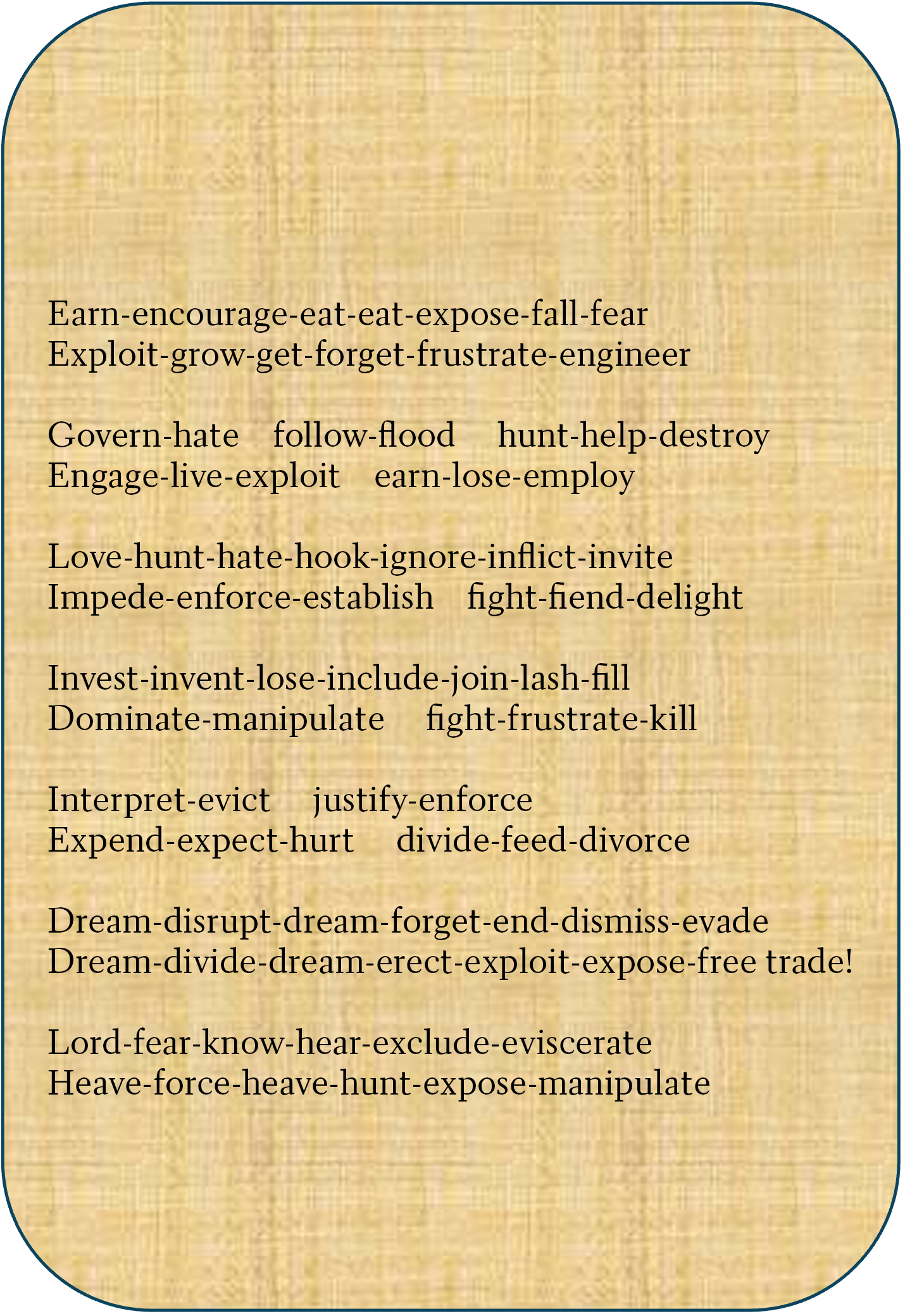
Copyright © 2026 by Daniel Borzutzky. Originally published in Poem-a-Day on July 24, 2026, by the Academy of American Poets.
The sound of quiet. The sky
indigo, steeping
deeper from the top, like tea.
In the absence
of anything else, my own
breathing became obscene.
I heard the beating
of bats’ wings before
the air troubled above
my head, turned to look
and saw them gone.
On the surface of the black
lake, a swan and the moon
stayed perfectly
still. I knew this was
a perfect moment.
Which would only hurt me
to remember and never
live again. My God. How lucky to have lived
a life I would die for.
Copyright © 2023 by Leila Chatti. Originally published in Poem-a-Day on January 3, 2023, by the Academy of American Poets.