


my kin, my ripe bushel of apples,
orcharding, my wealth: Neelo
with the round face & always on
some kind of exercise routine. Lubnah
name dripping silk, honey, a fat drop
of yogurt & blueberry. Lubnah who i haven’t
seen in years but then looks up at me
from the photo in my baby album, Khudejha,
who left me when i told my truth, who i knew
my words landed on like a knife, though
i did all i could to cut with flowers, bouquet
after bouquet. Ruquia, who i left & missed
with each footstep, would wake in the night
confused, calling her name. the years makes
long our distance, when i see her again
we’re strangers, talking about the people
in our lives like they’re characters in a tv show.
our worlds, fiction to each other, the raging
ocean between us, a murder of marine
life. cut me open & there they are: the ones
who left me, the ones i left, the roots
that ground me, the wind combing
my hair. & Mamun, who scared
me across the country for a decade, scattered
me like a seed. i still dream of the world
where i could’ve been his daughter. my ripe.
my beautiful apple. i still dream
of the world where he calls & i answer.
Copyright © 2026 by Fatimah Asghar. Originally published in Poem-a-Day on June 30, 2026, by the Academy of American Poets.
for my mother
This one moment I loved: you
in the air, permed hair flying
wild in the rain, around and through
and not a thought of us dying
in the air, permed hair flying
against the storm, lashing hot rain
and not a thought of us dying,
strapped in the plastic car, chained
against the storm lashing hot rain
on our faces as we’re hurled up,
strapped in the plastic car, chain
clouds glowing, whirling—the gust
on our faces as we’re hurled up,
launched into the electric
clouds glowing whirling, the gust
as you laughed and laughed. It’s
launched into the electric,
wild in the rain, around and through
as you laughed and laughed—it’s
this one moment I loved you.
Copyright © 2026 by Wo Chan. Originally published in Poem-a-Day on July 17, 2026, by the Academy of American Poets.
translated from the Spanish by Leo Boix
I have built a garden, as one makes
the right gestures in the wrong place.
Misplaced—not an error, but a being elsewhere,
like speaking with the mirror’s reflection
and not with the one who looks through it.
I have built a garden to speak there,
elbow to elbow in beauty, with death—always mute
yet active—working at the heart.
Leave the luggage behind, she repeated, now that your body
glimpses both shores—there is nothing,
the precise gestures
to let oneself go, to care for it,
and to be, the garden.
Treasure what you lose, she said—this death
speaking in flawless, distant Castilian.
What you lose, while you still have it, is the sole companion
that draws you close to the far shore of death.
Now language may loosen itself to speak.
She who never could wield the scalpel of horror,
though furnished with tools for doing, marvellous
from ominous. Terror is only digestible to the eye
if beauty bears it. Look at the blind hole:
precise and loving gestures, without reflection,
before the mirror in which all operations
are emptied of meaning.
To have a garden is to let oneself be had by it,
and by its eternal movement of departure. Flowers, seeds, and
plants die forever or renew themselves. There is
pruning, and there are moments, in the sweet dusk of a
summer afternoon, to see it exceeding itself,
while the shadow of its fall announces itself
in the dense brightness of March, or in the
dreamless sleep of the subject when it dies, while
the species that contains it never ceases to forge itself.
The garden demands, of its gardener, that she watch it die.
It demands her hand to cut back and to reshape
the naked earth, turned over in the beds
beneath the frozen night. The garden kills
and asks to be killed, in order to be a garden. But to make
correct gestures in the wrong place
dissolves the equation, uncovers páramo.
Love reclaimed through difference, like
dark blue sky against sorrow. Royal
drop of the storm in whose embrace you reach
the farthest shore. I wish you
were here, love, but you are—a gardener and not
a garden. You unearthed my heart from your bed.
He construido un jardín …
He construido un jardín como quien hace
los gestos correctos en el lugar errado.
Errado, no de error, sino de lugar otro,
como hablar con el reflejo del espejo y no
con quien se mira en él.
He construido un jardín para dialogar
allí, codo a codo en la belleza, con la siempre
muda pero activa muerte trabajando el corazón.
Deja el equipaje repetía, ahora que tu cuerpo
atisba las dos orillas, no hay nada, más
que los gestos precisos
dejarse ir para cuidarlo y
ser, el jardín.
Atesora lo que pierdes, decía, esta muerte
hablando en perfecto y distanciado castellano.
Lo que pierdes, mientras tienes, es la sola compañía
que te allega, a la orilla lejana de la muerte.
Ahora la lengua puede desatarse para hablar.
Ella que nunca pudo el escalpelo del horror
provista de herramientas para hacer, maravilloso
de ominoso. Sólo digerible al ojo el terror
si la belleza lo sostiene. Mira el agujero
ciego: los gestos precisos y amorosos sin reflejo
en el espejo frente al cual, la operatoria carece
de sentido.
Tener un jardín, es dejarse tener por él y su
eterno movimiento de partida. Flores, semillas y
plantas mueren para siempre o se renuevan. Hay
poda y hay momentos, en el ocaso dulce de una
tarde de verano, para verlo excediéndose de sí,
mientras la sombra de su caída anuncia
en el macizo fulgor de marzo, o en el dormir
sin sueño del sujeto cuando muere, mientras
la especie que lo contiene no cesa de forjarse.
El jardín exige, a su jardinera verlo morir.
Demanda su mano que recorte y modifique
la tierra desnuda, dada vuelta en los canteros
bajo la noche helada. El jardín mata
y pide ser muerto para ser jardín. Pero hacer
gestos correctos en el lugar errado,
disuelve la ecuación, descubre páramo.
Amor reclamado en diferencia como
cielo azul oscuro contra la pena. Gota
regia de la tormenta en cuyo abrazo llegas
a la orilla más lejana. I wish you
were here amor, pero sos, jardinera y no
jardín. Desenterraste mi corazón de tu cantero.
Copyright © 2026 by Diana Bellessi, translated by Leo Boix. Originally published in Poem-a-Day on July 16, 2026, by the Academy of American Poets.
The machine is ready to start. The symbolic beasts grow resty, curveting where they stand at their places in the great blue circle of the year. The Showman’s voice rings out. “Montez, mesdames et messieurs, montez. You, sir, must bestride the Ram. You will take the Scorpion. Yours, madame, is the Goat. As for you there, blackguard boy, you must be content with the Fishes. I have allotted you the Virgin, mademoiselle.” . . . “Polisson!” “Pardon, pardon. Evidemment, c’est le Sagittaire qu’on demande. Ohé, les dards! The rest must take what comes. The Twins shall counterpoise one another in the Scales. So, so. Now away we go, away.”
Ha, what keen air. Wind of the upper spaces. Snuff it deep, drink in the intoxication of our speed. Hark how the music swells and rings. . . . sphery music, music of every vagabond planet, every rooted star; sound of winds and seas and all the simmering millions of life. Moving, singing . . . so with a roar and a rush round we go and round, for ever whirling on a ceaseless Bank Holiday of drunken life and speed.
But I happened to look inwards among the machinery of our roundabout, and there I saw a slobbering cretin grinding at a wheel and sweating as he ground, and grinding eternally. And when I perceived that he was the author of all our speed and that the music was of his making, that everything depended on his grinding wheel, I thought I would like to get off. But we were going too fast.
This poem is in the public domain. Published in Poem-a-Day on July 19, 2026, by the Academy of American Poets.
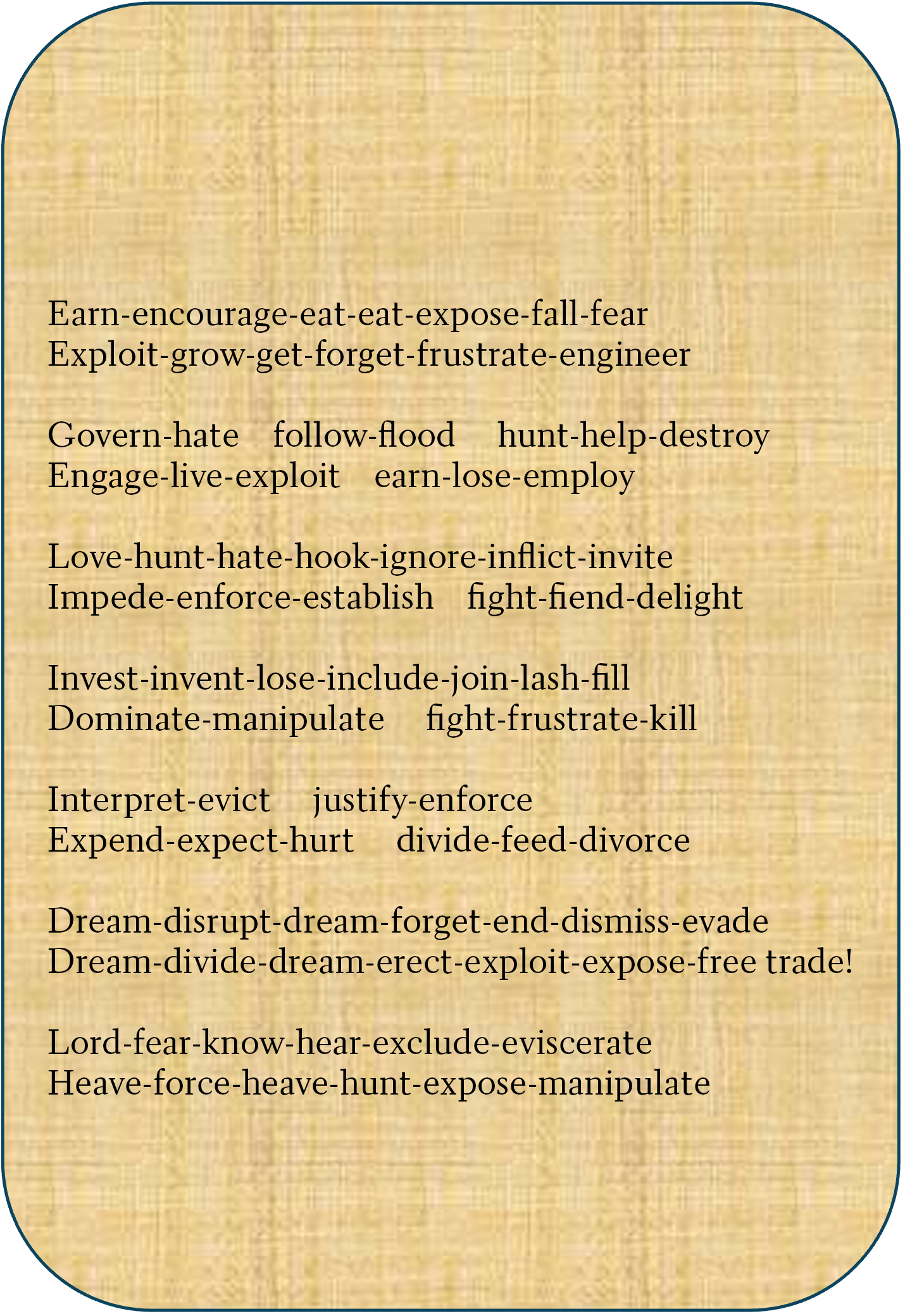
Copyright © 2026 by Daniel Borzutzky. Originally published in Poem-a-Day on July 24, 2026, by the Academy of American Poets.
With his two index fingers—“the eagle method,”
as one says in Korea—he broaches everything else:
the recent death of a Korean actress, lessons
from the life of a sportswear brand chairman.
Then, a turn: I don’t like to use the word “love.”
It never feels complete.
Away from him, me in my new country, everyone
and everything is in love: I love
your shoes, I love your hair, this, that, him, her.
When had my father and I said the word
to each other?
How many times had I, picking up his call,
ended it in a rush, bored, running
to declare love to my boyfriend?
My teenage passions, precious;
my father’s loneliness, not my responsibility.
My “wild goose father,” flying back and forth
to see a closed room, only petulance left
at the door, as I preened privately for nonexistent boys.
How easy it was to forget this man’s sensitivity,
his love for music, that he took saxophone lessons,
coming home to an unlit apartment.
A taciturn man, who sings alone.
Who, when years later asked
what instrument he likes listening to the most,
said, the human voice.
Copyright © 2026 by Emily Jungmin Yoon. Originally published in Poem-a-Day on July 28, 2026, by the Academy of American Poets.
The children are erasing
things again,
never doing it right—
I enter the room
to the sight
of their fists pressing
down on pencils,
heads bent over the page,
pushing too hard—
more smudge than blank.
We’re drawing you, they say
when I ask. If you put a pencil
on a table where
children draw
and write, what happens
to their mother? I
mistook
myself for her, letting
them erase me limb by limb
even as they sketched me
out again with each
and every cry,
Mama, mama, mine.
Last night I was reading
De Kooning’s biography—
the part where the author describes
how the artist felt
when Rauschenberg
asks him for a drawing
in order to erase it. To
let something go
because you love the fact of another’s
making more than you love
what you’d already made.
De Kooning said yes.
“It is no use worrying,” he wrote,
“about being related to something
it is impossible
not to be related to.”
Copyright © 2026 by Meghan O’Rourke. Originally published in Poem-a-Day on August 3, 2026, by the Academy of American Poets.
What if we got a gun? I whispered
from my pillow to you on yours.
I’m so against it in theory, I continued,
but in practice, & these days …
Then I burst, became
a wave of laughter, & you joined me.
We were a tidal giggle. & then I felt a huge
wobble, some cosmic shudders, perhaps from
a god with skin problems
unresolved from adolescence.
Unreleased from adolescence,
childhood, I saw how I was spiritually
still in uncomfortable overalls & overall over
none of it.
You too, it seemed, as what you
then said was, What if
I became a bodybuilder? You said,
you spoke this to me
at normal volume like it was regular info,
like we were at Planet Fitness or in Galaxy
Muscle, not in our bedroom, our bed.
What if, you said, I bodybuilt so good,
so Arnold, to the point of the world turning
totally unhomophobic? Not
a speck of homophobia left, not one
subatomic particle a miserable
homophobe, the whole damn globe,
amazing, right?
& I said, Or I could become a stronger
writer, more cutting
in my musings, more ferocious
in my music?
In bed, in response, you looked at me
fondly, probably the fondest
you’ve ever looked at me, & said, Baby.
You will. But how about we do both?
Both? I asked. Writing & bodybuilding?
Writing, you said, & the gun.
Copyright © 2026 by Chen Chen. Originally published in Poem-a-Day on August 4, 2026, by the Academy of American Poets.
If death is the absence of life, / then death’s death is life.
—Sun Ra
Gather your losses, oblong
& indiscriminate: avocado rot,
football, cracked soap dish;
dropped eggshells, embryo
gone. Gather mutilated joy.
Smelted promises. Aloft,
here & now. In open air.
Gather your heartbreak, wind-
ing & windowless. Animal
the shadow, lurking
at the edges
of your mouth.
Needle into a nest
your intricate sorrows.
Roost there. Gather
yourself. In a clearing—
Or gather your losses
like twin sheets, stripped
from a sick child’s bed.
I know I know it’s difficult
to face it alone.
To know you must
gather your darkness
or lose yourself to the animal
that thrives therein. To vanquish
your losses in daylight,
gather your life
by the scruff. Hold on
to what you can.
Copyright © 2026 by Marcus Wicker. Originally published in Poem-a-Day on August 11, 2026, by the Academy of American Poets.
I think Cliff Swallow sounds like the name
of a beige-clad mortgage broker who hangs
out at the bar and doesn’t talk politics, but
it’s a bird I’m reading about to keep my mind
from diving fast into the abyss. If someone asked
what changed me first, I’d say love. Secondly,
I’d say death. Does the order matter? When I took
to birds I thought I’d be destroyed by staring
at flying, twittering blurs, but what destroys me
is what always destroys me. A friend once said,
every elegy is a love poem and every love poem
is an elegy. But there must be a difference. Trying
once to identify swallows darting in and out
of the shadows above the creek water slick with
reflections of willows and white alders above us,
I asked a friend, What kind of swallows are those?
He squinted, and we all watched, the sky’s mirror
rippling in the shallow creek bed, the wet rocks
emerging like islands we might retire to when we
shrink into nothing. Fast ones, he said, turning,
and shrugged. So much for the naming. Instead
a pointing to the flitting minutes so they lasted,
until they didn’t. Then all of us leaned over
the railing and stared at the quickly thinning light
and all that the light contained, all of us calmly
unable to distinguish, to classify, but we could
show each other the whole view, practically
holding each other by the collar so no one
drowned, as we watched every last fast
flyer swoop, yes, we praised what lives and what
disappears, we made use of the end of the light.
Copyright © 2026 by Ada Limón. Originally published in Poem-a-Day on August 14, 2026, by the Academy of American Poets.
once again i’ve brought my dead dog to the party.
not the box of ashes, but the pen-drawn sketch
my friend lenny made six days after she died.
or five. i saw it coming, the way mimsy went.
the hard part was saying it, so i wrote it down:
something small i love is leaving me.
now it’s late morning in abiquiu & i’m alone
in the courtyard, rolling around on the flagstone
breathing, a drawing of mimsy in the shade,
a mug cooling at her side. i said i don’t drink coffee
or need a week to myself but look at me now, trying
not to lie. so i listen: a shrill of pinyon jays
in a juniper trills me from ghost to cobalt sky. all winter
i didn’t see them, not a single thrill of murmuration
& though it’s a hideous sound—a jay’s call, like a
small computer dying slow—to live, to move like that:
seven siblings at my side, six at each of theirs, my god!
not thinking where’s the threat but being
more than one, not less than any . . .
the nearly-noon shadows recede & soon
mimsy’s in full sun, where i leave her, the light
too bright to stay, the shrill too clear. i say yes,
i’ve seen a rock wren & no, that is a fishless osprey circling
the steppe & tomorrow i might make a cairn of quartz
just to knock it down, slip a stone into my pocket,
put nine postcards in the mail, or begin another poem
for lenny i’ll try to finish when i’m home—
you had a friend once.
now she’s different.
we remember what we need.
Copyright © 2026 by Kristin Lueke. Originally published in Poem-a-Day on August 27, 2026, by the Academy of American Poets.
translated from the Arabic by Tayseer Abu Odeh and Sherah Bloor
The woman in her wedding dress is not a poem, no
poem could outsmart her brother.
The women dancing in the wedding hall
are not poems either and neither is their father, stood
in the corner
gathering up the years of his life, year by year.
The mother feeds her children the day’s honey
with affection and a little cunning.
Just before the wedding this morning,
the women rushed to the market,
No poem is equal to a woman who’s decided
to move on
Her hand began to perspire in yours. That was
before the war.
War was waiting down the road. Then
a taxi tore past.
There was that midnight longing
the early days of love.
But be less poetic about it.
Your heart is going to break in new ways.
ﻛﻦ أﻗﻞ ﺑﻼﻏﺔ
ﻛﻦ أﻗﻞ ﺑﻼﻏﺔ
اﳌﺮأة في ﺛﻮب زﻓﺎﻓها ليست ﻗﺼﻴﺪة
...ﻻ ﺷﻌﺮ أﺟﻤﻞ ﻣﻦ أخ ﻳﻤﺴﻚ ﻳﺪ أﺧﺘﮫ اﻟﻌﺮوس ﻳﻮم اﻟﺰﻓﺎف
وﻻ اﻟﻔﺘﻴﺎت اﻟﻠﻮاتي ﻳﺮﻗﺼﻦ ﻛﻦّ ﻗﺼﺎﺋﺪ
وﻻ اﻷب اﻟﺬي ﻳﻘﻒ في زاوية اﻟﺼﺎﻟﺔ هناك
ﻳﻠﻤﻠﻢ ﺳﻨﻮات اﻟﻌﻤﺮ ﺳﻨﺔ، ﺳﻨﺔ... ا
اﻷم االتي ﺗﺮﺿﻊ أﻃﻔالها ﻋﺴﻞ اﻷﻳﺎم
ﻣﻦ ﻣﻜﺮ وﻋﺎﻃﻔﺔ
. ..وﻣﺎ ﻳﺠﺮي ﻗﺒﻞ اﻟﻌﺮس ﺳﺎﻋﺔ اﻟﻐﺪاء
ﻣﺸﺎوير اﻟﻔﺘﻴﺎت إلى اﻟﺴﻮق
عودتهنّ ﺑﺎﻟﻌﻄﺮ
واﻟﻔﺮح المستعجل في البيت
ﻻ ﺷﻌﺮ أﺟﻤﻞ ﻣﻦ اﻣﺮأة ﻗﺮرت أن تمضي
،شعرها خصرها
يدها التي تعرّقت بيديك
قبل الحرب
الشارع الذي احتضن خطواتكما الأولى
!...نحو ما لا تدريان
الخوف من المجهول الذي ينتظركما نهاية الشارع
اللهفة المستعجلة
Copyright © 2026 by Tariq Al-Arabi, translated by Tayseer Abu Odeh and Sherah Bloor. Originally published in Poem-a-Day on September 2, 2026, by the Academy of American Poets.
translated from the Spanish by Carmen Giménez and Dean Rader
The rage that shatters a man into children,
that shatters the child into identical birds,
and the bird, eventually, into tiny eggs;
the rage of the poor
bears one oil against two vinegars.
The rage that shatters the tree into leaves,
the leaf, into disparate buds,
and the bud, into telescopic folds;
the rage of the poor
holds two rivers against many seas.
The rage that shatters the good into doubts,
doubt, into three kindred arcs,
and then the arc into unexpected tombs;
the rage of the poor
wields one sword against two daggers.
The rage that shatters the soul into bodies,
the body, into dissimilar organs,
and the organ into eight-note thoughts
the rage of the poor
carries a core fire against two craters.
[La cólera que quiebra al hombre en niños,]
La cólera que quiebra al hombre en niños,
que quiebra al niño en pájaros iguales,
y al pájaro, después, en huevecillos;
la cólera del pobre
tiene un aceite contra dos vinagres.
La cólera que al árbol quiebra en hojas,
a la hoja, en botones desiguales,
y al botón, en ranuras telescópicas;
la cólera del pobre
tiene dos ríos contra muchos mares.
La cólera que quiebra al bien en dudas,
a la duda, en tres arcos semejantes,
y al arco, luego, en tumbas imprevistas;
la cólera del pobre
tiene un acero contra dos puñales.
La cólera que quiebra al alma en cuerpos,
al cuerpo, en órganos desemejantes,
y al órgano, en octavos pensamientos;
la cólera del pobre
tiene un fuego central contra dos cráteres.
Copyright © 2026 by César Vallejo, translated by Carmen Giménez and Dean Rader. Originally published in Poem-a-Day on September 3, 2026, by the Academy of American Poets.
I have forgotten precious things:
Wisdom in books, the words of lovers,
But not the shadow on the waters
Cast by a hidden sea-gulls’ wings.
I have forgotten many a pledge
Given and taken—fear and hunger
That once were knives—but not the pewter
Of olives from a mountain’s edge.
The tired brain gathers and lets go
Faces and cities, wars and weathers,
But keeps one sun as still as Joshua’s
On honey-bright unbroken snow.
This poem is in the public domain. Published in Poem-a-Day on September 6, 2026, by the Academy of American Poets.
translated from the Spanish by Idra Novey and Garth Greenwell
That was the most surprising thing
about writing in summer, there was
a slip of paper folded many times
in the urn of my head
and the trick was to know
how to unfold it carefully
avoiding any hullabaloo
that might tear it
while it spread out and out
until finally
fully revealed
it was impossible to take it all in.
Plegado
Eso fue lo más asombroso
de escribir en el verano, había
un papelito plegado muchas veces
en la urna de mi cabeza
y consistía la cosa
en saber desplegarlo con cuidado,
sin aspavientos
que pudiesen romperlo
mientras se descubría
más y más grande al punto
de que ya revelado
era imposible recorrerlo del todo.
Copyright © 2026 by Luis Muñoz, translated by Idra Novey and Garth Greenwell. Originally published in Poem-a-Day on September 8, 2026, by the Academy of American Poets.
translated from the Italian by Jamie McKendrick
To shelter at noon, pallid and rapt,
back against a scalding orchard wall;
to hear from in the thick of briars
blackbirds’ blatter, the slither of adders.
To spy how over the tares’ stalks, along cracks
in the earth, lines of red ants break
and close ranks, intertwine
atop miniature haystacks.
To observe through boughs the sea’s
distant shimmering of scales
while from bald heights the cicadas
unleash their tremulous calls.
Then emerging into the dazzling sun,
to feel, grimly amazed, how all
of life, its drudgery, is in
this slow trek hard by a wall
whose top is harled with jagged shards.
[Meriggiare pallido e assorto]
Meriggiare pallido e assorto
presso un rovente muro d’orto,
ascoltare tra i pruni e gli sterpi
schiocchi di merli, frusci di serpi.
Nelle crepe del suolo o su la veccia
spiar le file di rosse formiche
ch’ora si rompono ed ora s’intrecciano
a sommo di minuscole biche.
Osservare tra frondi il palpitare
lontano di scaglie di mare
mentre si levano tremuli scricchi
di cicale dai calvi picchi.
E andando nel sole che abbaglia
sentire con triste meraviglia
com’è tutta la vita e il suo travaglio
in questo seguitare una muraglia
che ha in cima cocci aguzzi di bottiglia.
Copyright © 2026 by Eugenio Montale, translated by Jamie McKendrick. Originally published in Poem-a-Day on September 9, 2026, by the Academy of American Poets.
translated from the French by Jane Draycott
—after Cent Balades, XIII
Imagine a boat sailing solo, just
the boat, no owner, no-one to steer.
This is hard. This is her.
The breeze may be with her
but she needs safe harbour—at sea
is a dangerous place to be.
So maybe the sun shines, the wind’s
kind, she’s making fine track
under moonlight, all it takes
is one storm, one risky encounter
to change everything—solo at sea
is a perilous, tough place to be.
Once death comes for her captain
a boat’s heart is filled with sorrow.
From the pitiful grief that follows
no-one’s immune: whatever you own,
even little boats sailing alone, out at sea
is a hazardous, hard place to be.
C’est fort chose
C’est fort chose qu’une nef se conduise,
Es fortunes de mer, a tout par elle,
Sanz maronnier ou patron qui la duise,
Et le voile soit au vent qui ventelle ;
Se sauvement a bon port tourne celle,
En verité c’est chose aventureuse ;
Car trop griefment est la mer perilleuse.
Et non obstant que parfois soleil luise,
Et que si droit s’en voit que ne chancelle,
Si qu’il semble que nul vent ne lui nuise,
Ne nul decours, ne la lune nouvelle,
Si est elle pourtant en grant barelle
De soubdain vent ou d’encontre encombreuse ;
Car trop griefment est la mer perilleuse.
Si est pitié, quant fault que mort destruise
Nul bon patron, ou meneur de nacelle ;
Et est bien droit que le cuer dueille et cuise.
Qui a tresor, marchandise ou vaisselle,
Ou seul vaissel qui par la mer brandelle :
N’est pas asseur, mais en voie doubteuse ;
Car trop griefment est la mer perilleuse.
Copyright © 2026 by Christine de Pisan, translated by Jane Draycott. Originally published in Poem-a-Day on September 24, 2026, by the Academy of American Poets.