
In the sixth grade, I read an anecdote about the child Hồ Xuân Hương that illustrates her innate talent for improvisation. One rainy day, while crossing the schoolyard, Hồ Xuân Hương accidentally slipped on a muddy spot and fell flat on her face. Seeing this, the other students loudly made fun of her. Unruffled, Hồ Xuân Hương got up, raised her arms toward the sky, and recited a câu đối, or “dialectical couplet” on the spot:
Raising my arms to gauge the height of the heavens
Spreading my legs to measure the span of the earth
As a child growing up in the disorienting period that preceded the 1975 collapse of South Vietnam, I loved this story about the defiant and quick-witted Hồ Xuân Hương, but did not fully grasp her nimble essence until years later. As a refugee, writer, and translator, I have come to appreciate Hồ Xuân Hương’s provocative mediation of opposites, which playfully straddles both the permissive and forbidden, cosmic and profane, mind and body, masculine and feminine, written and spoken. For over two hundred years, from the time of her purported death to the present day, the poet occupies a fluid spectrum in the Vietnamese imagination, both as an esteemed artist and a feisty outlier whose risqué poetry has often been conflated with her unofficial biography.
Take, for instance, this final couplet from Hồ Xuân Hương’s “Jackfruit,” a rather notorious poem translated by poet Marilyn Chin:
Dear prince, if you want me pierce me upon your stick
Don’t squeeze, I’ll ooze and stain your hands
Her official biography, on the other hand, suggests a refined upbringing. Her pen name, Hồ Xuân Hương (“Lake Spring Fragrance”), directly alludes to her birth name, Hồ Phi Mai, which signifies apricot blossoms fluttering over a lake and sending forth a soothing fragrance or essence (hương) in spring time. According to a handful of eminent Vietnamese scholars, who based their research on contemporaneous sources and family genealogies, Hồ Xuân Hương was born in 1772 in Ward Khán Xuân, Hà nội, to the mandarin Hồ Phi Diễn (1703–1786) and his young concubine with the surname Hà, and died in 1822. This fifty-year timeline places Hồ Xuân Hương squarely in the eventful period spanning the decadent end of the Lê Dynasty, the violent, short-lived Tây Sơn reign, and the early period of the Nguyễn Dynasty, marked by the stabilizing unification of north and south in 1802 by Emperor Gia Long, founder of Vietnam’s last imperial house.
Based on this biographical narrative, Hồ Xuân Hương came from a long line of illustrious and progressive forebears, and unlike most women of this period, was taught both Classical Chinese and Nôm—or the “southern script,” which modifies Chinese characters by using phono-semantic compounds to reflect Vietnamese tonal speech in written form.1
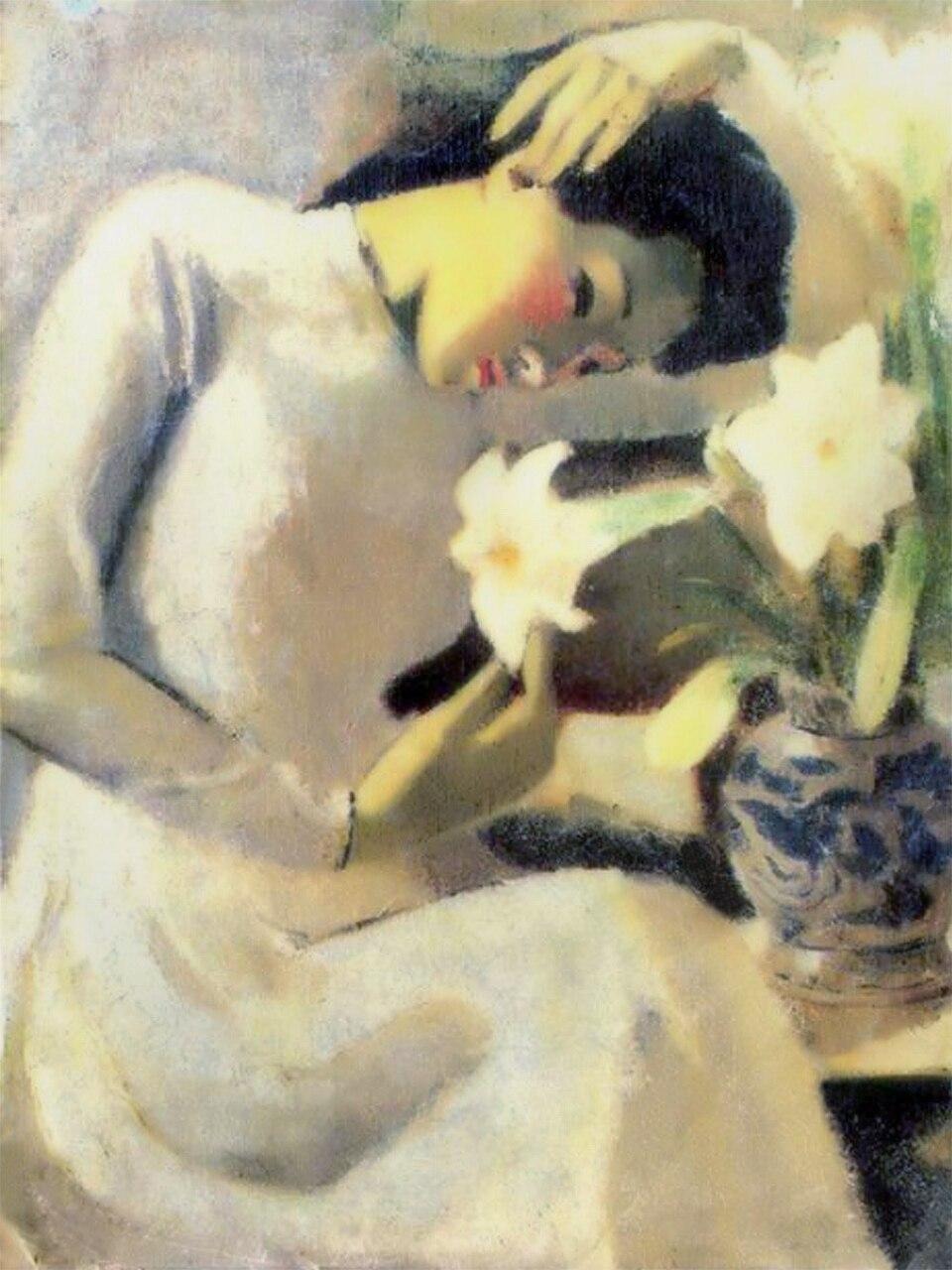
Tô Ngọc Vân (1906–1954), Young Woman with Lilies (1943). Oil on canvas, 60 x 45cm. This portrait, which fuses Vietnamese aesthetic influence with French modernism, brings to mind an elegant, proper Hồ Xuân Hương, who, in her friend Tốn Phong Thị’s words, possesses a “lively nature that knows how to contain itself within syntax and decorum.”
Hồ Xuân Hương resided at her small family home in Hà nội’s West Lake neighborhood, which she called Cổ Nguyệt Đường, a clever split of her surname, Hồ (胡), into two distinct Sino characters: Cổ (古—ancient) and Nguyệt (月—moon). She traveled to beautiful sites, wrote picturesque poetry, and engaged in poetic repartee with famous male poets of her time. In 1964, 142 years after her death, Lưu Hương Ký,2 a manuscript which contains twenty-four poems written in classical Chinese and twenty-eight in Nôm script, was discovered and attributed to Hồ Xuân Hương. This collection includes a foreword written in March 1814 by the scholar Tốn Phong Thị, a close friend and one-time romantic suitor, who describes Hồ Xuân Hương as “intellectually adept but modest and deferential.”3 Lamenting the scarcity of recorded writings by women in “a civilized nation with a rich cultural heritage,” he supports Hồ Xuân Hương’s wish to memorialize her art beyond live recitation or informal sharing among friends. In his words, Hồ Xuân Hương’s poetry is “brimming with clouds, mist, and moonlight, but conveyed with heartfelt words that resemble natural speech, revealing her lively nature that knows how to contain itself within syntax and decorum.”4
But alongside information considered more or less settled by a circle of respected scholars, there exists a wide array of speculations concerning Hồ Xuân Hương’s birth and death years, placing her timeline anywhere from 1735 to 1869, her multiple residences (Nghệ An, Hà nội, Hà Nam, Phú Thọ, Vĩnh Phúc, Quảng Ninh, Ninh Bình, and Thanh Hóa), ill-fated marriages and tempestuous dalliances with men of letters, prominent politicians, and undeserving louts. Legends about Hồ Xuân Hương persist due to Vietnam’s lack of institutional criteria on academic research, as well as the mythologization of her persona resulting from the provocative poetry generally attributed to her.5 Some critics even posit that there was never a flesh and blood Hồ Xuân Hương, but instead poetry created in the Hồ Xuân Hương tradition, replete with sexually explicit “drivel” penned by third-rate poets or failed scholars who impersonated her for their own commercial gains. Others counter, while this theory of profit-driven pornographers protects the social reputation of women artists, it rudely dismisses Hồ Xuân Hương’s literary genius6 .
Interestingly, while not explicitly challenging the authenticity of the late-discovered Lưu Hương Ký, many Vietnamese critics do not consider this “well-executed and wholesome” collection representative of Hồ Xuân Hương’s poetic gift. In this sense, “An Illustration of Two Beauties”—one of my translated poems—takes on a meta aspect; it’s as if Hồ Xuân Hương, and/or her liberal critics, chastise prudish scholars for disregarding the earthier, more pungent elements in her poetry. Thus those who prefer a “pure” or sanitized Hồ Xuân Hương are considered short-sighted for not appreciating the poet’s universally transgressive appeal. But even if we choose to embrace Hồ Xuân Hương’s “orally transmitted poetry” (thơ truyền tụng), circulated via the Nôm editions that emerged primarily from 1893 to 1922, hand-copied collections, and romanized Vietnamese texts—there has been no consensus on the number of poems attributed to Hồ Xuân Hương. Ranging anywhere from forty-six to 213, the poems have been grouped into two ever-shifting categories: (1) those that are widely circulated and “reliably” credited to her over time, and (2) “outlier” poems most likely authored by others due to their vulgar syntax, or vice versa, their “unusually refined” register.7
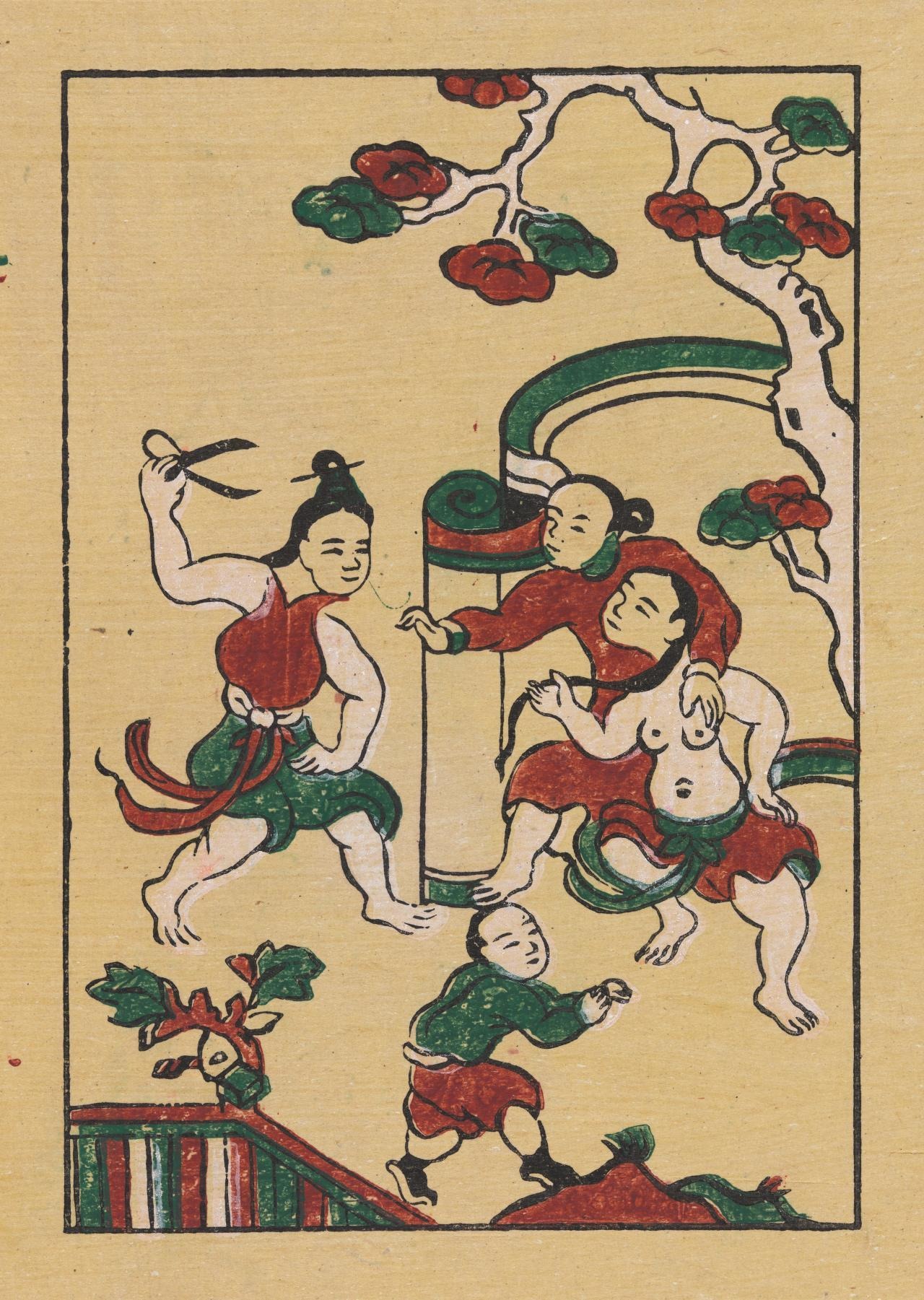
Jealousy Scene (Đánh ghen), folk woodcut painting (tranh khắc gỗ dân gian), from Đông Hồ village, Thuận Thành district, Bắc Ninh province, northern Vietnam, 25.5 × 18.3 cm (mid-twentieth century). Risqué poems attributed to Hồ Xuân Hương on the relations between men and women are often illustrated with Đông Hồ folk paintings. As a manual printing process, Đông Hồ techniques rely on a series of hand-carved woodblocks rather than on drawing pens or coloring brushes. Each specific color is applied by pressing a pigment-saturated block onto traditional điệp paper (i.e., handmade paper coated with crushed oyster shells) in a strict sequence, requiring perfect alignment to produce the final multi-layered image.
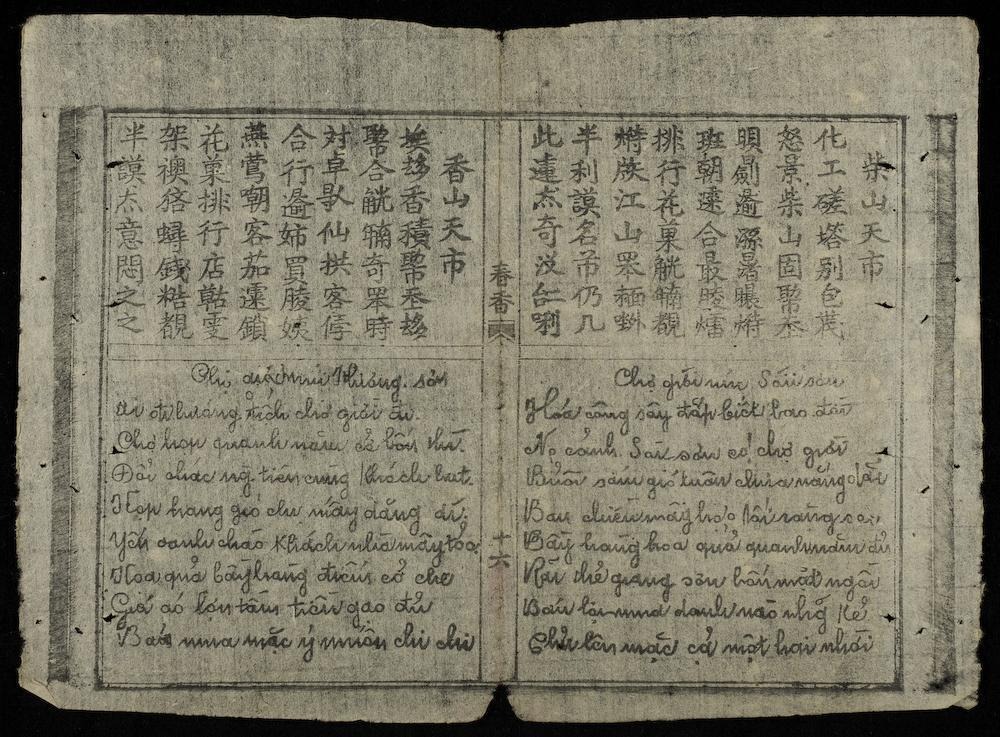
The uncertainty of authorship is further accentuated by nonstandard methods of transcription and critical annotation. During the late nineteenth and early twentieth centuries, Hồ Xuân Hương’s Nôm poetry, popularized by woodblock printing, was transcribed into the current romanized Vietnamese script by anonymous transcribers from different geographical regions of Vietnam. Their transcription methods were based on their subjective interpretations and tonal or regional pronunciations of Nôm characters, thus the various romanized versions transcribed from one Nôm poem could reflect a multitude of spelling variances and divergent meanings. In the past hundred years, subsequent editors of Hồ Xuân Hương poetry would add their modernizing touches and new biographical or textual speculations to the romanized versions, thus further complicating Hồ Xuân Hương’s legacy.
Nôm text and romanized transcription of “Chợ Giời Núi Sài Sơn” (“Open Market on Sài Sơn Mountain”) from the 1914 woodblock edition of Xuân Hương Di Cảo - Quốc Âm Thi Tuyển (Courtesy of The Vietnamese Nôm Preservation Foundation). An anonymous transcriber uses the northern spelling of “sky/heaven/open air,” rendering it as giời, instead of trời, the spelling normally used by a southern transcriber.
My translations strive to capture Hồ Xuân Hương’s organic multivalence, due to the inherent schism between reliable and unreliable authorship, as well as the inevitable gaps between Vietnamese and English. The five poems I selected, namely, “Quán Sứ Temple,” “Open Market on Sài Sơn Mountain,” “Drum Gorge,” “An Illustration of Two Beauties,” and “Husband-and-Wife Rock,” were widely disseminated in Vietnam before the 1964 discovery of Lưu Hương Ký, but are not quite like Hồ Xuân Hương’s typical double-entendre poems such as “Snail,” “Jackfruit,” and ‘Floating Cake” which have been rendered by previous translators. My translation approach does not wish to minimize Hồ Xuân Hương’s ribald gift—which is quite apparent in her associative wordplay and reverse puns in the original—but to convey both this aspect and her wry, meditative outlook that creates a haunting tension with eroticism.
For example, in “Drum Gorge,” while my translated line “Crossing the gorge, a woman looks back,” shifts the speaker’s voice into the third-person to convey her relief of having withstood parturition—as the idea of crossing a narrow gorge (vượt cạn) is a well-known Vietnamese idiom for surviving childbirth—the line in Vietnamese can also be understood as a woman’s postcoital command or warning to her male partner. Specifically, if we read this line aloud in Vietnamese and omit the comma between cửa and mình, it becomes cửa mình, “female genitalia.” Qua cửa mình ơi nên ngắm lại therefore means “Darling, let’s take another look at my vagina and consider what you’ve done!”
Similarly, in “Quán Sứ Temple,” while the English translation of the ending couplet seems mostly rueful:
The head monk had set his sail toward the Western Paradise
But the monsoon wind upturned his good ship.
The original exults in pornographic wordplay:
Buồm từ cũng rắp sang Tây Trúc,
Gió vật cho nên phải lộn lèo
The word buồm (“sail”) in Vietnamese is phonetically close to the northern Vietnamese slang buồi (“penis”). The compound verb lộn lèo is an example of nói lái—a reversal of lẹo lồn (“vagina leaning”). Thus, the ending couplet can also be rendered as follows:
His erect conviction seeks the Ultimate Truth,
But his vagina leaning way does him in.
My English translation establishes a temporal sequence for the “straight” reading: the head monk had meant to set his sail toward the Western Paradise, but the monsoon, occurring after his resolve, capsized his ship. Vietnamese, on the other hand, does not have conjugated verb tenses; therefore, in Hồ Xuân Hương’s version, this hapless monk is eternally split between his spiritual and sexual longings.
When possible, I have included geographical information on specific locations evoked in the poems. The various sites depicted in these poems suggest Hồ Xuân Hương’s mobility, her lively interest in the natural world, and her social milieu.
1 Vietnam was colonized by China for over a thousand years (111 BC–938 AD). As a result, the official written language was Classical Chinese (chữ Nho). During the tenth century, Vietnamese scholars adapted the Chinese script to create chữ Nôm. When Roman Catholic missionaries arrived in Vietnam during the seventeenth century, they developed a new writing system based on the Latin alphabet called chữ Quốc Ngữ (the national language), used in conjunction with Nôm until the early twentieth century. Today, Quốc Ngữ is the only script used for writing Vietnamese.
2 As a direct reference to Hồ Xuân Hương, Lưu Hương Ký can be translated as Preserved Essence, or Collected Writings by Hương.
3 Tốn Phong Thị’s foreword, originally written in Classical Chinese, was translated into Vietnamese by scholar Trần Thanh Mại, who announced his discovery of Lưu Hương Ký in Tạp chí Văn học, no. 11 (1964), published by Viện Văn học (Institute of Literature, Hà nội), cited in Dương Thượng Ngã’s Hồ Xuân Hương (Làng Văn Press, 1988), 17. My rendering of Tốn Phong Thị’s foreword is based on Trần Thanh Mại’s Vietnamese translation, reprinted in Dương Thượng Ngã’s Hồ Xuân Hương, 150–53.
4 According to Nguyễn Ngọc Bích, in Hồ Xuân Hương Tác Phẩm (Hồ Xuân Hương’s Literary Corpus) (Cành Nam Publisher, 2000), at 25, 255, Tốn Phong Thị’s foreword also appears in Du Hương Tích Động Ký (Travel Notes on Huong Tich Cavern) housed at The Sino-Vietnamese Library (Thư viện Hán-Nôm), Hà nội. While there is a Nôm poem attributed to Hồ Xuân Hương titled “Hương Tích Cavern” (“Vịnh Động Hương Tích”), Nguyễn Ngọc Bích does not mention whether Du Hương Tích Động Ký was authored by Hồ Xuân Hương.
5 Nguyễn Hữu Sơn, “Biên độ những đối nghịch tác giả, văn bản và nghệ thuật trữ tình thơ Nôm Hồ Xuân Hương” (“The Range of Contradictions: Author, Text, and Lyricism in Hồ Xuân Hương’s Nôm Poems”), Tạp chí Khoa học Xã hội Việt Nam no. 3 (2023): 122–23.
6 Dương Thượng Ngã, 11–13.
7 Nguyễn Hữu Sơn, 124-126.