
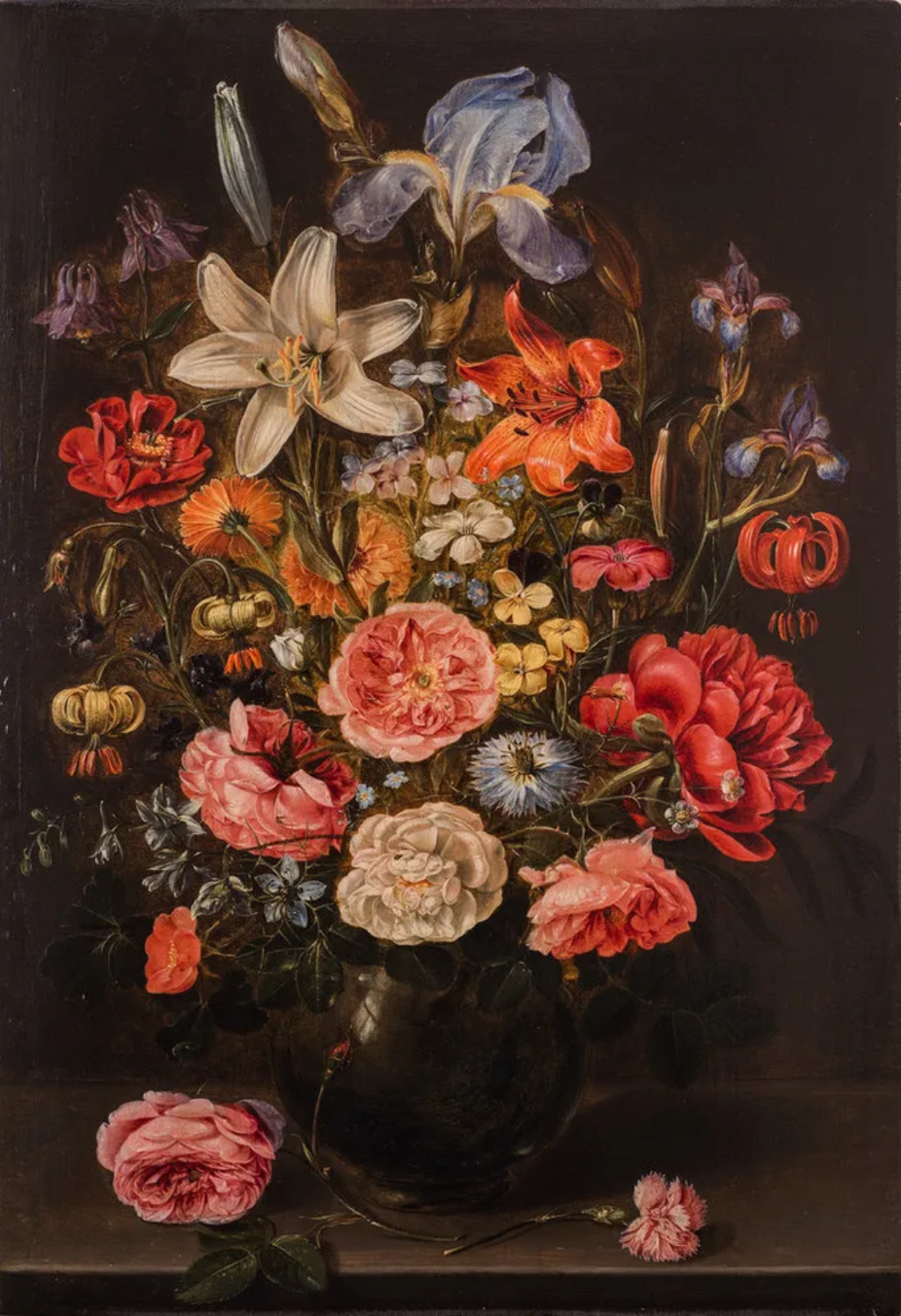
Look closely at the painting Still Life of Lilies, Roses, Irises, Pansies, Columbine, Love-in-a-Mist, Larkspur, and Other Flowers in a Glass Vase on a Table Top, Flanked by a Rose and a Carnation by Clara Peeters.
The following activities and questions are designed to help your students use their noticing skills to move through the poem and develop their thinking skills so they understand its meaning with confidence, using what they’ve noticed as evidence for their interpretations. Read more about the framework upon which these activities are based.
-
Warm-up: Look closely at the painting Still Life of Lilies, Roses, Irises, Pansies, Columbine, Love-in-a-Mist, Larkspur, and Other Flowers in a Glass Vase on a Table Top, Flanked by a Rose and a Carnation by Clara Peeters. What stands out to you in this still life? Why? Look again. What questions, if any, do you have? What emotions does this piece evoke?
-
Before Reading the Poem: Listen to the Song “My Old Man” by Mac DeMarco. What words or lyrics stand out to you? Why? What emotions does this piece evoke, and how do they compare or contrast to the painting?
-
Reading the Poem: Silently read the poem “Looking at My Father” by Wendy Xu. What do you notice about the poem? Note any words or phrases that stand out to you or any questions you might have.
-
Listening to the Poem: Enlist two volunteers and listen as the poem is read aloud twice. Write down any additional words and phrases that stand out to you. You may enjoy listening to the poet reading the poem.
-
Small Group Discussion: Share what you noticed about the poem with a small group. Based on the details you just shared with your small group, how does this poem compare to the resources from the beginning of class? How would you describe the relationship between the father and the speaker? Why?
-
Whole Class Discussion: Read the poem again with and without the final word, “amen.” Why might the final word in the poem be “amen,” and how does this impact the poem? How might the poem be different without this word? Enjambment means the continuation of a sentence or clause across a poetic line break. What do you notice about enjambment in the poem?
-
Extension for Grades 7-8: Write your own poem about someone that is important to you, reflecting on how this person has impacted you. Share your poem with your classmates.
- Extension for Grades 9-12: (Teachers, look at poems by Wendy Xu or other poets and reformat them in prose form without any line breaks to help students practice thinking about the poetic line. It might be interesting to have students all look at the same poem or series of poems. This works best if you are able to print out the poems.) With a partner, choose a poem from your teacher. Read and annotate the poem, thinking about what stands out to you and why. Then, rewrite the poem with lines and line breaks. Share your newly formatted poem with the class and discuss what choices you made. Then, read the published poem. How is this different from your work? What does this exercise teach us about the poetic line? Why might some poets choose to break the line or use enjambment?
“In the end, our connection to the past is more than a personal connection; it places us within a lifeline that extends before and beyond us, it places and holds us between the wings of something vast and eternal.” Read more from “The Bond of Living Things: Poems of Ancestry” by Toi Derricotte.
The line is a fundamental unit in verse, carrying meaning both horizontally across the page and vertically from one line to the next.