
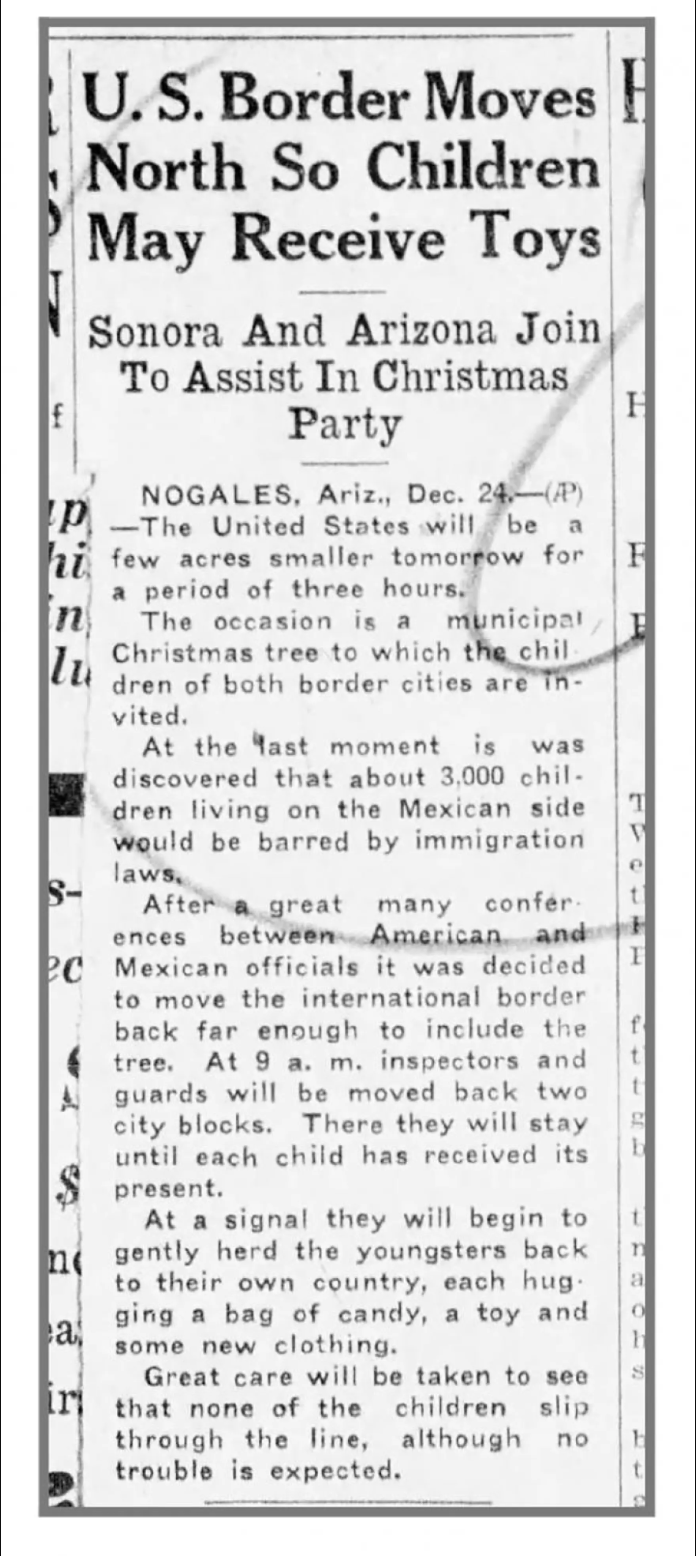
Look closely at this image of a newspaper clipping about an event.
The following activities and questions are designed to help your students use their noticing skills to move through the poem and develop their thinking skills so they understand its meaning with confidence, using what they’ve noticed as evidence for their interpretations. Read more about the framework upon which these activities are based.
-
Warm-up: What are the first three words that come to mind when you hear the word border? Write each word down on a separate sheet of paper and give these to your teacher. (Teachers, you may want to take a moment to preview the words before sharing.) Look closely at the words that people shared. What do you notice? What patterns emerged in people’s responses? What do these patterns reveal?
-
Before Reading the Poem: Look closely at this image of a newspaper clipping about an event. Take time to closely read the story. What stands out to you about this story? Why? What questions do you have?
-
Reading the Poem: Silently read the poem “Christmas on the Border, 1929” by Alberto Ríos. What do you notice about the poem? Note any words or phrases that stand out to you or any questions you might have.
-
Listening to the Poem: Enlist two volunteers and listen as the poem is read aloud twice. Write down any additional words and phrases that stand out to you. You may enjoy listening to the poet reading the poem.
-
Small Group Discussion: Share what you noticed about the poem with a small group. How would you describe the events in “Christmas on the Border, 1929”? Based on the details you just shared with your group, how does this poem compare to the resources from the beginning of class? What do you make of the lines, “For a few transcendent hours, / the border moved” and “[...] for one day, there was no border”?
-
Whole Class Discussion: How does this poem tell the story of Nogales, Arizona? In particular, which images in this poem stand out? Why?
-
Extension for Grades 7-8: Write a poem from the point of view of the border. In your mind, what is a border? What might the border think and feel about this Christmas Day and the days that follow?
-
Extension for Grades 9-12: How is this poem similar to or different from the newspaper article you read at the beginning of class? How does poetry offer a unique perspective? Write your own narrative poem that explores a real event. (Here are some examples you can use for inspiration.) Use sensory details and imagery to make your poem come alive.
“Longer lines keep us in the moment, and out of the prose or story of the page. The story will take care of itself, and can claim the whole page, after all. The moment has only itself.” Read more about narrative’s relationship to the line with “Some Thoughts on the Integrity of the Single Line in Poetry” by Alberto Ríos.
Point of view is the perspective or viewpoint of the speaker in a poem.