


To be a good
ex/current friend for R. To be one last
inspired way to get back at R. To be relationship
advice for L. To be advice
for my mother. To be a more comfortable
hospital bed for my mother. To be
no more hospital beds. To be, in my spare time,
America for my uncle, who wants to be China
for me. To be a country of trafficless roads
& a sports car for my aunt, who likes to go
fast. To be a cyclone
of laughter when my parents say
their new coworker is like that, they can tell
because he wears pink socks, see, you don’t, so you can’t,
can’t be one of them. To be the one
my parents raised me to be—
a season from the planet
of planet-sized storms.
To be a backpack of PB&J & every
thing I know, for my brothers, who are becoming
their own storms. To be, for me, nobody,
homebody, body in bed watching TV. To go 2D
& be a painting, an amateur’s hilltop & stars,
simple decoration for the new apartment
with you. To be close, J.,
to everything that is close to you—
blue blanket, red cup, green shoes
with pink laces.
To be the blue & the red.
The green, the hot pink.
From When I Grow Up I Want to Be a List of Further Possibilities. Copyright © 2016 by Chen Chen. Used by permission of The Permissions Company, Inc., on behalf of BOA Editions, Ltd., www.boaeditions.org.
I’m Nobody! Who are you?
Are you – Nobody – too?
Then there’s a pair of us!
Don’t tell! they’d advertise – you know!
How dreary – to be – Somebody!
How public – like a Frog –
To tell one’s name – the livelong June –
To an admiring Bog!
Poetry used by permission of the publishers and the Trustees of Amherst College from The Poems of Emily Dickinson, Ralph W. Franklin ed., Cambridge, Mass.: The Belknap Press of Harvard University Press. Copyright © 1998 by the President and Fellows of Harvard College. Copyright © 1951, 1955, 1979 by the President and Fellows of Harvard College.
Things got terribly ugly incredibly quickly
Things got ugly embarrassingly quickly
actually Things got ugly unbelievably quickly
honestly Things got ugly seemingly infrequently
initially Things got ugly ironically usually
awfully carefully Things got ugly unsuccessfully
occasionally Things got ugly mostly painstakingly
quietly seemingly Things got ugly beautifully
infrequently Things got ugly sadly especially
frequently unfortunately Things got ugly
increasingly obviously Things got ugly suddenly
embarrassingly forcefully Things got really ugly
regularly truly quickly Things got really incredibly
ugly Things will get less ugly inevitably hopefully
Copyright © 2019 by Terrance Hayes. Used with the permission of the poet.
with design by Anthony Cody
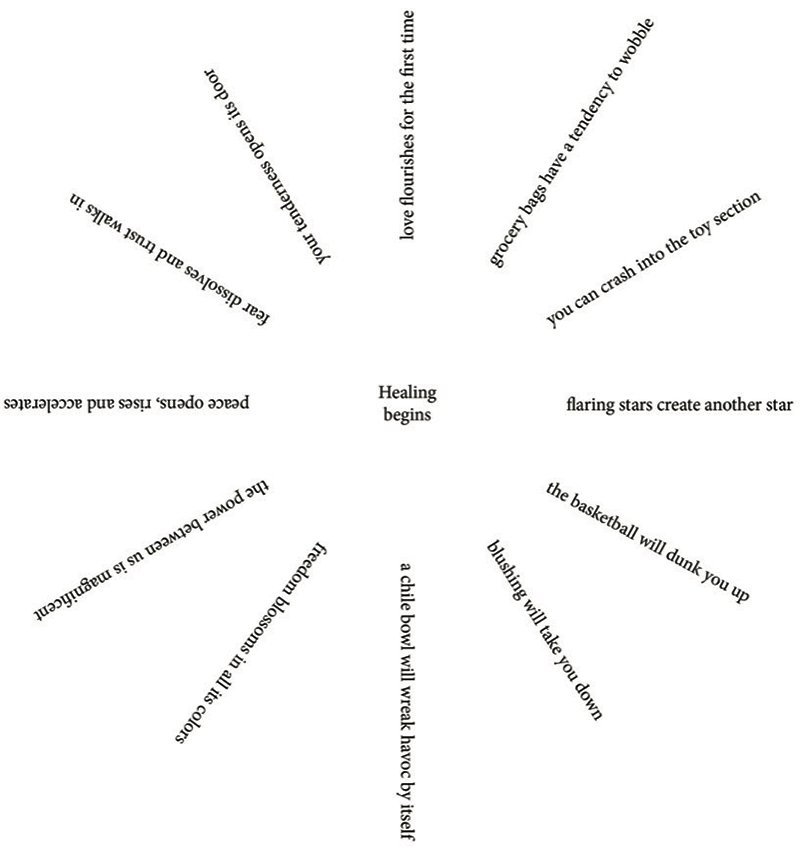
Copyright © 2020 by Juan Felipe Herrera. Design by Anthony Cody. Originally published with the Shelter in Poems initiative on poets.org.
As he holds his wife’s hand, the nurse tells him to
breathe. He will be a good father. He
could be. His wife tows a boat on land with her teeth.
Don’t worry. Good father. Breathe. Later,
everyone smiles when he jogs with the stroller. He
feigns interest in ponies. He pushes a swing and his daughter
giggles. He applies sunblock, and
helps warm the bottle, and he is
inducted into the fatherly hall of fame. He
jumps on the trampoline, and the chorus sings Good Father. He wipes
ketchup off her cheek at the zoo, and the old women
laud. He is told he is a new breed of
man. Evolved. His knuckles just barely or
never scraping the ground. He hugs
often enough, packs her lunch, and the crowd
pours on the applause. He lays her down for
quiet time. It goes somewhat well.
Rejoice, the people shout, for here is a
saint, as he lifts diapers to the conveyor belt.
Truthfully, he feels slightly
unwell. A bowl of plastic fruit is pretty, but
vaguely toxic. He sleeps fine
without a mouth affixed to his chest. His bottle of
Xanax is half full. The nurse says,
You will be a good father. He jogs with the stroller. He reaches the
zenith of a very small hill.
Copyright © 2024 by Keith Leonard. Originally published in Poem-a-Day on March 4, 2024, by the Academy of American Poets.
Copyright © 2016 by Craig Santos Perez. “Thirteen Ways of Looking at a Glacier” originally appeared in Newsletter of the Comparative Literature Association of the Republic of China. Reprinted with permission of the author.
What is home:
it is the shade of trees on my way to school
before they were uprooted.
It is my grandparents’ black-and-white wedding
photo before the walls crumbled.
It is my uncle’s prayer rug, where dozens of ants
slept on wintry nights, before it was looted and
put in a museum.
It is the oven my mother used to bake bread and
roast chicken before a bomb reduced our house
to ashes.
It is the café where I watched football matches
and played—
My child stops me: Can a four-letter word hold
all of these?
From Things You May Find Hidden in My Ear by Mosab Abu Toha. Copyright © 2022 by Mosab Abu Toha. Reprinted with the permission of The Permissions Company, LLC, on behalf of City Lights Publishers.
The seed is a wound in the form of a little girl buried alive. Buried inside me the sol de la terre. What do I remember of last night’s dream, that the children were painting a mural that spread beyond the surface of the wall. There was a blue spirit a benevolent ghost with no eyes that hung over the children like a cloud reaching out its arms. Did the image fatigue me? I was fatigued by everything. There were space chairs facing the walls and I kept falling asleep.
Cry at my library carrel. Cry when I step off the bus. A crystal-clear sky over midtown and I no longer have the energy (will?) to masticate subjective experience. Wrote nothing about the breakup. It’s as though nothing actually happens to me.
I wanted a quiet life—to keep the casket. They don’t even notice I’m half-here, while the other half lives in the crypt. Go down to the grotto with your headlamp and crowbar. Release the girl lost and afraid. I’m not here. No one touches her. Reserve a little for myself. To self-witness. But what’s become of my mind there is no world. What did I want to say to him—that there’s a crypt-shaped seed I show to no one: it is my fate. The impossibility of making a day, leaking one’s soul for want of an angel. The night was forever. And pearls of light rained down on me I lost myself in the lonely expedition toward the center of everything I would become: nothing there’s no time but love was a thing hanging in the air at night when I’d stalk the streets with my heart in my mouth.
Bury my heart in the haute mer. Find me not I’ve flushed it to spare myself the humiliation of being seen. She’s nowhere to be found or maybe there’s a casket bobbing on the ocean with a note inside that says, “The secret to survival is to disappear.”
Copyright © 2024 by Jackie Wang. Originally published in Poem-a-Day on September 27, 2024, by the Academy of American Poets.
imagine a tulip, upon seeing a garden full of tulips, sheds its petals in disgust, prays some bee will bring its pollen to a rose bush. imagine shadows longing for a room with light in every direction. you look in the mirror & see a man you refuse to love. small child sleeping near Clorox, dreaming of soap suds & milk, if no one has told you, you are a beautiful & lovable & black & enough & so—you pretty you—am i.
From Don’t Call Us Dead (Graywolf Press, 2017). Copyright © 2017 by Danez Smith. Used by permission of The Permissions Company, Inc., on behalf of Graywolf Press, www.graywolfpress.org.
Sometimes you don’t die
when you’re supposed to
& now I have a choice
repair a world or build
a new one inside my body
a white door opens
into a place queerly brimming
gold light so velvet-gold
it is like the world
hasn’t happened
when I call out
all my friends are there
everyone we love
is still alive gathered
at the lakeside
like constellations
my honeyed kin
honeyed light
beneath the sky
a garden blue stalks
white buds the moon’s
marble glow the fire
distant & flickering
the body whole bright-
winged brimming
with the hours
of the day beautiful
nameless planet. Oh
friends, my friends—
bloom how you must, wild
until we are free.
Copyright © 2018 by Cameron Awkward-Rich. Originally published in Poem-a-Day on August 30, 2018, by the Academy of American Poets.