
Altadena Chimneys
Homesteads in ashes
Fire Next Time rode mountain winds
Proud chimneys still stand
This was the first poem I wrote after the Eaton Fire that began on January 7, 2025. I wrote it fifteen days after the fire broke out, on January 22, out of complete necessity. At the time, I was Altadena Poet Laureate Editor-in-Chief for a two-year appointment that began in May 2024 and ended in April 2026. During that time, Sehba Sarwar was Altadena Poet Laureate for Community Events. I have been a poet for over sixty years and continue to enjoy a forty-year investment banking career in public finance.
There are times when poetry and public finance overlap. January twenty-second was one of those times. The State of California is one of my oldest and best clients. California State Treasurer Fiona Ma appeared in the fire zone for a press conference and to help distribute survival gear to fire victims. About thirty minutes before the press conference began, we were chatting via text. I reminded her that I was the Poet Laureate of Altadena. Immediately, she asked if I would read a poem at the end of the press conference. There was only one answer to that question and one problem: I had no fire poem. During the twenty-minute drive to Club 1881 in Pasadena I wrote the haiku “Altadena Chimneys.” I was not kidding myself that I had time for a longer poem. Even a fourteen-line sonnet was beyond my reach. Just before I read, the owner of the 1881 spoke of how she had lost three homes on her homestead to the fire. She said there was nothing left except the chimneys and concluded, “Those proud chimneys were still standing.” This inspired the last line and last-minute revisions to the poem I had just composed while driving. Originally, the poem was:
Christmas trees come down
Mountain winds bring restless sleep
Fire next time has come
It was without a title; but for twenty minutes of work, it was serviceable. I parked. Before exiting the car, I quickly composed it in my small notebook, which is always in my back pocket. The changes I made while listening to the speaker gave me not only a better poem but also the title for my fourth book of poetry: Altadena Chimneys: New and Selected Poems. Before reading the poem, I brazenly acknowledged my “Grand Theft Poetry” and thanked the previous owner.
Altadena was founded by the Woodbury brothers in 1887. It remains an unincorporated area of Los Angeles County. The founding is the only event in Altadena’s history more consequential than the Eaton Fire that claimed nineteen lives and destroyed nearly 9,500 structures. Devastation is not a strong enough word. As this is written, more than seventy percent of our residents have not returned. Seemingly overnight, a new diaspora (as one poet applied the term) was created. Altadenans, wanting to or planning to return, have dispersed—not only throughout Southern California but nationwide. Unlike too many homes on our block, ours was not burned; but because of smoke damage, my wife and I were displaced to a five-hundred-square foot apartment in Pasadena for ten months.
I thought, at seventy-seven, the best of my poetry was behind me, and the future would hold diminishing output. Then the Eaton Fire erupted with its unfathomable winds of one hundred miles per hour. After evacuating, I returned the next day to fight fires in my neighbor’s and my backyards with shovels and dirt (there was no water pressure). The poetry began to take hold and has not stopped. It has allowed me to review and record my experiences during and after the fire.
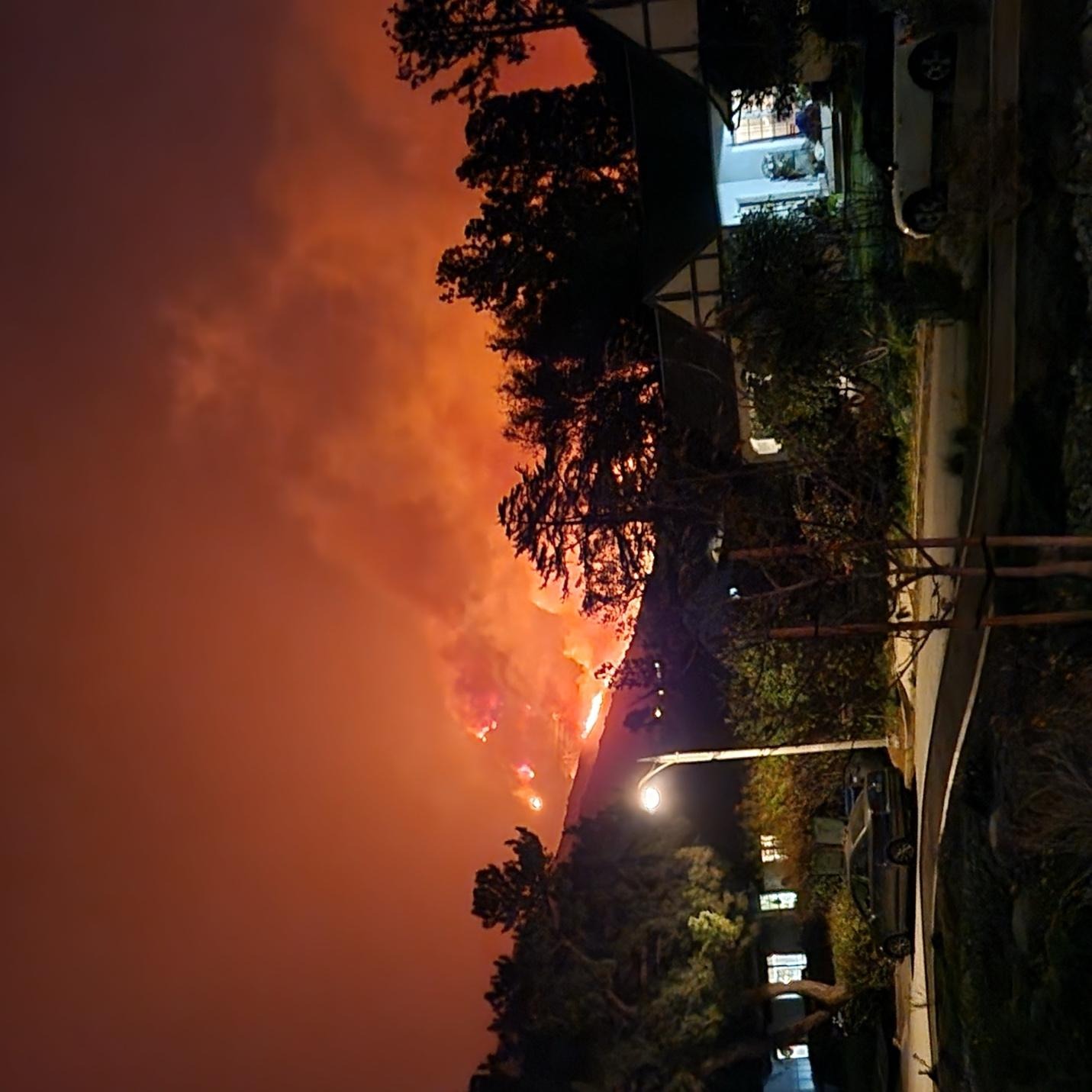
I took this picture from our front porch minutes before we left:
This is the poem I wrote, recalling our evacuation:
Time to Go
It’s time to go, flames over the ridge, it’s
time. Fire app says be ready. Flames say it’s time.
Bags are full. Both cars waiting filled with bags.
Record albums, hundreds, not one record
taken. Books, thousands, only four are taken,
poems: Yeats, Neruda, Hughes, Whitman.
Power still on. Streetlights haunt. Why is there power?
Friends see TV flames, text “Don’t stay! Leave!” Friends
say, “Come here. We’re safe. We have room,” they say.
Pictures, so many to lose, take three pictures:
our wedding pose, our daughter sleeping, our
home crowned by sunset. Now fire crowns lost homesteads.
Return: Last word we pack. Will we return?
Return: Will choking ashes greet return?
Return: Will neighbors say they won’t return?
Return: Will scorched deer die before return?
Return: Knowing fire always will return?
Return: Flames will not say if we return.
We stayed in our friend’s house for two weeks. That night and the next morning were dominated by news coverage of the fire, and we continually strained to locate our neighborhood. “Information” and well-intentioned hearsay were flying. The best way for me to relieve the tension was to try and find a way back to our neighborhood. This is the poem describing that journey.
Damn!
Damn! I’ve been waiting too damned long, twelve damn
hours since fire forced us to leave, twelve hours.
TV filled with loss, growing. Too much TV!
Chuck group texts KIM’S HOUSE BURNING! I don’t trust Chuck.
I wait as long as I can before I
say, “Fuck it!” Have to see if our house stays.
Morning quest up Lake Street, dark soot-filled morning.
Smoke has claimed new dominion. We live by smoke’s
restrictions. No sheriff’s cars mean no restrictions.
Flaming at right, Aldi’s roof is floor flaming.
Fox’s Café sign is all that’s left. Wild fox’s
burned carcass now road marker. All is burning.
Turning right on Palm, chimneys mark loss. Turning
left, half my street in ashes, some homes left.
“Oh My God!” I scream, “It is still there! Oh
My God,” to no particular god, my
home of thirty-two years is still our home.
Damn, we are so damned lucky. Oh, God Damn!
When I stood in my front yard and looked across our street to the same place I had photographed the previous night, this is what I saw.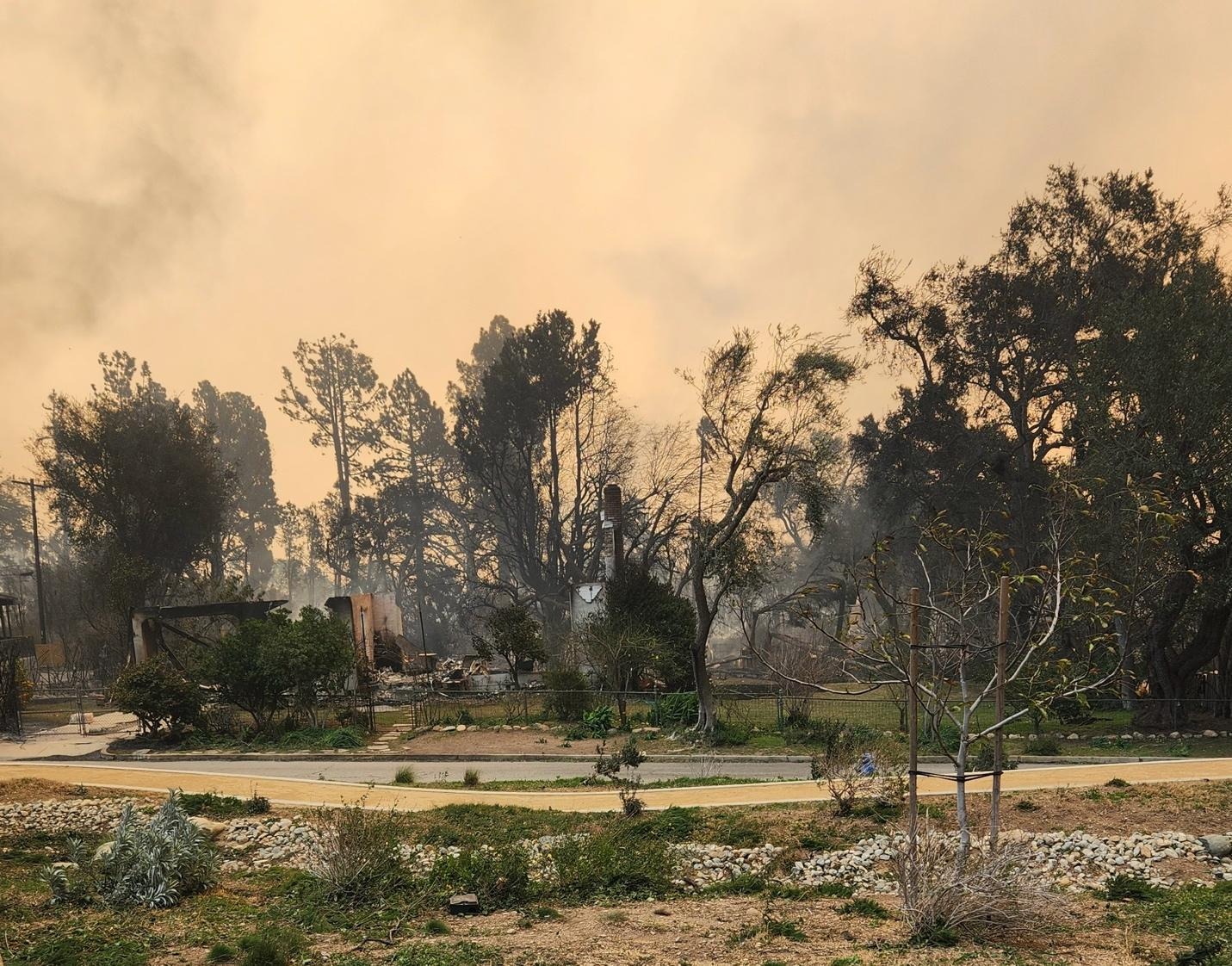
Our neighbor’s house was gone. We have been friends for over thirty years. Our children grew up together, sharing the same childcare provider at their house. The place where we had our last Christmas dinner was gone. Nothing I did in the first weeks after the fire was as hard as calling and telling my friend that his house was gone. This is the poem I wrote about that experience.
Your House Is Gone
“Your house is gone.” How do you say it? “Your
house is gone.” You call your friend say, “Your house
is gone.” No, you can’t start with, “Your house is
gone.” Start, “I am so sorry. It is gone.”
Cry? Yes, you do for him. He does not cry.
He asks, “Is the garage there?” No, it’s not. He
asks, “Are front walls there?” No. That’s all he asks.
“I am so sorry, your house is gone.” Eyes
staring at what is no longer there, staring
where he will stare when coming to see where
ruins now rule his home, collapsed in ruins.
Trees, black and wind-whipped, bend like weeping trees.
Chimney left reaching skyward like charred chimney
surviving night-bombed church to preach survival.
Disasters, personal and/or communal, require the best of poets, demand that poets be poets. From tragedy we must find the pathway to renewal. Poetry is one way of outlining that pathway. This is the closing poem from the Fire section of my next book.
Altadena Yes
Electric saws whine
Homes rebuild to hammers’ beat
Hummingbirds feeding