Each year, the Academy of American Poets invites a prominent poet to deliver the Blaney Lecture on contemporary poetry and poetics. The series gives readers a chance to hear how poets make their work. One lecturer traced the beginnings of a book to a collection of nineteenth-century photographs. Another recalled having three weeks to write three poems for a presidential inauguration.
Early Blaney Lectures were part of the Academy’s Poets Forum in New York City. Since then, audiences have gathered for the series at The New School and the Solomon R. Guggenheim Museum and have joined lectures online. The archive brings together recordings dating back to 2010, along with lecture texts and excerpts.
Past lecturers include Kaveh Akbar, Elizabeth Alexander, Richard Blanco, Anne Carson, Carolyn Forché, Joy Harjo, Terrance Hayes, Jane Hirshfield, Susan Howe, Adrian Matejka, Sharon Olds, Alicia Ostriker, Claudia Rankine, Paisley Rekdal, Patricia Smith, and John Yau.
The Academy of American Poets’ programs are made possible in part by the New York City Department of Cultural Affairs and the New York State Council on the Arts, with the support of the Office of the Governor and the New York State Legislature.
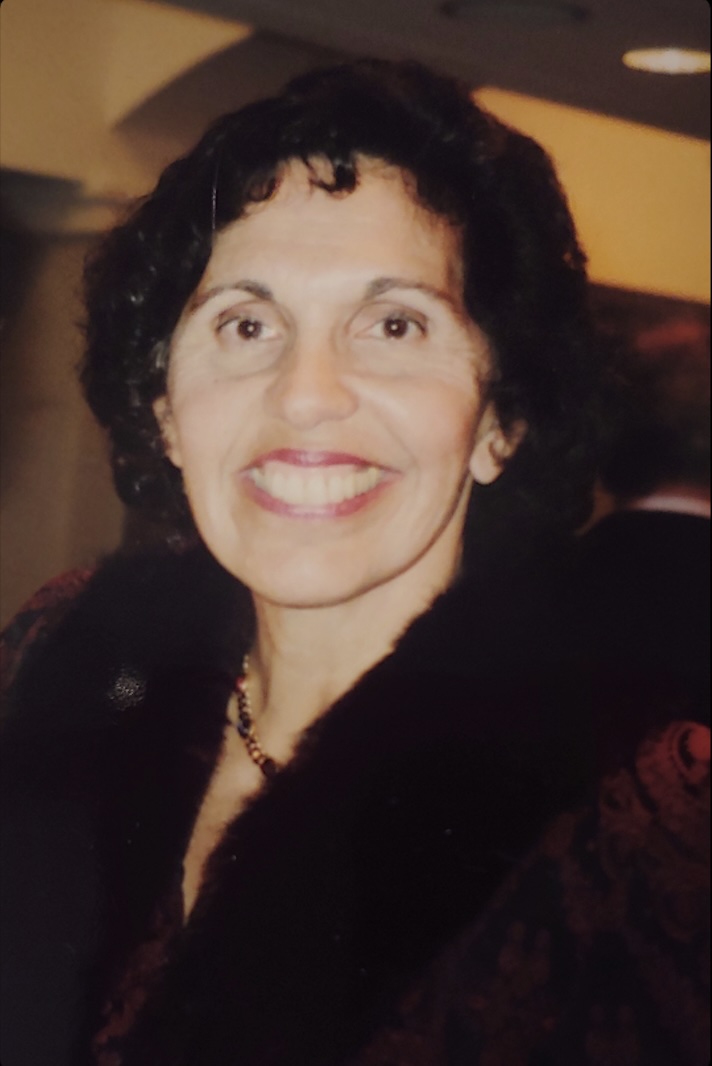
Dr. Dorothy Gulbenkian Blaney
A gift from Dr. Dorothy Gulbenkian Blaney’s estate established the lecture in her memory. A member of the Academy’s board, Blaney championed women’s education as president of Cedar Crest College. She taught English at the State University of New York at Albany and wrote Infinite Possibilities: A Personal View of a Changing World, with photographs by David Finn.
Blaney Lecture Archive
Select a poet to go directly to their lecture.
- Kaveh Akbar (2025)
- Elizabeth Alexander (2012)
- Richard Blanco (2014)
- Anne Carson (2010)
- Carolyn Forché (2013)
- Joy Harjo (2015)
- Terrance Hayes (2019)
- Jane Hirshfield (2024)
- Susan Howe (2011)
- Adrian Matejka (2020–21)
- Sharon Olds (2016)
- Alicia Ostriker (2018)
- Claudia Rankine (2017)
- Paisley Rekdal (2022)
- Patricia Smith (2023)
- John Yau (2026)
John Yau, Poetry, Movies, and Identity, 2026
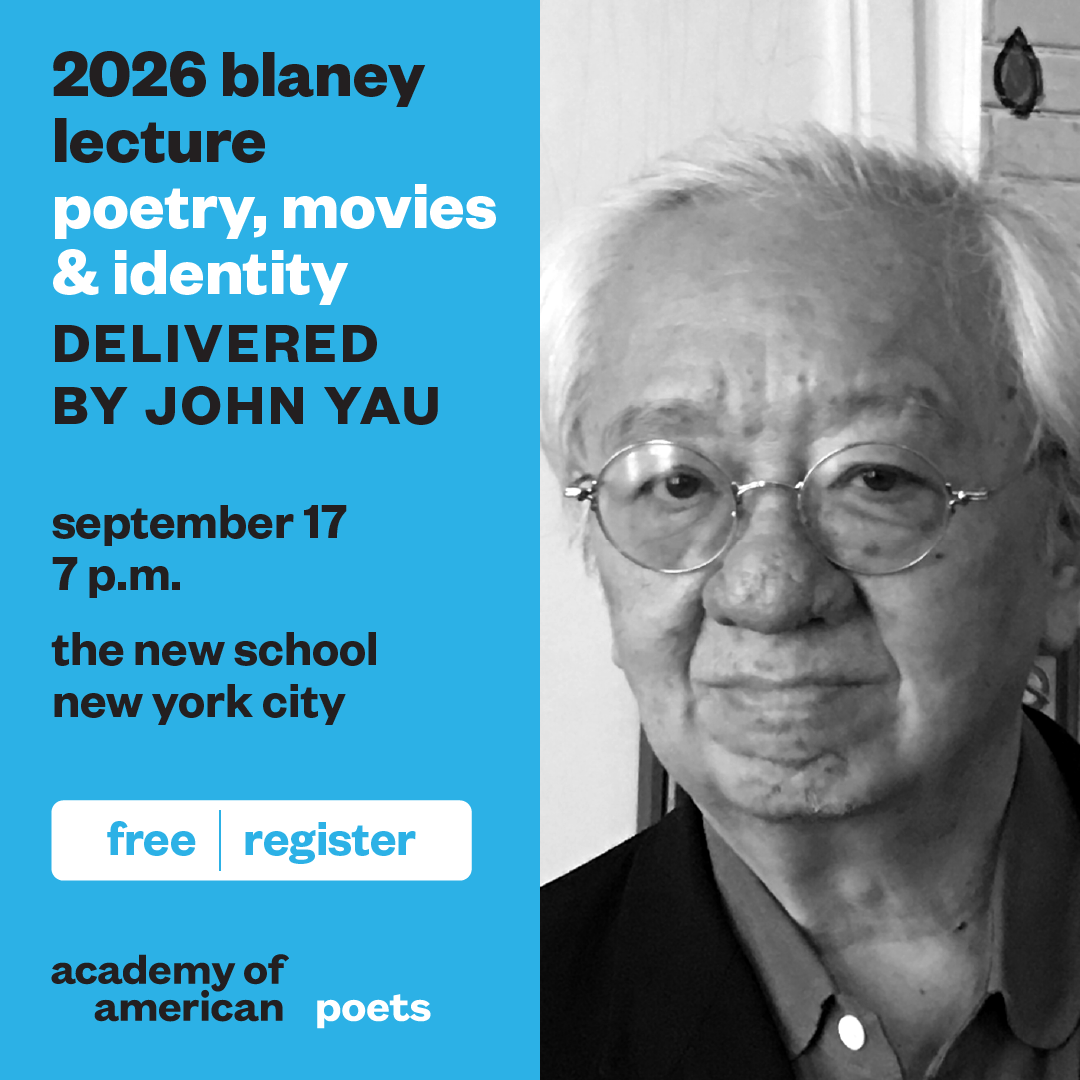
On September 17, 2026, John Yau delivered “Poetry, Movies, and Identity” at The New School in New York City. Yau, a poet, art critic, and writer, considered what happens when the worlds of poetry and film meet.
More about the lecture and John Yau
Boris Karloff played between 170 and 200 characters in a career that spanned five decades, including Frankenstein, Dr. Fu Manchu, the aging horror film star Byron Orlok, and the voice of the Grinch and narrator in the classic animated film How the Grinch Stole Christmas (1966). In his poem “Ave Maria,” Frank O’Hara characterized movies as “some glamorous country.” French New Wave director Jean-Luc Godard famously connected photography, cinema, and ideas of truth. Yet no Chinese actor ever played Dr. Fu Manchu, while Asian American actors frequently appeared in secondary roles.
Drawing these histories together, Yau explores their collisions in poetry and film. What is the relationship between the aesthetic and the ethical? How can poets and artists connect the two without becoming didactic?
About John Yau
John Yau is a poet, art critic, fiction writer, and publisher. He has published numerous books of poetry, most recently Diary of Small Discontents: New & Selected Poems, 1974–2024 (Omnidawn, 2025). His books of art criticism include The Passionate Spectator: Essays on Art and Poetry (University of Michigan Press, 2006). He has also published a novel and edited Fetish (Four Walls Eight Windows, 1998), an anthology of fiction.
Yau is the recipient of numerous honors, including the Lavan Award from the Academy of American Poets and the Jackson Poetry Prize, as well as fellowships from the National Endowment for the Arts and the Ingram-Merrill Foundation and grants from the John Simon Guggenheim Memorial Foundation.
Yau has taught and served as a visiting writer and critic at institutions including Pratt Institute, the Maryland Institute College of Art, the School of Visual Arts, Brown University, and the University of California, Berkeley. From 2006 to 2011, he was the arts editor of The Brooklyn Rail. He founded the nonprofit press Black Square Editions and cofounded the online magazine Hyperallergic. Yau is professor emeritus at Rutgers University and lives in Beacon, New York.
Kaveh Akbar, Poetry and Spirituality, 2025
About Kaveh Akbar’s lecture
As a child, Akbar learned to recite prayers in Arabic. He returns to that early experience of language to consider what a poem and a prayer can ask of a listener. For Akbar, the time it takes to attend to a difficult phrase is part of what makes poetry an answer to the empty phrases that make it easier to look away.
Jane Hirshfield, Making the Invisible Visible: Some Thoughts on Poetry & Science, 2024
About Jane Hirshfield’s lecture
What counts as seeing something? Hirshfield shares a letter from physicist Saul Perlmutter about how exploding stars helped scientists detect dark energy. She also follows her curiosity about the little word “huh” to a grammatical term for surprise. Both discoveries give her a way to think about what a poem can bring into view.
Patricia Smith, The Scrawny Little Black Girl with the Hasty Pigtails Sounds Out ‘Anemone,’ 2023
About Patricia Smith’s lecture
For more than twenty years, Smith collected nineteenth-century photographs, eventually concentrating on portraits of Black Americans. At a Cave Canem workshop, she gave each writer a photograph and asked what the person in it might say. Smith describes how that exercise helped her find the form of Unshuttered, her book of portraits paired with persona poems.
Paisley Rekdal, Beyond Empathy, Beyond the Archive: Notes on Poetic Representation, 2022
About Paisley Rekdal’s lecture
News footage of the fall of Kabul reminds Rekdal’s father of Saigon. For Rekdal, it also brings back watching the first Gulf War on television as a college student. She asks what a poet owes to the historical record when a poem can move a reader so deeply that it feels like firsthand experience.
Adrian Matejka, Let’s Stay Together: Notes About Black Poetry & Community, 2020–21
About Adrian Matejka’s lecture
Matejka remembers walking into a circle of nearly sixty Black poets at a Cave Canem retreat outside Detroit in 2002. Some he recognized from their book jackets. Recalling that first meeting on the occasion of Cave Canem’s twenty-fifth anniversary, he considers how Black poets have built places to learn from one another when literary institutions overlooked their work.
Terrance Hayes, Survey of an American Century, 2019
About Terrance Hayes’s lecture
Hayes delivers his survey as a succession of questions. He asks whether American poetry begins with Walt Whitman and Emily Dickinson, then asks his listeners how many poems they know by heart and whether they carry any on their phones. Hayes gave this 2019 installment of the series on February 13, 2020, at New York University’s Lillian Vernon Creative Writers House.
Alicia Ostriker, Containing Multitude: Poetry and the City, 2018
About Alicia Ostriker’s lecture
Ostriker gave this lecture on poetry and city life at New York University’s Lillian Vernon Creative Writers House while serving as New York State Poet. A companion to the talk is her poem “Waiting for the Light,” addressed to Frank O’Hara. It finds the speaker on a New York street corner in the small interval before the traffic signal changes.
Claudia Rankine, 2017
About Claudia Rankine’s lecture
At the Solomon R. Guggenheim Museum, Rankine opens with Paul Celan, then turns to Walt Whitman, Gertrude Stein, and Allen Ginsberg. She asks how the history of racism enters the work of white American poets and what a reader can learn from the places where that history goes unspoken.
Sharon Olds, Favorite Moments in Poems from Chaucer to Clifton, 2016
About Sharon Olds’s lecture
At The New School, Olds reads from poems that mattered to her own development as a poet. Her choices span centuries, from Geoffrey Chaucer to Lucille Clifton. She lingers over the moments in individual poems that stayed with her. In a separate Academy interview, Olds remembers being eight years old when a teacher first asked whether she had written her poem herself.
Joy Harjo, Ancestors: A Mapping of Indigenous Poetry & Poets, 2015
About Joy Harjo’s lecture
Harjo begins in Manhattan by acknowledging the Lenape people who cared for the island. She remembers an earlier visit to New York when she first heard Jayne Cortez perform. In Cortez’s phrasing, Harjo recognized a connection between the poetry on a printed page and the sung and spoken poetry of her own Mvskoke traditions.
Richard Blanco, On Becoming A Presidential Inaugural Poet, 2014
About Richard Blanco’s lecture
Asked to write for President Barack Obama’s second inauguration, Blanco had three weeks to produce three poems. He recalls the pressure of addressing the whole country and what the invitation meant to him as a gay man and the son of exiles. The question of whose story counts as American became a personal one as he prepared to speak for the nation.
Carolyn Forché, Not Persuasion, But Transport: The Poetry of Witness, 2013
About Carolyn Forché’s lecture
In Tripoli in 2012, Forché saw posters for a poetry reading pasted over bullet holes. On the night of the reading, the crowd overflowed the rows of folding chairs. She places that gathering alongside her work editing Against Forgetting to ask how a reader can recognize the marks that war, imprisonment, and exile leave on a poem.
Elizabeth Alexander, Rethinking Lucille Clifton, 2012
About Elizabeth Alexander’s lecture
Alexander devoted her 2012 Poets Forum lecture to Lucille Clifton. In “Remembering Lucille Clifton,” a remembrance she wrote two years earlier, Alexander describes Clifton writing at the kitchen table while raising six children. She considers how much history, grief, and humor Clifton could hold in a poem of only a few lines.
Susan Howe, The Whispered Rush, Telepathy of Archives, 2011
About Susan Howe’s lecture
Howe brings the research library into the lecture hall through images of Emily Dickinson’s fragments and William Carlos Williams’s manuscripts for Paterson. She sets these alongside her own Frolic Architecture and considers what changes when a reader encounters a manuscript on a screen.
Anne Carson, 2010
Anne Carson delivered the Blaney Lecture on October 29, 2010, at the Academy of American Poets’ Poets Forum in New York City. The Philoctetes Center hosted the lecture.
About Anne Carson’s lecture
At a gallery opening in Berlin, Carson saw a visitor punch an artist in the nose and accuse him of selling out. The charge led her back to Homer and a hero with a talent for turning gifts into profit. In the Odyssey, even the disguises give Odysseus away. When he needs a cover story, he sometimes makes himself a salesman. Carson asks how close he comes to selling out and what his affection for Penelope has to do with the bargain.
Read an excerpt from Anne Carson’s lecture
By Anne Carson. Originally published by the Academy of American Poets on November 29, 2010.
I was in Berlin a while ago, and I went to an art opening of a very famous, very celebrated, very wealthy American artist. And we were all there milling around, looking at the art, drinking wine, chatting. A man came in from the street, made his way through the crowd, stood in front of the artist and engaged him in conversation for a few moments, and then hauled off and socked him in the nose, yelling, “You sell-out!”
So, I began to get interested in this concept of “the sell-out.” What does it mean to be a sell-out nowadays? Because most of us sell pretty much anything, pretty much all the time. What’s the difference between mere “selling” and “selling out?” It seems to be a very thin border, and yet one that we’re intuitively aware of all the time. So, anyway, I was pondering these things, and, more pertinently, since I’m a classicist and I like to trace everything back to Homer, I was wondering if the ancient Greeks had this concept of the sell-out and this concern for the very thin border.
I did some research, and, sure enough, Homer turns out to be the very first artist in our tradition, the Western tradition, to build a work of art around the question, “What is a sellout?” and to perch his hero on that very thin border. The work, of course, would be The Odyssey, and the hero, Odysseus, who, I’m going to argue, is a person who comes very close to selling out, and then at the last moment transcends himself and his own materialism, and is saved by the power of true love.
*
In theory then, Odysseus does not wander the world for ten years racking up stuff out of motives of avarice or greed. He brings precious things home in order to store them as treasure or give them away as gifts. Nonetheless, as any astute reader of The Odyssey will observe, Odysseus’s own economic practice differs somewhat from this theory. It’s true he inhabits an economic order where the parameters are set and the rules are clear, yet he does like to test that very thin border. More than any other hero of ancient epic, Odysseus seems to enjoy gaming the gift exchange system for all its worth, and sometimes takes a lenient attitude toward that pesky distinction between honorable and dishonorable profit.
There is a certain irony in his tendency, whenever he’s in a tight spot and needs a fake identity, to pass himself off as a commercial salesman. What saves Odysseus from tragedy is, on the one hand, his economic attitude—this combination of gamesmanship and irony that Homer sums up by saying, “Odysseus is one who knows profit”—and on the other hand, the fact that he genuinely likes his wife. In fact, I think this may be two sides of one coin.