
Stanzas [How like a star you rose upon my life,]
How like a star you rose upon my life,
Shedding fair radiance o’er my darkened hour!
At your uprise swift fled the turbid strife
Of grief and fear,—so mighty was your power!
And I must weep that you now disappear,
Casting eclipse upon my cheerless night—
My heaven deserting for another sphere,
Shedding elsewhere your aye-regretted light.
An Hesperus no more to gild my eve,
You glad the morning of another heart;
And my fond soul must mutely learn to grieve,
While thus from every joy it swells apart.
Yet I may worship still those gentle beams,
Though not on me they shed their silver rain;
And thought of you may linger in my dreams,
And Memory pour balm upon my pain.
This poem is in the public domain. Published in Poem-a-Day on December 27, 2025, by the Academy of American Poets.
“Stanzas” [How like a star you rose upon my life,] was published in The Keepsake (1839) under the pseudonym of “By the Author of Frankenstein.” In their introductions to Shelley’s poems, the editors of Mary Shelley’s “Literary Lives” and Other Writings (Routledge, 2002), scholars Clarissa Campbell Orr and Lisa Vargo, write, “Here the lost one is compared to a star, an image that held particular significance to Mary Shelley.” They continue, “The Hesperus image used in [Shelley’s poem] ‘The Choice’ reappears. However, while these considerations might suggest that the addressee is the soul of [Percy Bysshe] Shelley, grief and fear were not particularly ascendant in Mary Godwin’s life when he rose upon it in 1814. That the eclipsed star is said to be now gladdening another heart (instead of irradiating the universe or the world beyond) suggests transference of affections rather than separation through death. While the addressee is said to have brought joy and gentle light to the speaker’s dark and turbid existence, there is no actual mention of love. The addressee could even be a personified abstraction, such as the imagination.”
Mary Shelley
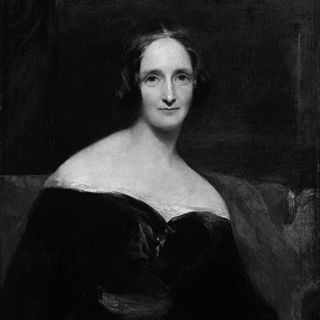
Mary Wollstonecraft Shelley, born Mary Godwin on August 30, 1797, in London, England, was a Romantic-era writer best known for her novel Frankenstein; or, The Modern Prometheus (Lackington, Hughes, Harding, Mavor & Jones, 1818), often credited as the first true science- fiction novel. In addition to producing her own literary works, Shelley was instrumental in publishing the works of her late husband, Percy Bysshe Shelley.