
Mr. Pope
When Alexander Pope strolled in the city
Strict was the glint of pearl and gold sedans.
Ladies leaned out, more out of fear than pity
For Pope’s tight back was rather a goat’s than man’s.
Often one thinks the urn should have more bones
Than skeletons provide for speedy dust,
The urn gets hollow, cobwebs brittle as stones
Weave to the funeral shell a frivolous rust.
And he who dribbled couplets like a snake
Coiled to a lithe precision in the sun,
Is missing. The jar is empty; you may break
It only to find that Mr. Pope is gone.
What requisitions of a verity
Prompted the wit and rage between his teeth
One cannot say. Around a crooked tree
A moral climbs whose name should be a wreath.
This poem is in the public domain. Published in Poem-a-Day on May 31, 2026, by the Academy of American Poets.
“Mr. Pope” is the titular poem of Allen Tate’s first collection, Mr. Pope and Other Poems (Minton, Balch & Company, 1928). In his book Allen Tate and the Augustinian Imagination: A Study of the Poetry (Louisiana State University Press, 1983), Robert S. Dupree, a distinguished professor emeritus at the University of Dallas, writes, “‘Mr. Pope’ acts as a balancing assertion of the role of the poet. [Tate] is concerned in ‘Mr. Pope’ with more than a world of art, removed from both space and time in its ideal existence. He is concerned about the health of the human community. The poem is about the quest of the artist to overcome the paralysis of the imagination in a world given over to radically dissociated notions of space, time, and history.” He continues, “[Alexander] Pope stands in Tate’s volume for something irrecoverable; his bones can never be retrieved from the urn. He was a poet in a time of crisis who was still very much a part of his society, however difficult his position in it. He was the last poet, Tate suggests, who could draw on a whole tradition for his vision.”
Allen Tate
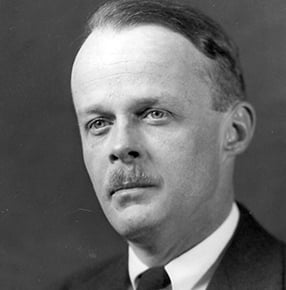
Poet Allen Tate was a founding editor of The Fugitive and had a great influence as a critic and a mentor to younger poets.