
To the Here and Now
translated from the Arabic by Khaled Mattawa
for Najib Elhassadi on the road to the airport at the moment he turns to look back.
Be kind to your foolish lovers
with their naïve infatuation.
We are your children,
newly descended from
the meagre shelters of myth.
We count you on our fingers,
pain by pain.
Be kind to our faded clothes
in the span of your burning summer.
Be kind to us,
worshippers of the here and now
as you weave the garments
of your coming womb,
and grant your crooked palm trees
to the obscure horizon.
And as you spill the faces
of friends on the quay’s pavement,
be kind to our faces, caught deep
into your blistering winds.
Be kind to us.
Of your treasures, our only share
is the asphalt that drags us
to the airport’s clamor.
To you we offer
this laughter passed around
behind the darkness of our hearts,
these empty pockets billowing
far from the orchards
of your sweet dates,
and our dry lips which you push off
to nursemaids made of paper.
And you have us—
we have none but you.
We curse the elegance
of distant cities and return
to your elegant ruin.
None but you,
we settle in you,
full of sleeplessness,
and we sleep
to the scent of cloves
on your miserly breasts.
Copyright © 2026 by Salem Al-Okaly. Originally published in Poem-a-Day on February 27, 2026, by the Academy of American Poets.
“The figure turning back in the poem, Najib Elhassadi, was one of Libya’s most gifted intellectuals—a professor of philosophy who, in 2001, left Libya to teach in the United Arab Emirates. Before his departure, he had spent many years at the University of Benghazi, working under the shadow of the Qaddafi regime. Nonetheless, he managed to publish numerous monographs of his own work and translations of modern philosophy. The voice of the poem addresses the homeland directly while bidding farewell to his friend. Speaking on behalf of those who stayed, he articulates a sense of abandonment and devotion to a nation, a harsh yet beloved mother—one that has long mistreated her children and driven them away. Despite poverty, heat, and neglect, the speakers insist, ‘We are yours / And none but you.’ Even as they curse ‘the elegance of distant cities,’ they return to the homeland’s ‘elegant ruin.’ Elhassadi did return to Libya after a few years away. He died in July 2025 of lung cancer. Najib was also a dear friend of mine, as he was to Salem. I translated the poem to celebrate the intellectual companionship their friendship fostered, the moral clarity and steadfast generosity it engendered, benefiting all those who knew them.”
—Khaled Mattawa
Salem Al-Okaly
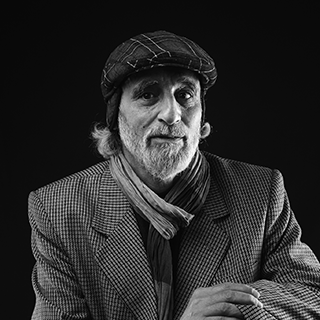
Salem Al-Okaly, born in Al-Qayqab, Libya, in 1960, is the author of several volumes of poetry and fiction. In addition to his literary work, Al-Okaly is a prominent cultural activist. He currently serves as the director of the House of Culture in Derna, Libya.