
For Asopichos of Orchomenos, Winner in the Boys’ Short Foot-Race
translated from the ancient Greek by Ernest Myers
O ye who haunt the land of goodly steeds that drinketh of Kephisos’ waters, lusty Orchomenos’ queens renowned in song, O Graces, guardians of the Minyai’s ancient race, hearken, for unto you I pray. For by your gift come unto men all pleasant things and sweet, and the wisdom of a man and his beauty, and the splendour of his fame. Yea even gods without the Graces’ aid rule never at feast or dance; but these have charge of all things done in heaven, and beside Pythian Apollo of the golden bow they have set their thrones, and worship the eternal majesty of the Olympian Father.
O lady Aglaia, and thou Euphrosyne, lover of song, children of the mightiest of the gods, listen and hear, and thou Thalia delighting in sweet sounds, and look down upon this triumphal company, moving with light step under happy fate. In Lydian mood of melody concerning Asopichos am I come hither to sing, for that through thee, Aglaia, in the Olympic games the Minyai’s home is winner. Fly, Echo, to Persephone’s dark-walled home, and to his father bear the noble tidings, that seeing him thou mayest speak to him of his son, saying that for his father’s honour in Pisa’s famous valley he hath crowned his boyish hair with garlands from the glorious games.
This poem is in the public domain. Published in Poem-a-Day on February 22, 2026, by the Academy of American Poets.
Ernest Myers’s translation, “For Asopichos of Orchomenos, Winner in the Boys’ Short Foot-Race,” was published in The Extant Odes of Pindar (Macmillan & Company, 1874) as part of the “Olympian Odes.” In his introduction to the collection, Meyer writes, “Of Pindar as a poet it is hard indeed to speak adequately, and almost as hard to speak briefly. [...] To say that to his poetry in supreme degree belong the qualities of force, of vividness, [...] of a mastery of rhythm and metre and imaginative diction, of a profoundly Hellenic spirit modified by an unmistakable individuality, above all of a certain sweep and swiftness as of the flight of an eagle’s wing—to say all this would be to suggest some of the most obvious features of these triumphal odes; and each of these qualities, and many more requiring exacter delineation, might be illustrated with numberless instances which even in the faint image of a translation would furnish ample testimony.” In his note to the poem, he continues, “This ode was to be sung, probably by a chorus of boys, at the winner’s city Orchomenos, and most likely in the temple of the three Graces, Aglaia, Euphrosyne and Thalia. The date of the victory is B.C. 476.”
Pindar
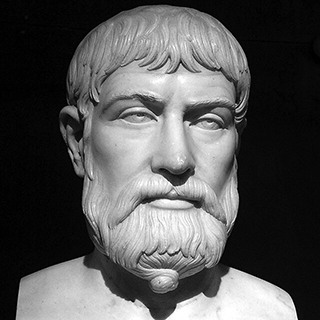
Only a handful of details are known about the life of Pindar. He was born around 518 BC in Cynoscephalae, near Thebes, to an aristocratic family. As a young man, he received a formal education in music and poetry, likely studying in Athens. Evidence suggests that, in 497 or 496, Pindar won at least one dithyrambic victory at the Great Dionysia.