
After the Work Is Done
I can tell you that some things vanish
without ceremony—a town can lose its name
and keep the post office, or keep the name
and lose the rest. There still marks a point
on the map where it began, but the work’s long done;
the road grown over with bleeding hearts and alder.
You can walk there. The gravel crunches
under the phantom buzz of chainsaws, and fog
licks at the gridded hillside like an old debt.
Each stump is a headstone,
a biography in every ring. You think you see
a form in the mist—a thrashing elk, or a bobcat
or the shape of work that once
held the valley upright. Every road here
leads to another road that stops
at a locked gate, a washout,
a view of nothing but cloud.
Acceptance lives somewhere past that.
They say the forest heals, some say faster
than the heart—Scotch broom,
thistle, the thin gray line of runoff
that feeds the river in winter.
If there’s holiness in this, it’s in the rot,
the glacial comeback of what was taken.
Once I dreamed the salmon spoke
in a tongue I almost understood—
a language of loss, but also return.
They swam upstream through
clear-cuts and culverts, their bodies bright
as stripped wire, and I woke thinking
maybe the land dreams us too,
and stirs awake each time we leave
another scar across its ribs.
Docks rust and rot beside the river,
the paper mill sighing its white smoke
like a ghost rehearsing its final exit.
On the coast: blown glass, fish smells
and salt wind—the gulls screaming
for everything we drop.
Sometimes I go there just to see
where the road gives out at the jetty,
where the land admits defeat. Or victory.
No revelation, only the dull
thought that everything moves
toward water, then into it.
I’m somewhere inland still,
standing in the rain, or threat of it,
watching a fern push through the asphalt.
The sky as always undecided
gray, opening, closing—
slack mouth of forgiveness, of apology.
Copyright © 2026 by Deahna Fumarol. Originally published in Poem-a-Day on May 17, 2026, by the Academy of American Poets.
“This poem grows from the logged and abandoned landscapes of the Pacific Northwest, where industry leaves both visible and ghosted traces. I’m interested in how absence behaves materially—how roads, mills, and clear-cuts persist as afterimages, and how the land continues without resolving what’s been taken. The poem moves associatively, following observation into a quieter reckoning with repair, memory, and return. I chose a lyric structure that accumulates rather than argues, allowing the human and ecological terrain to speak through the image instead of conclusion.”
—Deahna Fumarol
Deahna Fumarol
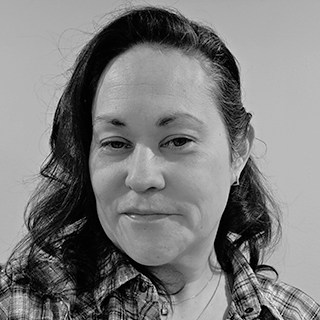
Deahna Fumarol is a poet. She lives in Toledo, Oregon, on the ancestral lands of the Yaqo’n.