


I
Living is no laughing matter:
	you must live with great seriousness
		like a squirrel, for example—
   I mean without looking for something beyond and above living,
		I mean living must be your whole occupation.
Living is no laughing matter:
	you must take it seriously,
	so much so and to such a degree
   that, for example, your hands tied behind your back,
                                            your back to the wall,
   or else in a laboratory
	in your white coat and safety glasses,
	you can die for people—
   even for people whose faces you’ve never seen,
   even though you know living
	is the most real, the most beautiful thing.
I mean, you must take living so seriously
   that even at seventy, for example, you’ll plant olive trees—
   and not for your children, either,
   but because although you fear death you don’t believe it,
   because living, I mean, weighs heavier.
II
Let’s say we’re seriously ill, need surgery—
which is to say we might not get up
			from the white table.
Even though it’s impossible not to feel sad
			about going a little too soon,
we’ll still laugh at the jokes being told,
we’ll look out the window to see if it’s raining,
or still wait anxiously
		for the latest newscast . . .
Let’s say we’re at the front—
	for something worth fighting for, say.
There, in the first offensive, on that very day,
	we might fall on our face, dead.
We’ll know this with a curious anger,
        but we’ll still worry ourselves to death
        about the outcome of the war, which could last years.
Let’s say we’re in prison
and close to fifty,
and we have eighteen more years, say,
                        before the iron doors will open.
We’ll still live with the outside,
with its people and animals, struggle and wind—
                                I  mean with the outside beyond the walls.
I mean, however and wherever we are,
        we must live as if we will never die.
III
This earth will grow cold,
a star among stars
               and one of the smallest,
a gilded mote on blue velvet—
	  I mean this, our great earth.
This earth will grow cold one day,
not like a block of ice
or a dead cloud even
but like an empty walnut it will roll along
	  in pitch-black space . . .
You must grieve for this right now
—you have to feel this sorrow now—
for the world must be loved this much
                               if you’re going to say “I lived” . . .
From Poems of Nazim Hikmet, translated by Randy Blasing and Mutlu Konuk, published by Persea Books. Copyright © 1994 by Randy Blasing and Mutlu Konuk. Used with the permission of Persea Books. All rights reserved.
The world is too much with us; late and soon,
Getting and spending, we lay waste our powers;
Little we see in Nature that is ours;
We have given our hearts away, a sordid boon!
This Sea that bares her bosom to the moon;
The winds that will be howling at all hours,
And are up-gathered now like sleeping flowers,
For this, for everything, we are out of tune;
It moves us not.—Great God! I’d rather be
A pagan suckled in a creed outworn;
So might I, standing on this pleasant lea,
Have glimpses that would make me less forlorn;
Have sight of Proteus rising from the sea;
Or hear old Triton blow his wreathèd horn.
This poem is in the public domain.
A group of almost anything
Has a name: crows are a murder,
& flamingoes a flamboyance.
Most of the others I don’t know.
A group of empty shot glasses
Is called a disaster; of empty
Rooms, a yesterday; a collection
Of tomorrows, even if dreamed,
If desired, craved for like a some
Small child wanting one more story
At bedtime, is called hope. Too
Many nights when all I had was hope.
No collective noun exists to hold
All the people you love. If we name
It at all wouldn’t it be abundance?
I have an abundance of loves
& even when I am lonely, especially
Then, they show up. It rains outside,
& inside everyone I love sleeps.
There is no word for listening
To them breathe, but if there were,
It would be the Antithesis of murder.
Crows always remember a face,
Is what I read once, & can recall it as if
A part of a dream, & so I’ve always
Thought a house full of loves
Is a dreaming, & what better word
For listening to all your loves breathe
At night than a dreaming? What more
Could any of us ask of the dusk?
Reprinted from Redaction by Titus Kaphar and Reginald Dwayne Betts. Copyright © 2023 by Titus Kaphar and Reginald Dwayne Betts. Used with permission of the publisher, W. W. Norton & Company, Inc. All rights reserved.
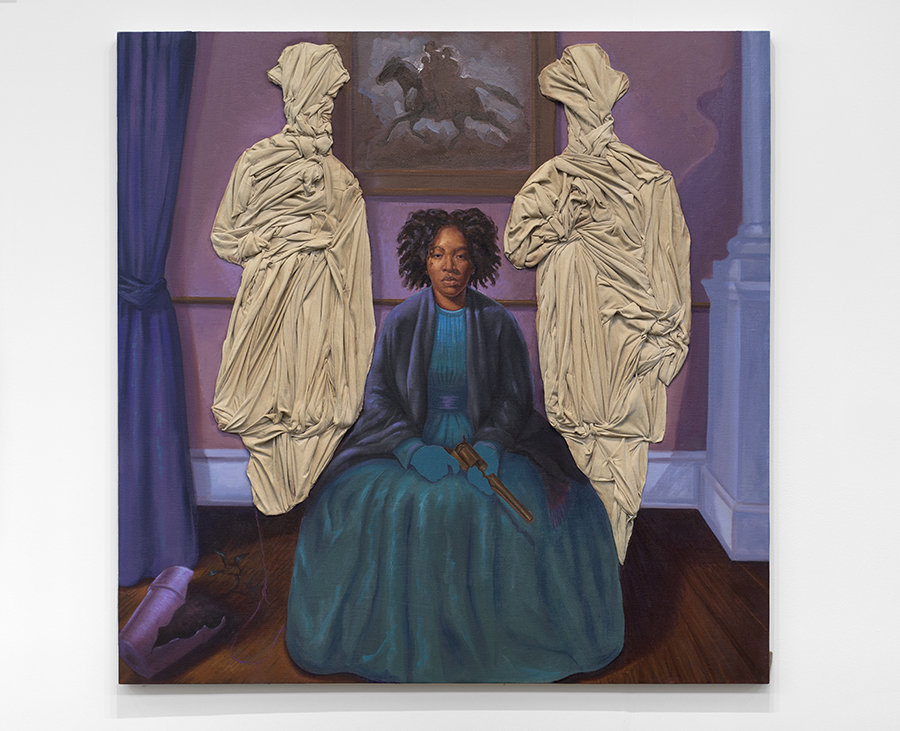
Titus Kaphar, Alternate Endings II, 2016. Oil on canvas. 74 x 74 inches. © Titus Kaphar. Courtesy of the artist.