
Song for the Luddites
1.
As the Liberty lads o’er the sea
Bought their freedom, and cheaply, with blood,
So we, boys, we
Will die fighting, or live free,
And down with all kings but King Ludd!
2.
When the web that we weave is complete,
And the shuttle exchanged for the sword,
We will fling the winding sheet
O’er the despot at our feet,
And dye it deep in the gore he has poured.
3.
Though black as his heart its hue,
Since his veins are corrupted to mud,
Yet this is the dew
Which the tree shall renew
Of Liberty, planted by Ludd!
This poem is in the public domain. Published in Poem-a-Day on July 12, 2026, by the Academy of American Poets.
Lord Byron’s “Song for the Luddites” was originally written in a letter composed to his friend, Thomas Moore. Byron describes the genesis of the poem in the letter, writing, “There’s an amiable chanson for you—all impromptu. I have written it principally to shock your neighbor ****, who is all clergy and loyalty—mirth and innocence—milk and water.” In her essay, “Byron Was One of the Few Prominent Defenders of the Luddites,” published in Smithsonian Magazine (February 2017), Kat Eschner, a science and culture journalist, provides further historical context, writing, “Automation reached the textile makers of northern England in the early nineteenth century, fundamentally changing the fabric of their lives. When the textile workers (whose movement was named after anti-industrial folk hero Ned Ludd) waged war on the automation that threatened both their jobs and their way of life, they were met with the same opposition as many others who allegedly get in the way of progress. But they also had supporters, like Lord George Gordon Byron. In the end, the pleas of Byron and others were ignored, and some of the Luddites paid the ultimate price.”
Lord George Gordon Byron
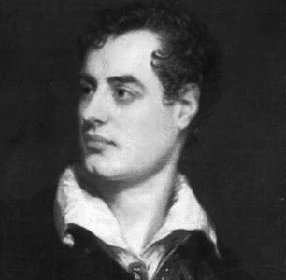
Lord George Gordon Byron was the author of Don Juan, a satirical novel-in-verse that is considered one of the greatest epic poems in English written since John Milton’s Paradise Lost.