
Persuasion
Man’s life is like a Sparrow, mighty King!
That—while at banquet with your Chiefs you sit
Housed near a blazing fire—is seen to flit
Safe from the wintry tempest. Fluttering,
Here did it enter; there, on hasty wing,
Flies out, and passes on from cold to cold;
But whence it came we know not, nor behold
Whither it goes. Even such, that transient Thing,
The human Soul; not utterly unknown
While in the Body lodged, her warm abode;
But from what world She came, what woe or weal
On her departure waits, no tongue hath shown;
This mystery if the Stranger can reveal,
His be a welcome cordially bestowed!
This poem is in the public domain. Published in Poem-a-Day on March 28, 2026, by the Academy of American Poets.
First published in William Wordsworth’s Ecclesiastical Sketches (Longman, Hurst, Rees, Orme, and Brown, 1822), later renamed Ecclesiastical Sonnets, “Persuasion” is a sonnet written after the medieval English monk and scholar Bede’s parable of the sparrow. In their translation of Bede’s Ecclesiastical History of the English People (Clarendon Press, 1969), medievalists Bertram Colgrave and R. A. B. Mynors’s edition of the parable is as follows: “This is how the present life of man on earth, King, appears to me in comparison with that which is unknown to us. You are sitting feasting with your ealdormen and thegns in winter time; the fire is burning on the hearth in the middle of the hall and all inside is warm, while outside the wintry storms of rain and snow are raging; and a sparrow flies swiftly through the hall. It enters in at one door and quickly flies out through the other. For the few moments it is inside, the storm and wintry tempest cannot touch it, but after the briefest moment of calm, it flits from your sight, out of the wintry storm and into it again. So this life of man appears but for a moment; what follows or indeed what went before, we know not at all.”
William Wordsworth
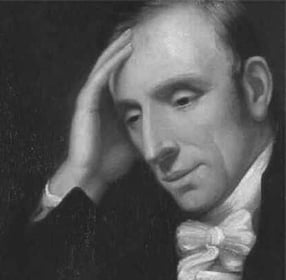
William Wordsworth, who rallied for “common speech” within poems and argued against the poetic biases of the period, wrote some of the most influential poetry in Western literature, including his most famous work, The Prelude, which is often considered to be the crowning achievement of English romanticism.