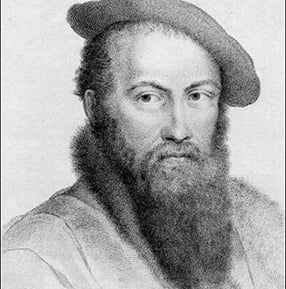
[The long love that in my thought doth harbour]
The long love that in my thought doth harbour
And in mine heart doth keep his residence,
Into my face presseth with bold pretence
And therein campeth spreading his bannèr.
She that me learns to love and suffèr
And wills that my trust, and lust’s negligence
Be reined by reason, shame, and reverence,
With his hardiness takes displeasùre.
Wherewithall unto the heart’s forest he fleèth,
Leaving his enterprise with pain and cry,
And there him hideth, and not appearèth.
What may I do when my master fearèth?
But in the field with him to live and die
For good is the life, ending faithfully.
This poem is in the public domain. Published in Poem-a-Day on April 19, 2025, by the Academy of American Poets.
“[The long love that in my thought doth harbour]” was featured in Bernhard Ten Brink’s History of English Literature (George Bell & Sons, 1902). About the poem, author Lisa Klein writes in her essay, “The Petrarchanism of Sir Thomas Wyatt Reconsidered,” collected in The Work of Dissimilitude (University of Delaware Press, 1992), “A standard critical exercise is the comparison of Wyatt’s ‘The long love that in my thought doth harbour’ and Surrey’s ‘Love, that doth reign and live within my thought’ to their Petrarchan original, ‘Amour, che nel penser.’ […] In Wyatt’s poem, love presses into the speaker’s face ‘with bold pretense,’ then, upon displeasing the mistress, flees to the ‘heart’s forest . . . / Leaving his enterprise with pain and cry.’ […] Wyatt preserves Petrarch’s sense, but intensifies the speaker’s pain and, hence, the surprise of his seeming resignation at the end.”
Thomas Wyatt