
A Dozen Cocktails Please
No spinsterlollypop for me—yes—we have
No bananas I got lusting palate—I Always eat them— — — — — — —
They have dandy celluloid tubes—all sizes—
Tinted diabolically as a baboon’s hind-complexion.
A man’s a—
Piffle!
Will-o’-th’-wisp! What’s the dread
Matter with the up-to-date-American-
Home-comforts? Bum insufficient for the
Should-be wellgroomed upsy!
That’s the leading question.
There’s the vibrator— — —
Coy flappertoy! I am adult citizen with
Vote—I demand my unstinted share
In roofeden—witchsabbath of our baby-
Lonian obelisk.
What’s radio for—if you please?
“Eve’s dart pricks snookums upon
Wirefence. ”
An apple a day— — —
It’ll come— — — —
Ha! When? I’m no tongueswallowing yogi.
Progress is ravishlng—
It doesn’t me—
Nudge it—
Kick it—
Prod it—
Push it—
Broadcast— — — —
That’s the lightning idea!
S.O.S. national shortage of—
What ?
How are we going to put it befitting
Lifted upsys?
Psh! Any sissy poet has sufficient freezing
Chemicals in his Freudian icechest to snuff all
Cockiness. We’ll hire one.
Hell! Not that! That’s the trouble— —
Cock crow silly!
Oh fine!
They’re in France—the air on the line—
The Poles— — — — — —
Have them send waves—like candy—
Valentines— — — —
“Say it with— — —
Bolts !
Oh thunder!
Serpentine aircurrents— — —
Hhhhhphssssssss! The very word penetrates
I feel whoozy!
I like that. I don’t hanker after Billyboys—but I am entitled
To be deeply shocked.
So are we—but you fill the hiatus.
Dear—I ain’t queer—I need it straight— —
A dozen cocktails—please— — — —
This poem is in the public domain. Published in Poem-a-Day on March 14, 2026, by the Academy of American Poets.
“A Dozen Cocktails Please” was first published in 1927 in the magazine The Little Review, edited by Margaret Anderson and Jane Heap. About the poem, biographers Irene Gammel and Susan Zelazo write in their introduction to the book Body Sweats: The Uncensored Writings of Elsa von Freytag-Loringhoven (MIT Press, 2011), “Boldly erotic, the Baroness’s poems offer poignant commentary on the cultural consumption and valuation of the female body and what insights that might lend to an understanding of the economy of art. Thus, it is in poems like ‘A Dozen Cocktails—Please,’ that she, as a woman, rivals and arguably outperforms the shocking bodily exuberance of male Dadaists such as poet-boxer Arthur Cravan.” They continue, “To demonstrate her appetites is to make herself present, to take up space in a sociocultural landscape that privileged male subjectivity and objectified women. By inhabiting her own exhibitionism, the Baroness reclaims the female body in language, but also transforms that body through a new language of desire.”
Elsa von Freytag-Loringhoven
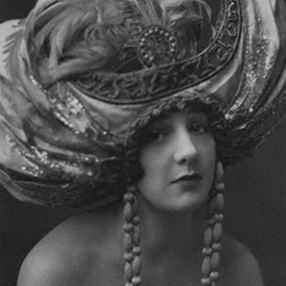
Elsa Hildegard Baroness von Freytag-Loringhoven was a German artist, poet, and performer associated with the Dada movement. She died on December 14, 1927.