
The Cocoon
As far as I can see this autumn haze
That spreading in the evening air both ways,
Makes the new moon look anything but new,
And pours the elm-tree meadow full of blue,
Is all the smoke from one poor house alone
With but one chimney it can call its own;
So close it will not light an early light,
Keeping its life so close and out of sight
No one for hours has set a foot outdoors
So much as to take care of evening chores.
The inmates may be lonely women-folk.
I want to tell them that with all this smoke
They prudently are spinning their cocoon
And anchoring it to an earth and moon
From which no winter gale can hope to blow it,—
Spinning their own cocoon did they but know it.
This poem is in the public domain. Published in Poem-a-Day on September 5, 2026, by the Academy of American Poets.
“The Cocoon” was first published in The New Republic (February 1927) and later collected in Robert Frost’s West-Running Brook (Henry Holt & Company, 1928). About the poem, scholar Gavin Schulz writes in The Robert Frost Encyclopedia (Greenwood Publishing Group, 2000), “It is a poem in which Frost explores the implications of human isolation. The poem is founded upon issues of perspective, and Frost positions himself carefully. The speaker’s point of vantage in ‘The Cocoon’ is vague, specified only by the opening phrase, ‘As far as I can see.’ The speaker’s vision is an internal gaze, located within the realm of his own imagination, which effectively isolates him from the world that he views. From this location he can observe and meditate upon human community while maintaining his own protective isolation.”
Robert Frost
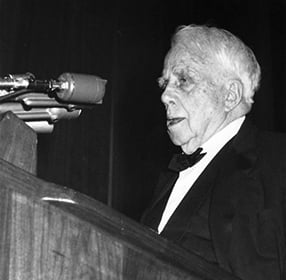
One of the most celebrated figures in American poetry, Robert Frost was the author of numerous poetry collections, including New Hampshire (Henry Holt and Company, 1923). Born in San Francisco in 1874, he lived and taught for many years in Massachusetts and Vermont. He died in Boston in 1963.