
The Artist Orpheus
It was a tropical landscape, much like Florida’s, which he knew.
(Childhood came blazing back at him.) They glided across a black
And apathetic river which reflected nothing back
Except his own face sinking gradually from view
As in a fading photograph.
Not that he meant to stay,
But, yes, he would play something for them, played Ravel;
And sang; and for the first time there were tears in hell.
(Sunset continued. Years passed, or a day.)
And the shades relented finally and seemed sorry.
He could have sworn then he did not look back,
That no one had been following on his track,
Only the thing was that it made a better story
To say that he had heard a sigh perhaps
And once or twice the sound a twig makes when it snaps.
“The Artist Orpheus” from NEW AND SELECTED POEMS by Donald Justice, copyright © 1995 by Donald Justice. Used by permission of Alfred A. Knopf, an imprint of the Knopf Doubleday Publishing Group, a division of Penguin Random House LLC. All rights reserved.
“The Artist Orpheus” appeared in New and Selected Poems (Alfred A. Knopf, 1995). About the poem, poet and scholar James McCorkle writes in his review, “Donald Justice: The Artist Orpheus,” published in The Kenyon Review, Vol. XIX, No. 3 (Summer/Autumn 1997), “Justice is celebrated, and should be, for his formal genius. ‘The Artist Orpheus,’ one of the most striking of his new poems, presents a portrait of the poet[.] [. . .] Composed as a sonnet with implosive envelope quatrains and a split line after the first quatrain, which marks a temporal and topographical shift, the poem proposes that what seems a better story becomes the story that is told.” McCorkle continues, “The trace of the human, the other’s or the beloved’s presence, humanizes and makes for the best stories. To hear ‘a sigh perhaps / And once or twice the sound a twig makes when it snaps’ is poignant. Laden with deferred action, we expect the human response: to look back sympathetically. By closing with this stilled moment of action or ekphrastic moment (though ironically one that is proposed rather than pictured), Justice incorporates the reader into the moral, aesthetic, and human response of the poem.”
Donald Justice
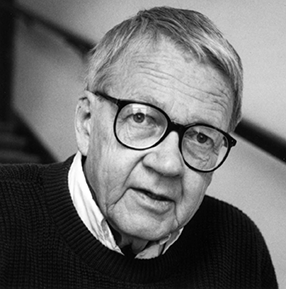
Born on August 12, 1925, Donald Justice authored many books of poetry and received the Lamont Poetry Selection and served as a chancellor for The Academy of American Poets