The Merry-Go-Round
The machine is ready to start. The symbolic beasts grow resty, curveting where they stand at their places in the great blue circle of the year. The Showman’s voice rings out. “Montez, mesdames et messieurs, montez. You, sir, must bestride the Ram. You will take the Scorpion. Yours, madame, is the Goat. As for you there, blackguard boy, you must be content with the Fishes. I have allotted you the Virgin, mademoiselle.” . . . “Polisson!” “Pardon, pardon. Evidemment, c’est le Sagittaire qu’on demande. Ohé, les dards! The rest must take what comes. The Twins shall counterpoise one another in the Scales. So, so. Now away we go, away.”
Ha, what keen air. Wind of the upper spaces. Snuff it deep, drink in the intoxication of our speed. Hark how the music swells and rings. . . . sphery music, music of every vagabond planet, every rooted star; sound of winds and seas and all the simmering millions of life. Moving, singing . . . so with a roar and a rush round we go and round, for ever whirling on a ceaseless Bank Holiday of drunken life and speed.
But I happened to look inwards among the machinery of our roundabout, and there I saw a slobbering cretin grinding at a wheel and sweating as he ground, and grinding eternally. And when I perceived that he was the author of all our speed and that the music was of his making, that everything depended on his grinding wheel, I thought I would like to get off. But we were going too fast.
This poem is in the public domain. Published in Poem-a-Day on July 19, 2026, by the Academy of American Poets.
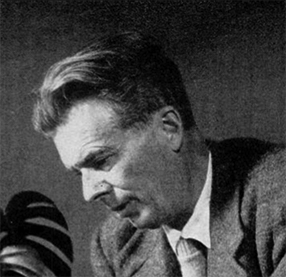
Aldous Huxley’s “The Merry-Go-Round” first appeared as part of a small selection of prose poems published in the Modernist journal Wheels (1918), and later in his full-length collection Leda (George H. Doran Company, 1920). About Huxley, Charles Mason Holmes, chair of the humanities division of Transylvania University, wrote in his book, Aldous Huxley and the Way to Reality (Indiana University Press, 1970), “Aided by the startling imagination of Arthur Rimbaud, Huxley began to add creatures to his weird, ironical zoo.” In Holmes’s essay “The Early Poetry of Aldous Huxley,” collected in Aldous Huxley: A Collection of Critical Essays (Prentice-Hall Inc., 1974), he expands on the theme of the Huxley zoo, writing, “The style of his next group [of poems], for the 1918 cycle of Wheels, is merely the purest, clearest expression of the impact on him of Rimbaud. They are not in dialectic, nor are they in any other previous Huxley style; they are prose poems in the manner of Illuminations, with something of the energy of Rimbaud’s imagination. The Huxley zoo reappears in the zodiac beasts of ‘The Merry-Go-Round,’ although these animals are driven, to the poet’s alarm, by ‘a slobbering cretin grinding at a wheel.’”
Aldous Huxley