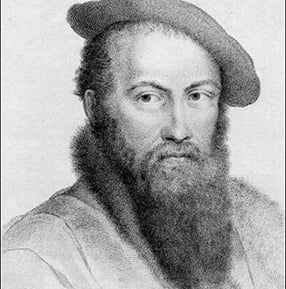
[Farewell love and all thy laws forever]
Farewell love and all thy laws forever;
Thy baited hooks shall tangle me no more.
Senec and Plato call me from thy lore
To perfect wealth, my wit for to endeavour.
In blind error when I did persever,
Thy sharp repulse, that pricketh aye so sore,
Hath taught me to set in trifles no store
And scape forth, since liberty is lever.
Therefore farewell; go trouble younger hearts
And in me claim no more authority.
With idle youth go use thy property
And thereon spend thy many brittle darts,
For hitherto though I have lost all my time,
Me lusteth no lenger rotten boughs to climb.
This poem is in the public domain. Published in Poem-a-Day on September 19, 2026, by the Academy of American Poets.
Sir Thomas Wyatt’s sonnet “[Farewell love and all thy laws forever]” was originally printed in Songs and Sonnetts (Tottel’s Miscellany), the 1557 poetry anthology published in London by printer Richard Tottel. About the poem, D. K. Smith, associate professor of English at Kansas State University, writes in his book, Strategies of Failure in the Early Modern Sonnet: Petrarch, Wyatt, Sidney, Shakespeare, and Wroth (Routledge, 2026), “Wyatt’s ‘Farewell, Love’ is one of his few sonnets without a specific Italian model, and it is perhaps Wyatt’s most direct attempt to put aside the courtly love lyric in favor of the humanist emphasis on classical learning. It is here most clearly that we see him trying to balance his failures of love with a more rigorous and reliable form of authority. The aphoristic quality of Wyatt’s poetry reflects a humanist reliance on the gathering and framing of proverbial wisdom as a way of imposing order upon the disorder of his feelings. But proverbial sayings ‘remain for Wyatt a sign of steadfast moral authority that he cannot achieve,’ and the certainty of aphoristic wisdom remains at odds with Wyatt’s own awareness of his failures in love. If the sonnet achieves a kind of intellectual and moral authority, it comes at the expense of the whole Petrarchan model of virtuous failure.”
Thomas Wyatt