
Abecedarian Beginning with Alif
اlhillo means the sweet though in the language
I married into &
بelong to also now it is often pronounced
to mean the thread
تogether we delight over the words we share
for elevator, pillow
ثhreading through our olives, oil & sugar
& God willing. The
جoke is all the years I chased fluency
in the meagerest language, my
ح absent in its alphabet—without it my central
consonant becomes a sigh. In
خartoum I finally understand meter
when the anapest slants my accent
دactyl receding from Safia when it merges
with the fathers I am assigned, all
ذhe stress in the syllables reserved
to denote my family.
رice another word he & I share, rolled r
trembling at its center &
زee at its close, lips buzzing after every
utterance. I find it
سweet, though I roll my eyes, when my aunties
insist he looks Sudanese
شhares features with so-&-so; he doesn’t,
but it’s their way of calling him ours.
صafaa’s daughter, born far away.
My favorite joke is the one about
ضulles, the ones who first arrived calling home
& pronouncing it the way ال
طayeb my grandfather did, with heavy tongues,
sending half the diaspora to D.C. &
ظhe other half to Texas, where I learn there is also
a Sudan though without the
عosmans & Mohamed-Ahmeds of the original.
I know I make too much of this in my stupid
غorba, assigning overlarge significance to this American
Sudan. Maybe intended in its adjective
فorm, the word that translates to mean many Blacks.
The Blackness in my Arabic when I say
قamar with a g, & gahwa & gatar & galag.
I know it always
كills the vibe when I insist I am not an Arab,
& all the easier solidarities
لeave the room, echoing with all the ugly words
for my kind in this our shared &
مost beautiful language, which multiplies its capacity
to wound. Find me a language without an
ن-word & maybe I will meet you there,
though even I know
هow it hurts to believe safety exists already somewhere,
that if I were to only travel enough of the
وorld, I would find it, the country where darkness is safe.
I know already, learned early on, that
يutopia, from the Greek, means no place
Copyright © 2026 by Safia Elhillo. Originally published in Poem-a-Day on May 28, 2026, by the Academy of American Poets.
“I’ve been experimenting for some time now with an abecedarian that follows the Arabic alphabet—of all my attempts so far, this is the one I’ve liked best.”
—Safia Elhillo
Safia Elhillo
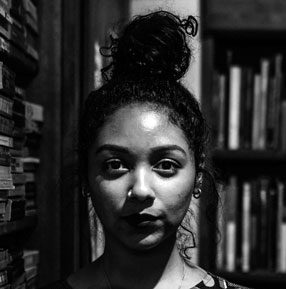
Safia Elhillo is a Sudanese American poet and the author of Psychogeography (One World, 2027); Bright Red Fruit (Make Me a World, 2024); Girls that Never Die (One World, 2022); Home Is Not a Country (Make Me a World, 2021); and The January Children (University of Nebraska Press, 2017), winner of the Sillerman First Book Prize for African Poets and the Brunel International African Poetry Prize.