
Sonnet
O too dull brain, O unperceiving nerves
That cannot sense what so torments my soul,
But like torn trees, when deep Novembers roll
Tragic with mighty winds and vaulting curves
Of sorrowful vast sound, and light that swerves
In blown and tossing eddies, branch and bole
Shudder and gesture with a grotesque dole,
A grief that misconceives the grief it serves,
O too dull brain,—with some more subtle sense
I know you here within the lightless room
Reaching your hand to me, and my faint eyes
See only darkness and the night’s expanse,
And horribly, within the listening gloom,
My voice comes back, still eager with surprise.
This poem is in the public domain. Published in Poem-a-Day on August 1, 2026, by the Academy of American Poets.
Archibald MacLeish’s poem “Sonnet” was collected in The Happy Marriage and Other Poems (Houghton Mifflin Company, 1924). About MacLeish’s poetic work, Grover Smith, a noted scholar of T. S. Eliot and professor emeritus at Duke University, wrote in his biography Archibald MacLeish, “Between 1917 and 1924 MacLeish’s style acquired the features of its maturity—conscious symbolism; witty, almost metaphysical strategies of argument; composed and intense implications—all of these owing much, though quite certainly not everything, to Eliot’s example. [...] MacLeish’s poetry, for the most part, is not introspective, and this is why indeed no persona is wanted. According to its own purposes, its diminution of the persona is a strength: by this means it turns the reader away from the endless labyrinths of subjective illusion and irony, the ‘echoing vault’ of the poetic self, and invites him to contemplate the phenomenal world. It does not vocalize that self: it can and often does fabricate a kind of disembodied speech, or speech whose origin need not be known.”
Archibald MacLeish
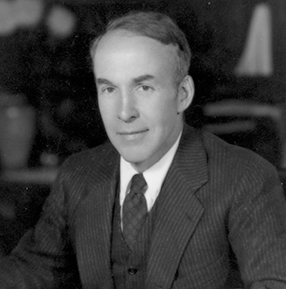
Born in 1892, Archibald MacLeish was a poet, critic, and playwright who fought in World War I. MacLeish was awarded the Pulitzer Prize three times, and he served as a Chancellor of the Academy of American Poets from 1946 to 1949. He died in 1982.